It was a great honor to present at the GeneHumdi annual meeting last week in beautiful Granada. Thanks a lot to the organizers for giving me the opportunity!
Excited to share our paper in @ScienceTM!
Together with @Francesca_Pietr as co-first author, we used in vivo prime editing to correct a pathogenic SCN1A mutation in a GEFS+ mouse model.
Huge thanks to all co-authors for their work!
https://t.co/hmklFBYuaJ
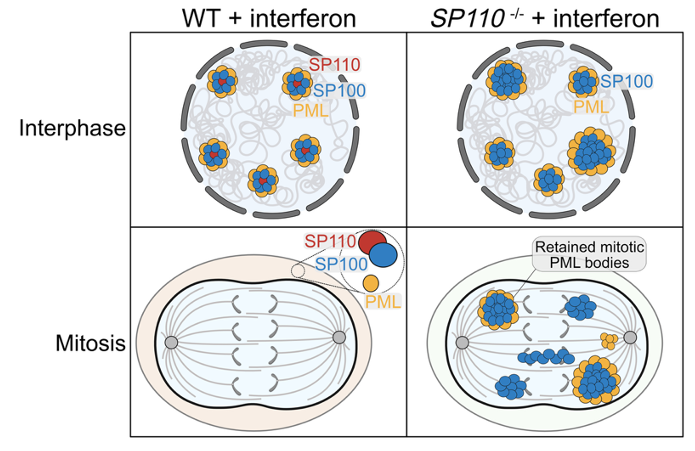
Proper organelle regulation during mitosis is a must, but how do membrane-less condensates like PML bodies behave during cell division? In work led by @eric_aird, we found the balance of speckled proteins SP110 & SP100 to be the key. https://t.co/MkNBfYPxcJ
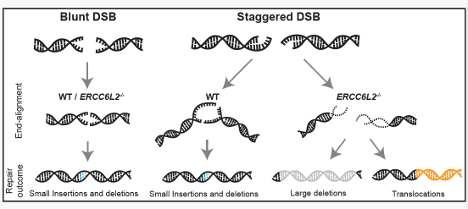
I’m very happy to share the second paper of my PhD thesis together with @almuseben and @eric_aird in which we identified a role of ERCC6L2 specifically in staggered DSB repair.
Many genome-editing tools work by cutting DNA - but the shape of the cut matters. Using #CRISPR screening, we show ERCC6L2 is specifically required to maintain #DNArepair fidelity at staggered DNA breaks, but not at blunt ends.
https://t.co/MbW8DTjIre
Many genome-editing tools work by cutting DNA - but the shape of the cut matters. Using #CRISPR screening, we show ERCC6L2 is specifically required to maintain #DNArepair fidelity at staggered DNA breaks, but not at blunt ends.
https://t.co/MbW8DTjIre
Happy to share that my postdoctoral work is now out in @ScienceMagazine. We show that the RNA-programmable bridge recombinase ISCro4 can insert, delete, or invert multi-kilobase DNA fragments at defined genomic sites in human cells.
Study link: https://t.co/CFBOiQvhAf
CRISPR-Cas has transformed genome editing, but many diseases involve diverse patient-specific mutations within the same gene. A mutation-agnostic alternative is to insert a healthy gene copy at a defined genomic locus, but gene-sized, site-specific insertions remain a major challenge.
Main findings of our work:
(1) ISCro4 is highly active in human cells and can be delivered by plasmid or all-RNA formats
(2) Proof-of-concept programmable multi-kb insertions, deletions, and inversions
(3) Structural insights into the basis of enhanced ISCro4 activity
(4) Specificity and off-target characterisation
(5) A framework to support future development and adoption of bridge recombinases
The work was made possible through a close collaboration between the Jinek Lab, @schwanklab, and @jcornlab. I am deeply grateful to all of my co-authors for the team spirit, hard work, and dedication that went into this publication: @talasandris, Javier Fernández Carrera, @nicopmat, Lilly van de Venn, Charles Yeh, @p_kulcsar, @marquark, @YanikWeber, @SaskiaGerecke, Isabelle Harvey-Seutcheu, Dominic Mailänder, @MorPfl, and @ChrisChanez89. Special thanks to my supervisor, Prof. Martin Jinek, for his outstanding mentorship, and to Prof. Gerald Schwank and Prof. Jacob Corn for their generous support throughout. Finally, I would like to thank everyone in the Jinek lab for creating a supportive work environment, and @EMBO for funding my postdoctoral work.
In parallel, independent work led by @ntperry13, @SKonermann and @pdhsu also reported ISCro4 activity in human cells, reinforcing the robustness and momentum of this direction.
Please reach out if you would like to test the system or discuss potential applications. Relevant plasmids are now available via @Addgene.
Now out in @GenomeMedicine@BioMedCentral. Transform your #crispr screens with "Exorcise", EXOme-guided Re-annotation of nuCleotIde SEquences, https://t.co/ekrZRkOf2d.
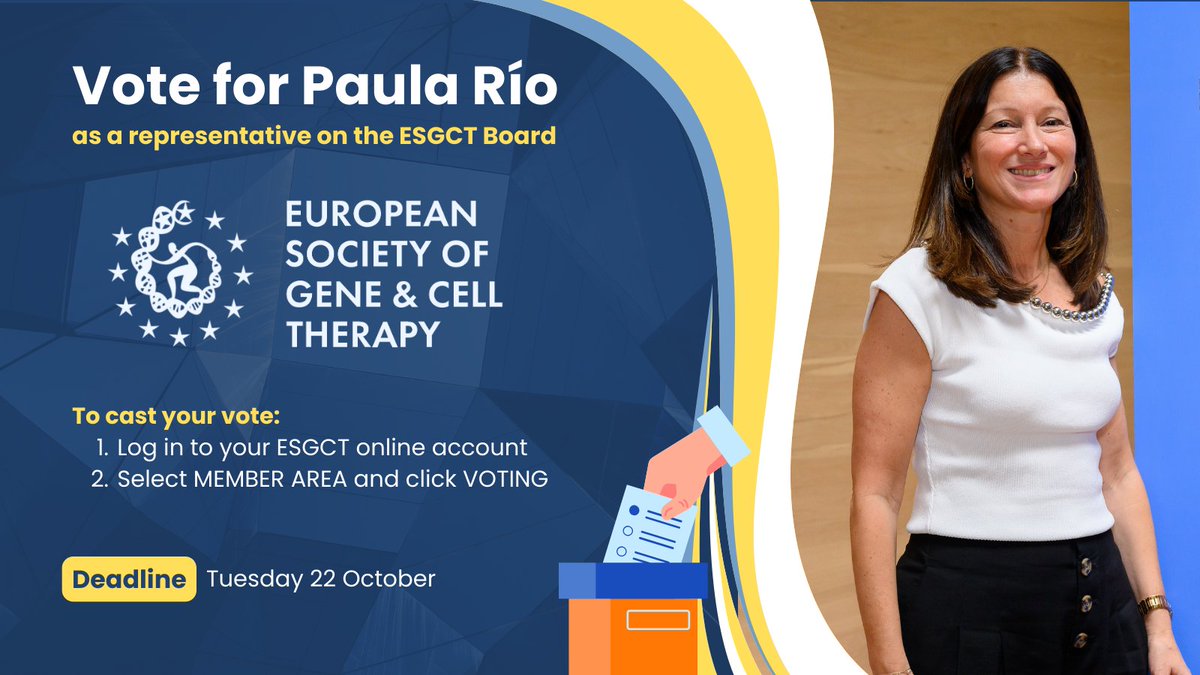
🇪🇺 Our President Paula Rio (@PauFerrol) has been nominated as a candidate for the @ESGCT Board. It’s time to vote for Paula!
🗳️ ESGCT members can vote until Tuesday, October 22 for their Board representatives, who will serve a 3-year term.
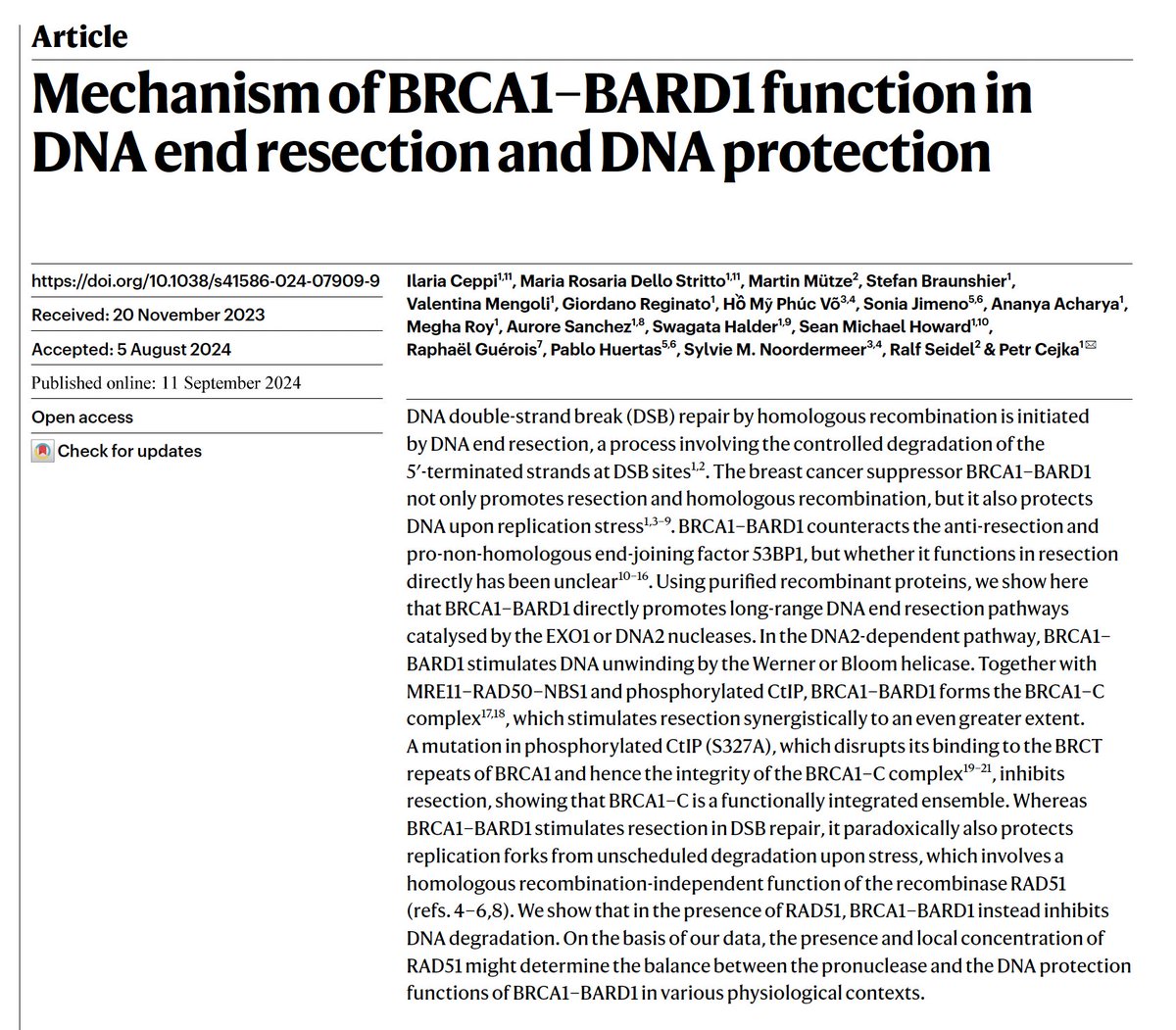
We are thrilled to present you our work on BRCA1-BARD1 @Nature showing that the complex has a direct role in long-range DNA end resection. With @CeppiIlaria@DelloStritto_MR and our collaborators @PabloHuertasLab@SylvieNoorderm1 and Seidel labs.
https://t.co/xh3J7mtwaV
Excited to share our new preprint, led by our @GiuseppinaDAle9 and Olga Kochenova @harvardmed, a great collaborative effort with Johannes Walter's lab, + @GS_Lab_Bham.
USP37 prevents premature disassembly of stressed replisomes by TRAIP https://t.co/W6sQ19oCmf
Have you ever wondered why some cell lines are easy to edit with CRISPR-mediated gene editing, while others are more difficult? Our paper is now online and offers an interesting answer: https://t.co/0ck5FHVXvb
I am happy to share that our paper on the surprising role of CCAR1 in FANCA mRNA splicing is now online @MolecularCell . Please see the paper for the details. https://t.co/K49Cx0f0Y7
A bit ago I posted a #preprint from @karasuerman1 about a surprising role of CCAR1 as a "splicing cop" for hundreds of transcripts, including #DNArepair factor FANCA. Final version is out now in @MolecularCell. Lots of new, exciting data. Check it out! https://t.co/6vOr9L7CDR
Amazing postdoc Eric Aird asked how #CRISPR gRNAs & interferon regulate innate #immunity. He found a wild partnership that balances appropriate response w/ cell death. SP100 builds filaments that kill cells, and SP110 breaks them to keep things in line. https://t.co/xJ4Xi3W8m8 🧵
I am looking for a Research Technician!
If you want your work to shape the future of gene and cell therapy, join us - #geml & @jcornlab
Apply: https://t.co/vjeBMbU59C
Multiple exciting and ambitious projects ongoing!
@HorizonEU@SBFI_CH funding 🧬✂️💉
#geneTIGA#TFITNESS#EDITSCD