Sickening.
Reminds me of what I couldn't stand about New Jersey: the ethnic tensions, largely driven by these RSS/BJP thugs and their obsession with Muslims.
They went out of their way to antagonize us. We didn't even think about them. But left unchecked, they escalate.
I have a lot to say about the hype currently surrounding AI in total synthesis, but I will limit myself to this:
I dare those who promote AI-driven total synthesis in industry and to funding agencies to bet their savings on the success of the synthetic routes proposed by AI.
In my thirty years as a practicing synthetic chemist, having published more than 125 total syntheses as a PI, I have encountered only one case in which each step worked as planned. Everything can look good on paper (Papier ist geduldig). But, as Mike Tyson famously put it, “Everybody has a plan until they get punched in the mouth.”
How you respond to the inevitable setbacks, surprises, and insults that chemistry throws at you is precisely what makes total synthesis such a challenging and rewarding endeavor. And it is the reason why total synthesis is such a good training ground for problem solvers in academia and industry.
I do wonder, however, what all this means for writing proposals on total synthesis, which seem to be increasingly reviewed by colleagues who have little understanding of what total synthesis actually entails. Writing such proposals has always been a somewhat silly exercise, for the reasons outlined above. Evaluating them will become even more challenging in the age of Claude, when anyone can generate a seemingly convincing synthetic route on paper. The real question, of course, is what happens when that route encounters reality.
Iran cloned a sheep, launched its own satellites, mastered uranium enrichment, built most of its missile and drone arsenal domestically, manufactured 95% of its medicines domestically, and climbed into the world’s top 20 in scientific output, all under decades of brutal sanctions.
Yet people feel compelled to post videos of skimpily dressed Iranian women doing yoga and Pilates to convince the West that Iranians deserve dignity and shouldn’t be bombed.
Ask Jordan Peterson and his family what happens when he disrespected Maa Kaali. He will tell you the lore. Tweet from his daughter (see the reference of blue Colour)
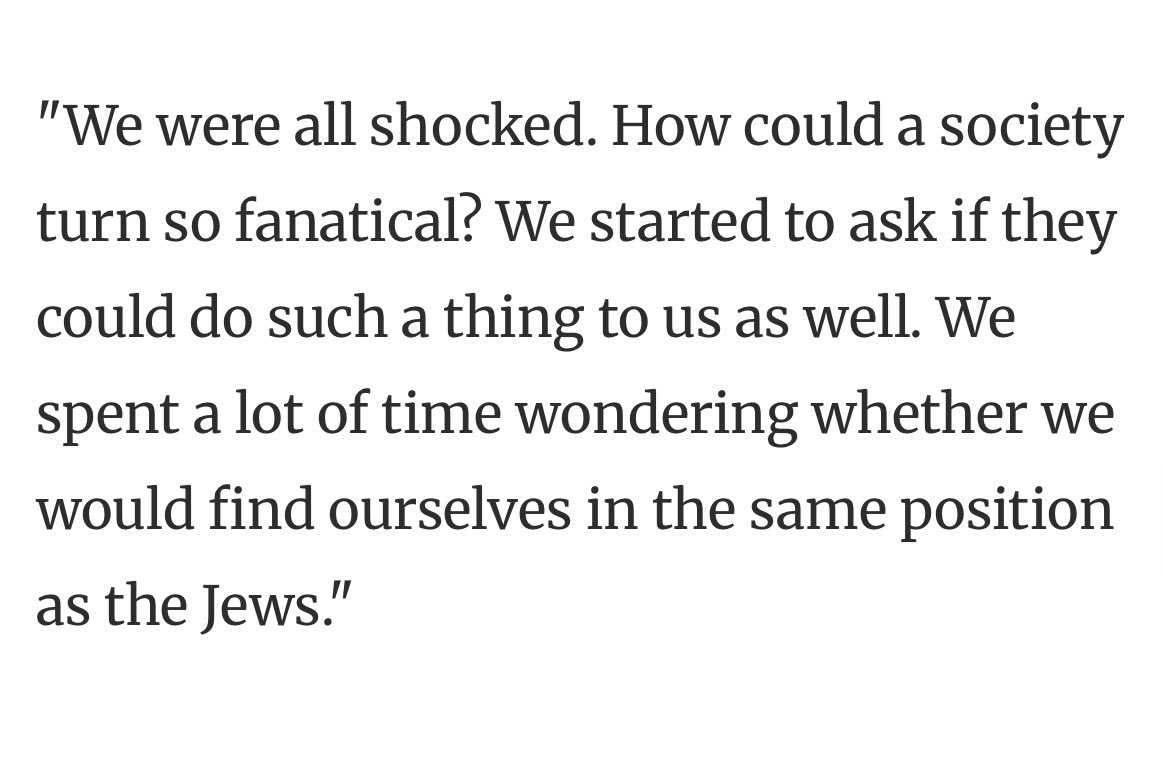
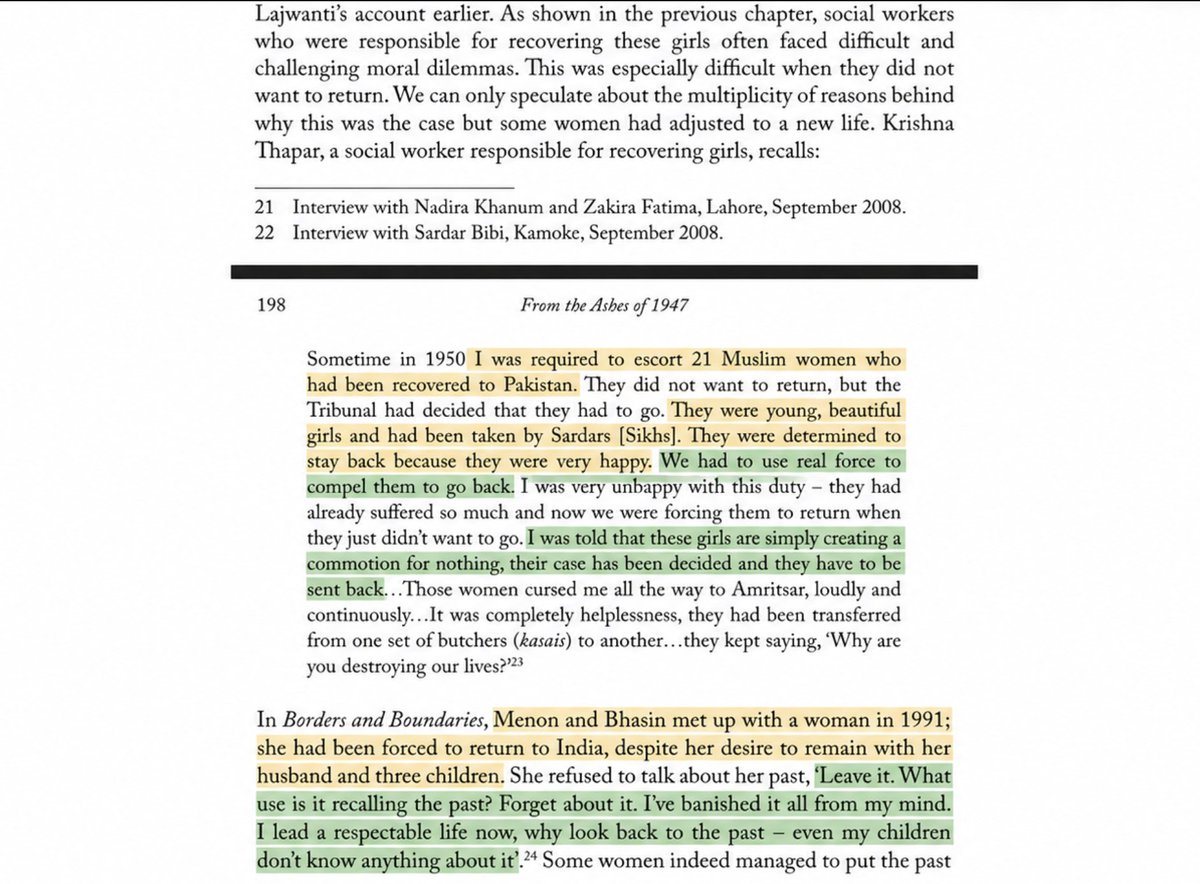
No matter how often I read accounts of the "recovery" of abducted women after Partition, I am shaken afresh. Here, a social worker recalls how twenty one Muslim women cursed them while on the way back to Pakistan after their pleas to remain with their Sikh husbands were declined.
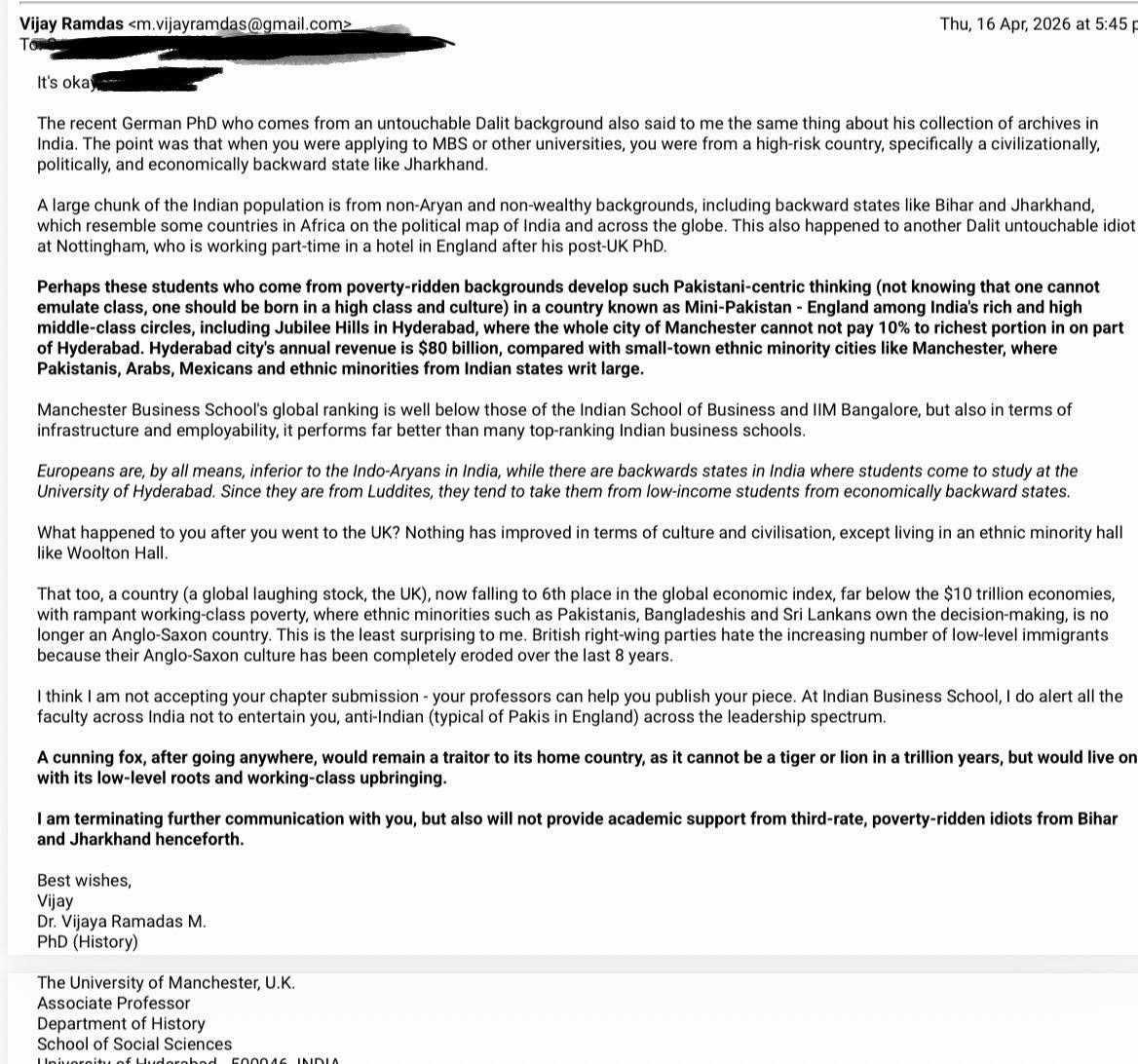
This is what a associate professor ( Vijaya Ramdas ) from University of Hyderabad wrote to an alumni from the university. How can some one like him
remain as a faculty? It is ripe Islamophobia, caste, class and racial hatred. Shame on those who remain silent.
@SfiHcu
I keep seeing people claiming that "grad students only work 5 hours a week" and then clicking on their profile and they're in some tea-leaf reading field like econ or analytic philosophy. You're telling on yourselves! Some of us are doing real things like reading sonnets.
Harvard brings in about $280K of outside research funding per PhD student per year. The stipend is $50,460, about 71% of the local living wage.
Lots of takes calling the striking Harvard PhD students entitled. I did my PhD at the University of Delaware and I’m a postdoc there now, so I’ve seen this job from inside, as a student and now from the lab bench next to them. Here’s what it looks like, and then what the public data says about Harvard.
At UD, the first year or two is classes while you’re already doing research, often 30-50 hours a week in total. Then the classes end and it’s 40-60 hours a week of research. Research assistants are contracted for 20 hours a week, so you’re paid for half your time or less. No retirement, no staff benefits.
Before anyone says this is inaccurate, you are literally required to work 8 hours a day 5 days a week or take vacation days, even though you are paid for 20 hours of work... This is quite common in academia.
I pulled NSF’s research spending (HERD) and graduate student (GSS) survey data to put numbers on it. In UD biomedical engineering there’s about $115K of outside research funding per PhD student per year. A grant-funded student costs that grant about $66K. The student gets $36K. The other ~$30K goes to the university as overhead and “tuition.” Once classes are done, what is that tuition paying for?
Grants also pay faculty, postdocs and supplies, so students don’t generate all of that money. Still, outside funding covers a student’s full cost about 1.75x in UD BME and 2.4x across UD science and engineering. That’s before the papers, patents and startups built on intellectual property the students create.
Harvard is the same picture with bigger numbers. It brings in $280K of outside research funding per PhD student, 1.8x UD. In the life sciences it’s $365K per student. A grant-funded Harvard student costs about $91K: the $50,460 stipend, ~$35K of overhead at Harvard’s 69% rate, and health insurance. Outside funding covers that about 3x. The stipend equals 18% of the outside research money per student, versus 23% at UD.
Harvard’s stipend is 1.4x UD’s, which matches the cost of living and nothing else. Both schools pay about 71% of the MIT living wage for a single adult in their county ($70,707 around Cambridge). At 50 hours a week, $50,460 is about $20 an hour. And in the humanities and social sciences, where there’s little grant money at all, teaching fellows reportedly drop to about $26,300 after year four.
Which brings me to the “entitled communists” line. PhD pay today barely responds to markets. It’s set by university-wide minimums, union contracts and a federal cap: NIH won’t pay more than $63,480 a year toward a grad student’s whole package (stipend, benefits and tuition together), however much the lab brings in. Within a school, departments tend to pay close to the same number.
Meanwhile the money per student varies enormously. At UD, chemical engineering brings in about $428K of outside research per PhD student and math about $40K, a 10x gap. At Harvard, the life sciences bring in $365K per student and psychology $26K, a 14x gap. High-revenue fields carry low-revenue ones. Universities also put $30B of their own money (tuition, endowment, state funds) into research in FY2024, about a quarter of all university research spending.
A market approach would look different. If a field produces far more PhDs than there are jobs for, it would train fewer or pay less. A lab bringing in 8x the revenue of another could pay its students accordingly instead of matching a schoolwide number. Departments and labs could negotiate their own rates. That’s the opposite of communism: it’s an argument for more market pricing.
Some subsidy should stay. Fundamental science pays off on timelines no market prices well. Studying Gila monster venom in the early 1990s led to exenatide, the first GLP-1 drug, the class that now includes Ozempic. Basic work on how bacteria fight viruses became CRISPR gene editing and, in 2023, the first approved CRISPR therapy. A pro-NIH coalition estimates every NIH dollar generates $2.57 in economic activity. And the humanities are some of the most valuable work a society does, whatever their grant totals. Subsidizing some fields beyond what a pure market would choose makes sense. The questions are how much, and whether anyone can see it.
I don’t claim to have the economics figured out. Universities have real costs, grant money pays for a lot more than students, and fields without grants work differently. But why is it so outrageous to start thinking about other systems? What if you were paid less during coursework, when you’re partly a student? What if candidacy marked a real change in employment status: a 40-hour contract, benefits, retirement, and pay closer to a junior scientist’s? What if “tuition” ended when the classes did? What if undergraduate teaching, research, graduate training and faculty lines each had their own budget, so everyone could see who pays for what and where the waste is?
Rough math suggests the first steps aren’t out of reach. At UD, the staff benefits rate (38.3%) on a $36K stipend is about $14K a year, under half of the ~$30K each grant already pays the university per student. That money covers real costs today, so it would have to come from somewhere, and I’d like to hear from people who know university budgets better than I do. But after candidacy, PhD students are doing the work of full-time scientists, and it seems fair to ask why they aren’t employed as one.
Sources: NSF HERD FY2024 and GSS fall 2023 microdata (https://t.co/kHR5YzW4G3), UD Graduate Tuition Policy and rate agreement, Harvard stipend and F&A pages, NIH notice NOT-OD-26-044, MIT Living Wage Calculator (2026), United for Medical Research 2026 report, Boston Globe strike coverage (Nov 2026). Harvard’s numbers exclude its affiliated hospitals, so they’re conservative.
Remember when the entire Congress walked out of the Rajya Sabha in support of Mayawati after she was denied the opportunity to speak on the Saharanpur violence?
Angered by the treatment, she resigned from the Rajya Sabha. Lalu Prasad Yadav offered to send her to Parliament from Bihar, while Sonia Gandhi personally called her to express solidarity and support.
That was the kind of political solidarity Mayawati once commanded across party lines.
And today, seeing her political trajectory and her surrender to the BJP is genuinely heartbreaking.
The downfall is unreal. What a contrast to the fearless leader she once was.
dude im glad you got a phd in the pseudoscience of criminology by slacking off but some of us have to do serious work. we make research universities what they are because we produce original research, advance knowledge, not because we learn in exchange for grades. flailing idiot
Hey yall dont need to be arging with econ and criminology profs about a living wage. Sometimes youre better off simply ignoring folks who uphold the status quo, esp when it comes to the wealth gap. Dont feed their demands for attention.
All of this debate about harvard PhD student incomes just shows me:
1. How few faculty understand the financial pressures students may face
2. How everyone presumes you have family/partner support
3. How little class solidarity we have across system at large 1/4
Europeans: Yes, Israel is committing a genocide, but that is because of trauma from the Holocaust
Also Europeans: A starving Romani woman stole some bread. That's because their culture is inferior