Kaspa is real-time bitcoin, solving scalability is great but not the core value prop.
Real-time bitcoin means achieving in a few seconds the same security guarantees that nakamoto consensus / bitcoin achieves after an hour; decentralizing each consensus round rather than chain quality achieved through a coarse aggregate of rounds.
A clean definition anchor for real-time decentralization (RTD): The ability to sample the honest majority in real-time.
(Note that even fast leaderless VRF-based proof-of-stake cant sample honestly bc the selected nodes get to choose the content of their blocks after they've been selected; pos=select then write, pow=write then select)
--
RTD affects: txn confirmation, censorship resistance, secure oracle finality, MEV resistance.
Eg censorship resistance, bitcoin is the most censorship resistant chain, but if 60% of the miners are censoring you (point in reference: OFAC abiding tornado censoring eth miners), your txn will pend for 30-40 minutes. For shady business payments that's not prohibitive, but for a real economy, for an asset aspiring to be at least a king of collateral even if not an MoE, this is unacceptable, esp under economic stress.
Beyond censorship, all things finance benefit tremendously from pow density, from sampling the majority in real-time in a secure and honest manner.
I wont get into MEV resistance now, but having a "conscious" stream of oracle attestations (not price oracles) finalized in real-time qualitatively upgrades the ability to encode informed risk, collateral, liquidity management, which is the lifeblood of defi.
In context of conf times, increasing from 1 to 10bps saturates the latency optimization. But for pow density we need dozens of blocks per second, with the endgame of 100 bps: Under 10bps a 37% attacker can fake the majority signal with probability 12%. With 100bps this drops to 0.3%. Today Kaspa can't accelerate to >10bps w/o harming conf times, but DAGKNIGHT will be implemented hopefully by Q3 at least on testnet, by which we will push for 25-40bps.
The cherry on top: RTD also implies netsplit resistance, as per the partial synchrony framework.
WWIII cyberwar resistance. Hypothetically speaking ofc.
(elaborated- https://t.co/o8vKa7gBwm)
The chairman of @KaspaKii , @pvson, is the founder and president of an international group of 120+ energy infrastructure and financial companies with a combined valuation of more than $5T based on my best estimates.
Five...trillion…dollars. And that’s probably on the low end of things…and they are going with #Kaspa.
This man is telling you that they specifically chose $KAS to “position Kaspa as the ultimate base layer for various applications…for industrial and enterprise applications in finance, supply chain, energy, and the public sector, while promoting sustainable and ethical development.”
They are now telling you that only $KAS can do what is needed to build their infrastructure for energy trading and other applications that I don’t even understand lol. They told you that Bitcoin and Ethereum cannot do what they need them to do to accomplish their tasks.
Anyone telling you AI agents are going to use $BTC is lying to your face. Anyone telling you Bitcoin’s slow speed is a feature is coping and doesn’t understand anything about the world.
Please read the attached article posted by KII to see the results of all the stress testing they did on Kaspa’s testnet-12.
So, I just had to create this thread.
Is $KAS founder Yonatan Sompolinsky (will abbreviate with YS) Satoshi Nakamoto (will abbreviate with SN)?
Personally I'm biased, but let's have a look at the clues supporting this bold claim.
A thread 🧵
Sorry guys for the double post but WTF KASPA?! I did a few minutes of curious digging just to see wtf it is and apparently it has been around since 2011-2012??? That’s right around the time the shitcoins LTC and XRP were launched??? And it gets crazier. Apparently the founders of Kaspa were early Bitcoin OGs who researched ways to scale the protocol…like I’m talking 2013. I’m in the Bitcoin class of 2022 so I feel like if they were around in 2013 posting on https://t.co/FhlVQZtTng maybe it’s worth looking into??? My mind is absolutely blown right now because I thought it was a fly by night pre mined shitcoin but apparently in 2013 they proposed this thing called the GHOST rule (greedy heaviest observed subtree) instead of Bitcoin’s longest chain rule and it would’ve helped Bitcoin have faster block times if implemented? But the community wasn’t willing to implement it so as the years went by the founder was presenting his updated ideas at scaling Bitcoin conference in Hong Kong in 2015 and apparently @adam3us was in the audience taking notes? So from what I can tell the timeline of research papers that were peer reviewed by the community goes like this. “Accelerating Bitcoin’s Transaction Processing. Fast Money Grows on Trees, Not Chains” (GHOST rule) -> Inclusive Blockchains -> SPECTRE -> and currently Phantom GHOSTDAG which is what $KAS is now?? I’m so confused can somebody please fact check me on all this new information?? And this whole line of work which lead to Kaspa is for proof of work? I don’t know what to think anymore about Kaspa. Oh and here’s the link to the https://t.co/FhlVQZtTng discussion in 2013 where even Peter freaking Todd was impressed??? Holy shit guys https://t.co/G39QzynVYZ
I’m mildly intrigued now to dig further into Kaspa origins over the last decade and a half.
Thoughts guys?
Kaspa’s evolution: from local scripts to stateful systems, without losing locality
I want to try to explain, in simple words, the vision and the gradual implementation path for smart contracts and complex financial systems on Kaspa.
Instead of trying to cover everything, I am going to weave one continuous line of thought: from the most basic primitives, through the key additions we are making, toward the system-level picture.
A meta note: even in parts where the destination feels intuitively clear, conceptual clarity only emerges while building. This is not just engineering, and not pure theory either. It is system research: making the model itself clear as we walk.
A simple ladder to keep in mind:
• UTXO scripts constrain spend authorization
• Covenants constrain next outputs
• Lineage authenticates which instance is “the real one”
• ZK verifies transitions by succinct proofs, without on-chain execution
One guiding principle throughout: we want these capabilities as first-class consensus and script-engine primitives that compose cleanly, not as clever edge-case constructions.
---
UTXO as the base model: a constitution that governs a resource
The UTXO model is, at its core, a script (a “constitution”) that controls a resource.
That constitution is local in two senses:
• Local in space: the spending script sees only the inputs it spends, plus whatever data the spender provides.
• Local in time: the script is a one-shot gate. Once a spend happens, the old constitution does not persist into the future. The future is governed by whatever new scripts the coins are sent to--but there is no inherent linkage between old rules and new rules.
In the common case, the constitution is minimal: “only someone who can prove possession of a private key may spend”.
In pseudo-form it is basically: SigVerify(pk). The spender provides a signature proving they control the private key behind pk, and that they authorized this specific transaction.
---
The one thing that is enforced over time: conservation of value
There is one strong temporal law baked into the base model: conservation of value.
Consensus enforces that the total KAS value created by a transaction is less than or equal to the total KAS value it consumes. This is why “Kaspa the asset” is not just data in a UTXO. It is a native resource with a conservation law enforced by the protocol.
So Kaspa already has one temporal invariant “for free”.
---
But what if we want richer rules than “who can spend”?
Now imagine we want more complex logic. Examples:
• Coins can only be sent to a whitelist of addresses.
• Only 5% of the balance can be spent per day.
• This resource must evolve under a fixed policy over time.
This is where the right mental model becomes a state machine.
A state machine has a state and a transition function. The transition function must be able to enforce what the next state is allowed to be. In UTXO terms, “writing state” happens by creating the outputs of the spending transaction--so a real transition function must be able to constrain the outputs.
The problem is the locality constraint: in the classic btc-style scripting model, without introspection, the spending script cannot constrain what it is creating. It gates the spend, but it cannot reason about outputs. Without seeing outputs, implementing a genuine state machine is impossible.
(Notwithstanding btc’s indirect workarounds via sighash tricks, which can approximate limited introspection in specific patterns.)
---
Introspection: enabling state machines in a local-compute model
This is why transaction introspection opcodes are a foundational step. (This is what KIP-10 introduced, starting with Crescendo.)
Once the script engine can read transaction fields, and crucially inspect output scripts, the transition function can finally say: “you may spend this input only if you create outputs that satisfy these constraints”.
Conceptually, that is the birth of what we call a covenant: a spend is no longer pure ownership transfer. Spending becomes conditional on preserving a policy across time.
It lets a resource enter a covenant: the owner’s freedom becomes constrained by an on-chain policy that must remain true after the spend, not only at the moment of spending.
Note how this enables persistence without losing locality. The script only enforces a one-step look-ahead, by constraining the next outputs. But if it requires those outputs to carry the same policy forward, it becomes an inductive rule: one-step enforcement is enough to preserve the covenant across arbitrarily many future transitions.
---
Completing the state machine model: primitives and lineage
At this point we can describe covenants in principle, but to make general state machines possible we need two things: better building blocks, and a notion of authority for non-KAS state.
(1) Byte and hash primitives: even if you can see outputs, you still need the low-level tools to express robust constraints. That means byte-string construction and parsing (e.g., OpCat, OpSubstr) and strong hashing with domain separation (e.g., OpBlake2bWithKey). Without these, you can’t reliably build commitments, slice out exact fields, or enforce consistent state encodings that make transition validation composable. (This is what KIP-17 added on TN12.)
(2) Lineage (provenance): “who says this state is real?”
Once a covenant represents non-KAS state (a token, an asset, or the compressed state commitment of an off-chain application), the state is no longer self-authenticating the way KAS value is.
A short concrete story:
• I can create a UTXO whose script claims “I am TokenX with supply 1,000,000”.
• Nothing in consensus prevents me from writing that claim into a script and funding it with real KAS.
• So the real question becomes: how do wallets know which instance is the real TokenX state machine?
This problem only appears once “state” is no longer the native KAS resource, so it helps to separate the KAS case from the non-KAS case:
• If the covenant is “about KAS”, the value already has native, consensus-backed provenance via conservation. You do not need lineage to prove the KAS value was not created from thin air.
• For non-KAS state, there is no conservation law. Without lineage, you cannot prevent “fake instances” of the same-looking scheme.
So for non-KAS covenants, lineage must be part of the design: the instance has to be anchored to a recognized genesis, meaning an agreed initial state and rules for a specific state machine instance, and then continued through valid transitions. KIP-20 addresses this by introducing consensus-tracked covenant IDs for instance identity and lineage.
---
The next layer: ZK
With covenants able to enforce transitions and lineage, we can move beyond “everything must be revealed and executed in-script on-chain”. This is already the direction on TN12 with ZK verification opcodes (KIP-16).
Without ZK, each state transition must be validated on-chain by revealing what the base layer needs to check. In practice, every step tends to carry three costs: revealing the state preimage, revealing the rules preimage, and executing the transition checks in-script.
ZK verification opcodes let us keep only commitments on-chain and prepare the public transition inputs, then a proof attests that there exists a valid hidden witness and execution trace that takes the old commitment to the new commitment under the intended rules.
That gives scalability, and sometimes privacy. L1 enforces correctness without re-executing the full computation in-script, and without forcing state and rules to be re-published on every transition.
The bigger consequence is expressiveness: ZK is machinery above covenants that lifts the “on-chain execution” ceiling. The base layer verifies validity, while the full transition function can be arbitrarily complex off-chain, including loops and large computations. In that sense, covenants plus ZK give a path to general-purpose computation anchored and enforced by L1.
---
Outlook: Part 2
Part 2 will go deeper into the ZK layer and the shared-state story:
• How a zk app can be based, meaning L1 sequencing fully determines the transition history.
• How these primitives support canonical bridging of KAS.
• How we further modify the base layer so multiple zk apps or vprogs can synchronously compose without waiting for base-layer messaging roundtrips.
💎 KASPA HOLDERS SHOW DIAMOND HANDS: 18% OF SUPPLY UNTOUCHED FOR TWO YEARS
According to various reports within the @kaspaunchained ecosystem, the amount of $KAS that has not moved at any time in the last two years has hit a new ATH.
The likes of @DailyKaspa highlight an incredible figure of 18%...
"A growing share of KAS is staying untouched for the long term... a clear sign of increasing conviction among long-term holders"
That piece of shit @realdonaldtrump is tearing the world apart and has already extracted over $1 billion from crypto, and he is still draining more.
Meanwhile, here are a few hard numbers that define this sick year:
In roughly 365 days of Trump:
➡️Trump family net worth: +80% to +90%
from about $3.9 billion → $7.0–7.3 billion
➡️Trump family crypto income: $800 million+
from tokens, licensing, crypto ventures and related deals
➡️Total crypto extracted by Trump-linked projects:
$1.0–1.2 billion+
$TRUMP token:
−86% from peak
about 80% of supply controlled by insiders at launch
$MELANIA token:
−99% from peak
$WLFI:
early insider-heavy distribution
aggressive narrative-driven inflows
significant retail losses while insiders exited
another extraction vehicle, not an outlier
I have already reported on all the shady deals with Binance, CZ, UAE money, and much more.
➡️Since the maoist commie with a love for fascism came:
Bitcoin (BTC): −12%
Ethereum (ETH): −5%
XRP: −40%
Solana (SOL): −50%
Other large caps: −50% to −60%
Mid caps: −70% to −80%
Small caps and memes: −90%+
Total crypto market cap: −20%+ from early 2025 highs
➡️ US billionaires overall: +$1.5 trillion richer
➡️His 20 wealthiest political donors: +$380 billion richer
It is deeply ironic that so many people in crypto are only realizing now that Trump is a complete disaster for everything he touches, and only after the raw numbers slapped them in the face and everything got absolutely nuked.
They cheered, they hyped, they defended him like the useful idiots they are. Now the charts are red, liquidity is gone, and suddenly the illusion collapses.
At least this asshole and his rotten regime cannot fake crypto prices the way they fake narratives, facts, and reality everywhere else.
Global numbers do not care about propaganda. They do not care about cults. They simply sit on the screen, brutally honest and visible to everyone.
That is why the damage is finally undeniable, at least in crypto.
And yet, even here, there are still people refusing to accept what is obvious to everyone.
Just like they refuse to acknowledge the violence, repression, and brutality carried out by Trump’s enforcement machinery.
Reality is visible and denial is a choice.
But while people are still talking about prices, these regime parasites are doing something far worse.
They are actively dismantling the global order and, most clearly and irreversibly, their own country. Institutions hollowed out.
Trust burned. Alliances poisoned.
Long term credibility erased for short term ego, power theatrics, and personal revenge.
In a functioning country, a person like this would be under psychiatric supervision, not sitting in the highest office of the state.
Trump only gets away with this behavior because he controls nuclear weapons.
Remove that fact, and what remains is an isolated, unreliable actor that the rest of the world is already learning to bypass.
And that is exactly what is happening.
Recent agreements between the EU and India, the EU and China, as well as deepening cooperation with Canada, Japan, and others, make one thing unmistakably clear.
The United States is more isolated than it has been in decades.
Because Washington made itself toxic.
I hope the international response to Trump finally becomes firm and coordinated.
Cold, strategic, and consequential.
I love the United States. I spent many years of my life there. But since Trump, I no longer want to go back. And I am far from alone.
History shows this pattern clearly. Markets break first. Institutions follow. Empires collapse last. And the people who cheered the loudest are always the first to pretend they never supported it when the bill comes due.
Crypto just happened to show the receipts first.
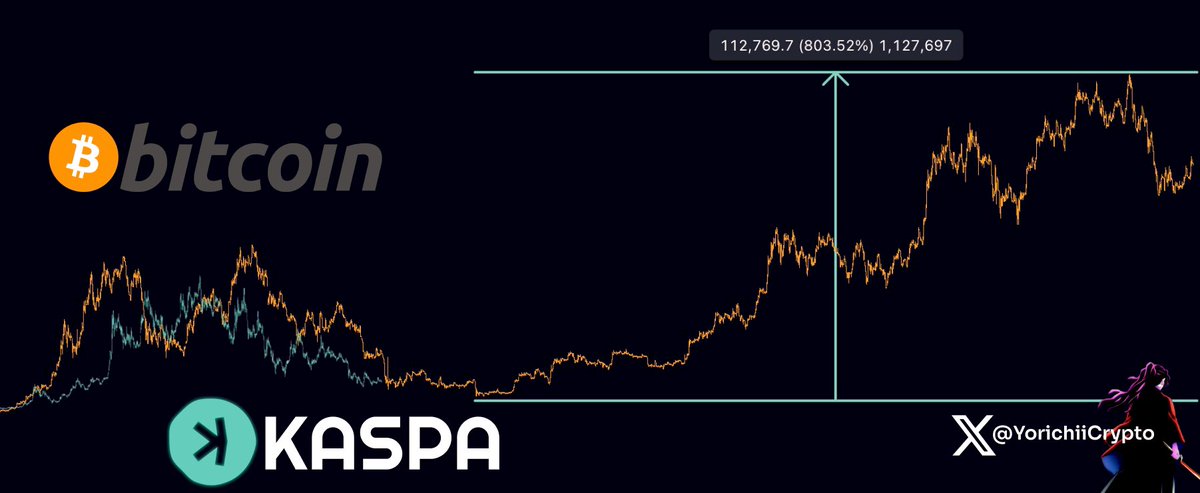
Kaspa walking in Bitcoin’s footsteps👀
Kaspa’s chart looks almost identical to Bitcoin’s chart before it went on its BIGGEST run.
$BTC gained 803% following this pattern.
If history were to repeat itself, a similar run would send $KAS to $0.36.
Needless to say, I expect this run to be potentially even more explosive, considering Kaspa’s fundamental superiority and how much the overall space has grown over the past few years.
Again, I don’t have a crystal ball; I’m just sharing my opinion.
cc - @Kaspa_HypeMan@OfficialTravlad@KaspaGuru@GoonBoyCrypto@Crypt0Proselyte
🎓🔖Introducing https://t.co/UR5lxlAiiJ🔖🎓
The first decentralized Learn-to-Earn platform built natively on Kaspa L1. Learn BlockDAG technology. Earn real KAS rewards. Mint your diploma KRC-721 NFT. Or use a demo mode to go through the courses.
We believe that Learn-to-Earn can be an effective way to simplify, incentivize, and gamify the learning and onboarding experience.
🤝Help us test the beta and give feedback🤝
📚The Protocol Stack📚
• KU Protocol - On-chain quiz completion proofs . Every passed quiz creates verifiable proof on Kaspa L1. Custom protocol made for this platform open sourced with many potential use cases and a KU explorer tab on the platform. We hope this can be reviewed and improved upon by the community for optimization and efficiency with a full indexer being built.
• K Protocol - Public Q&A powered by @thesheepcat's decentralized microblogging system @KSocialNetwork (https://t.co/4BfwTK3H1M). Post questions on lessons, get community answers - all on-chain.
• @kasiamessaging Protocol - End-to-end encrypted P2P messaging for private student support. (This is under construction. Est. completion 2-3 weeks)
• KRC-721 Protocol - Diploma NFT certificates. The KUDIPLOMA collection (max 10,000 supply) is mintable only after completing all 23 courses.
⚙️How It Works⚙️
1⃣Connect your KasWare wallet (more integration planned in the future):
2⃣Complete 23 courses with all quiz results recorded on chain! Special thanks to @NikolaGalilei for 80% of the content being sourced from @kaspacom learn page!
3⃣Pass quizzes to earn 0.1 KAS per course (recorded on-chain via KU Protocol)
4⃣Complete all courses through the DAG progression page to unlock diploma minting (~20 KAS for graduates including fees)
🛡️Anti-Sybil Protection🛡️
Built with fair reward distribution in mind - multi-wallet detection per IP, quiz cooldowns, minimum completion times, and VPN detection. Real learning, real rewards.
🛜Open Source🛜
We built this 100% with ai tools as a public utility for the Kaspa ecosystem. Fork it, learn from it, contribute back.
Try the beta: https://t.co/UR5lxlAiiJ
GitHub: https://t.co/AMyHu9Ddru
Support: https://t.co/J7eIekBtgT
Report bugs: @KasUniversity
Built for @kaspathon 2026. Submission coming after more testing and bug fixes!
Kaspa is more than a coin 🔥 it’s a movement.
Let’s support builders and spread real knowledge
#Kaspians check out @KasUniversity by @_DrLiberty and show your support with a like and share!