Value judgements are two-way streets: what someone thinks of something might contain information about that "something", but the opinion itself certainly contains information about that "someone".
EM is quite literally one of the best humans on earth. So if someone really hates him, they're signaling a lot about themselves
I personally wouldn't feel sad if Google weren't part of the winners in the AI race.
How the other labs will evolve is unknown and might not go well, but the history of Google Search and YT gives a clue of how Google as a winner would evolve, and it wouldn't be good
This is the point. Same will happen in all countries that will make social media age restrictions. “Won’t someone think of the children” is usually not about the children
One negative externality of AI is that it makes it harder to distinguish real knowledge from Chauffeur knowledge.
I.e., does the person really know this subject?
OSS is already affected
There’s something ominous about the speed with which the entire world has marched to require identification on platforms and, as I expected, begin the process of banning anonymous VPNs.
this advice from @MattHennessey in @WSJFreeEx mirrors the advice I receive from my older patients.
I routinely ask my older patients for life advice and repeatedly they tell me “have as many children as you can”
Last year, this news would have been science-fiction:
GPT5.4 Pro found an elegant solution to a 60 year old conjecture, Erdős Problem #1196. The proof subverted the natural human intuitions.
A day later, the proof was fully formalized in Lean by Gauss.
What a time to be alive
Idea: treat Code Review Feedback as an Incident that needs a Post-Mortem.
We're seeing way more PRs, many with bigger diffs. We've been evaluating different code review tools, and time spent reviewing code has gone up. If this is only the start of what's to come, Code Review needs to be rethought bigger than anything I've heard so far.
In this new world, we should change engineering culture to aim for zero code review interventions, with the aspiration to fully eliminate code review some day *gasp!*
Any time changes are requested, that should be treated as a failure of upstream process. We have post-mortem culture to root-cause process failures and corrective actions for incidents. What if we apply that mentality to code review feedback?
Any time a human requests changes on an agent's PR, the agent obliges and iterates. This is equivalent to bringing prod back online when an incident occurs.
But then we must track that this feedback was given, and have a follow-on review of what lead to this failure:
Tribal Knowledge: Are our docs not sufficiently specific? Are we missing an explicit style guide?
Requirements: Was the design not fully thought through? Were optimization criteria not ranked properly? Were edge-cases left undefined?
Taste: are the boundaries of the system architecture not sufficiently enforced?
Verification: are testing standards not fully documented?
I will try running this culture to measure the impact on PR iterations.
Paul Ehrlich was one of the most pernicious public figures of the last 50 years.
Somehow he was still celebrated in certain intellectual circles until the very end.
Never forget the harm his ideas caused.
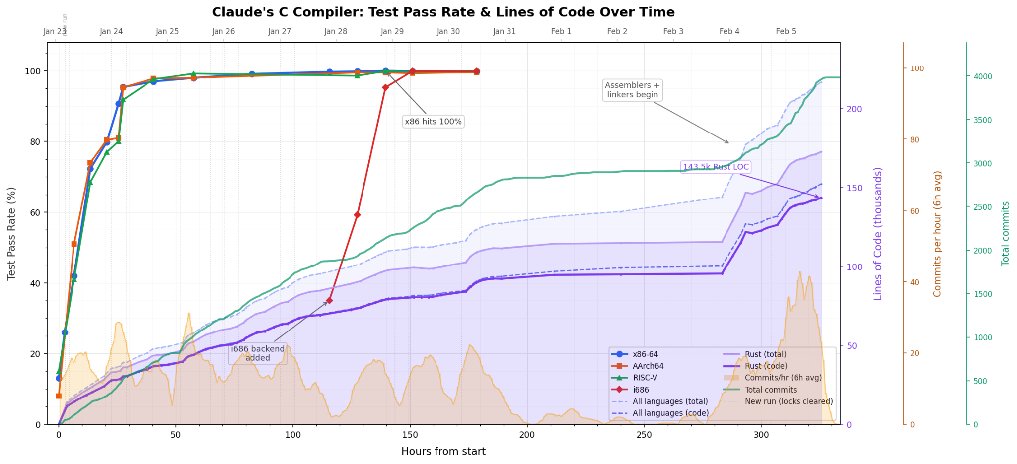
The Claude C Compiler is the first AI-generated compiler that builds complex C code, built by @AnthropicAI. Reactions ranged from dismissal as "AI nonsense" to "SW is over": both takes miss the point.
As a compiler🐉 expert and experienced SW leader, I see a lot to learn: 👇
Twitter's Eng org used to be TWO THOUSAND engineers.
Now it's ~25 engineers and a few designers and PMs.
I knew the cuts were big but this is blowing my mind.
@PGelsinger If Wikipedia is to be believed, my first name is the Finnish derivation of the name that medieval folklore traditionally assigned to one of the magi!
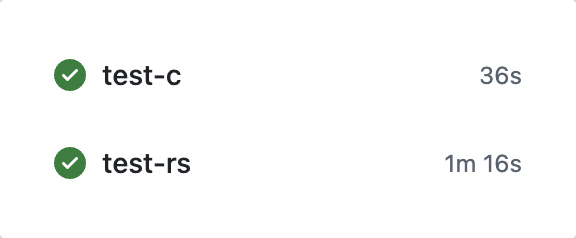
Doing a project written in both C and Rust (as in, two different sources for the same program).
Got a minimal-ish pipeline going for both, and the Rust side seems to begin with initial overhead
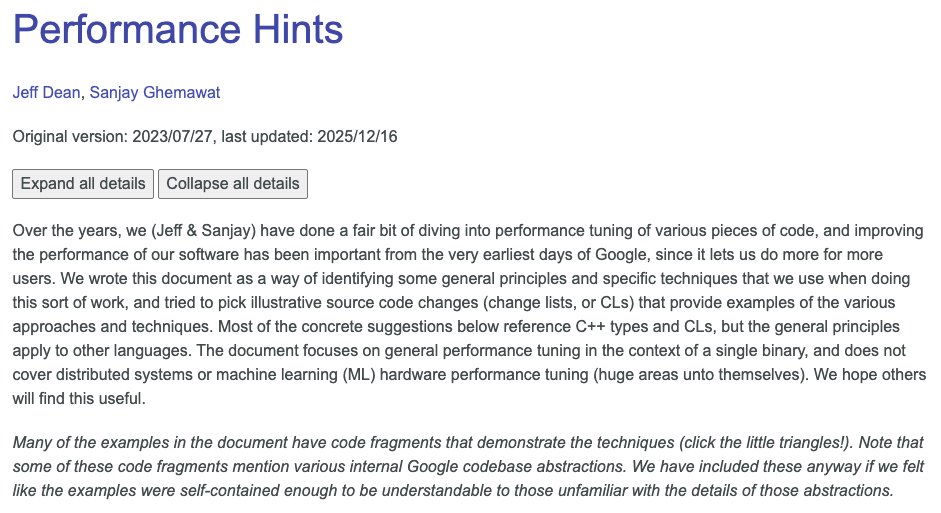
Performance Hints
Over the years, my colleague Sanjay Ghemawat and I have done a fair bit of diving into performance tuning of various pieces of code. We wrote an internal Performance Hints document a couple of years ago as a way of identifying some general principles and we've recently published a version of it externally.
We'd love any feedback you might have!
Read the full doc at: https://t.co/jej95g236P
Haven't posted about this before but might be a curiosity for some.
Back when I was going deep into math, I had a habit of putting all my notes up into a web repository I set up:
https://t.co/BNn0IX9oNu
I still feel pretty good about the result. Most data is private though.
One thing that is bound to happen: someone starts a conversation with an AI that they continue for the rest of their life.
Maybe instead of letters and (auto)biographies, in the future the lifelong AI conversations of people will be published?