Im idealen Staat bleiben Kinder in ihren ersten Lebensjahren zuhause und werden von ihrer Mutter behütet. Ich selbst hatte den Luxus, erst mit 4 in den Kindergarten zu gehen und um 12 von meiner Mutter abgeholt zu werden und bin froh, dass auch unsere Kinder zuhause bleiben können.
Im gesellschaftlichen Scherbenhaufen der späten BRD ist dieses Modell allerdings keine Selbstverständlichkeit mehr. In vielen Familien müssen beide Eheleute arbeiten, um über die Runden zu kommen und bleiben Kinder oft gänzlich aus. In dieser Notlage kann kostenlose Kindertagespflege ein Anreiz sein, überhaupt noch (mehr als ein, zwei) Kinder zu kriegen.
Die Wahrheit liegt hier zwischen den Extrempositionen und behält sowohl die finanzielle Situation vieler Familien als auch ein konservatives Familienideal im Auge, ohne den kommunalen Haushalt aus den Augen zu verlieren, wo die Kindertagespflege zumindest bei uns einer der mit Abstand größten Posten geworden ist. Ich vertrete als Kommunalpolitiker die Position, die Kindertagespflege in den ersten drei Jahren kostenpflichtig und danach im Geiste der entwicklungspsychologisch akzeptablen Elternzeitdauer von drei Jahren kostenlos zu halten.
Das zweite Kind zahlt nur noch 50% der Beiträge, das dritte und jedes weitere gar nichts mehr - so ist auch ein gewisser pronatalistischer Anreiz gesetzt. Gutverdiener, die ohne finanzielle Not aus Selbstverwirklichungs- und Karrieregründen schon innerhalb der ersten zwei Jahre das Kind in die Kita geben, werden stärker als bislang zur Kasse gebeten.
@pluant If you read carefully you’ll see that there is no micro-managing ideology in this decision, but the opposite. Lay people simply cannot dictate how a Diocese structures its churches. The right to receive while kneeling remains, but there obviously cannot be a right to altar rails!
@CatholicSat The disunity within the Church stems almost entirely from disagreements over matters of faith or discipline. This cannot be resolved without clear directives. I do not yet see how he intends to solve these problems with an approach that studiously avoids stepping on anyone’s toes
Que León XIV no derogaría Traditionis Custodes se sabía desde hace un año, junto con su disposición a ser “generoso” con las dispensas, que fue lo que le pidió a los obispos franceses. No veo novedades ni motivos de alarma, aunque nos decepcionen sus palabras. Notemos que el Papa señala una vía a las minorías con "sensibilidad" tradicional que queremos permanecer fieles a la Iglesia: no pidamos la abrogación, pidamos que esa vía se ensanche, insistamos, no nos desanimemos y, sobre todo, recemos para que así sea.
At Mass in Uruguay, Pope Leo XIV addresses men, challenging them to be men, and take their faith seriously, to teach their children the value of honest work and treat women with respect:
“I would also like to address the men; fathers, and grandfathers. Your children and grandchildren need to see that the faith occupies a genuine place in the lives of the men in your family.
Imitate Saint Joseph, who took on the task of raising Jesus, bringing Him to the temple, teaching Him to work honestly, and showing Him that God must come first in a person's life.
Dear fathers and grandfathers, young people need to see that you pray, receive the sacraments, treat your wives with respect, ask for forgiveness, and live with integrity, even when doing so requires sacrifice.
Children learn a great deal by seeing that their fathers can kneel before God without feeling that he is any less of a man for doing so.”
Jemand schrieb hier auf X, Priester usw. seien ein "Verweis auf die geglaubte, aber unsichere Nachwelt". Indes: Die Glaubensgewißheit ist die höchste, da sie auf Gottes Autorität beruht. Die Haltung, der Glaubensinhalt sei unsicher, ist mit dem Glauben *absolutest* unvereinbar.
« À la suite des saints, soyons nous aussi une pièce de la grande mosaïque de sainteté que Dieu crée dans l'histoire. » (Benoît XVI, Audience générale, 13 avril 2011)
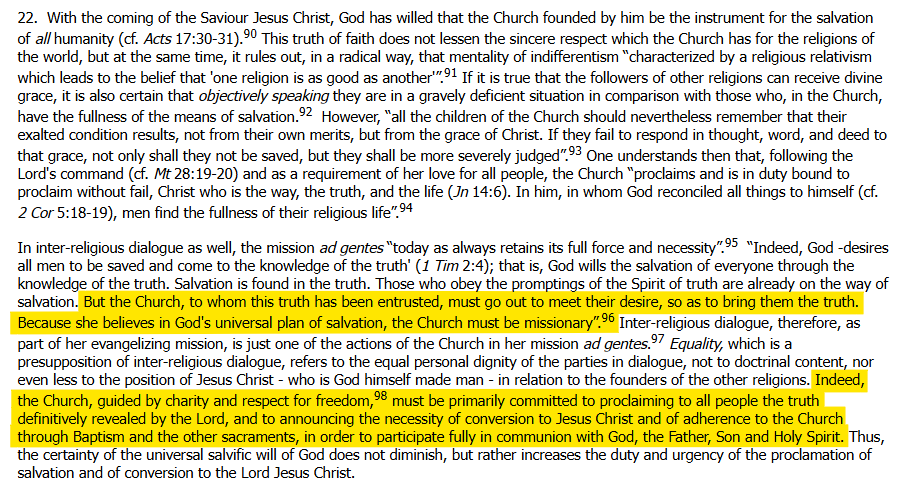
++Vesco: "I believe that believers of the three monotheistic faiths have better things to do than try to convert one another..."
This is, in fact, quite some way from being a "terrific response" or "speaking from the Church", as «Dominus Iesus» made abundantly clear 26 years ago!
Well, another Cardinal has come out with a, shall we say, puzzling take on evangelization.
A few years ago, Cardinal Américo Aguiar, at the time auxiliary bishop of Lisbon, said that he and the other organizers of World Youth Day in his hometown had no interest in converting anyone to Christ.
Now Cardinal Jean-Paul Vesco of Algeria has opined that “the Church is not there to convert” and “Christians should approach other religions through fraternity rather than seeking conversions.”
Excuse me, but…what?
Last time I checked, the Founder said, “All authority in heaven and on earth has been given to me. Go therefore and make disciples of all nations, baptizing them in the name of the Father and of the Son and of the Holy Spirit, and teaching them to obey everything I have commanded you.” Sure sounds like conversion to me.
When St. Paul came to Corinth or Athens or Thessalonica, his purpose was not to listen or to form a discussion group but rather to declare an unnerving message: the euangelion (glad tidings) that Jesus Christ is risen from the dead.
So impassioned is he for this work that he says, “I have become all things to all people, that I might by all means save some. I do it all for the sake of the gospel” (1 Cor. 9:22); and “If I proclaim the gospel, this gives me no ground for boasting, for an obligation is laid on me, and woe to me if I do not proclaim the gospel” (1 Cor. 9:16)!
Moreover, the entire thrust of the Second Vatican Council was toward bringing the Light of Christ to the peoples of the world (Lumen Gentium). And this missionary élan has given rise in the last few decades to the idea of a “new evangelization,” which is to say, a fresh declaration of the Lordship of Christ.
Quite obviously, no one thinks that this work of evangelization should be done in a brow-beating, overbearing, or disrespectful manner (proselytization), but for God’s sake, let’s not throw the baby out with the bathwater.
If I really thought that the Church does not exist to bring people to Christ, then I would resign and get an honest job.
Just a thought, but maybe “conservative” bishops are kept awake worrying about teaching sexual morality because a rumoured 10% of young women have OF accounts, virtually all men have consumed porn with an average exposure age of 12, and a rising number of…
Statement by the Catholic Archbishop of Melbourne, Dr. George Pell, addressing the issue of homosexuals who request Holy Communion on May 31, 1998.
Original, June 2, 1998
"While I accept that people may hold views on the proper expression of their sexual life and identity which differ from the Church's teachings, I deeply regret that such people — who profess the Catholic faith — would choose to mount an ideological demonstration during Mass and especially at Communion time. This is inappropriate.
"Receiving the sacrament is the ultimate expression of our Catholic faith an intensely personal matter between communicant and priest.
"It's not a question of refusing homosexuals or someone who is homosexually oriented. The rule is basically the same for everyone.
"If a person is actually engaged in — by public admission, at any given time — a practice contrary to Church teaching in a serious matter, then that person is not entitled to receive Holy Communion.
"This would apply, for example, to a married person openly living in adultery. Similarly, persons who openly declare themselves active homosexuals, take a position which makes it impossible for them to receive Holy Communion.
"Also, a person who is not a member of the Catholic Church has no right to Catholic Communion, except in exceptional circumstances.
"The Church's view on sexuality I have explained many times before. It is clear and unequivocal, and derives from natural moral law, which we believe is unchanging. Such moral law governs all people everywhere, in precisely the same way, regardless of the circumstances under which they live.
"However, this incident allows me to explain the centrality of the Catholic teaching on marriage and family. Our Judeo-Christian religious tradition allows men and women sexual expression within the bounds of family life, a sexuality which is life-giving. Homosexual acts are contrary to the natural law; they close the sexual act to the gift of life.
"We have had these protests before. Probably they will be with us for quite a time yet. I will pray for the protesters. But they must realise that the Church's teaching on this matter cannot, will not, change.
"Although human weakness is universal and God's mercy infinite, the path to happiness and heaven for a Catholic does not lie in seeking to re-interpret what is right and wrong.
"Rather, one should commit oneself, in good faith, to the Church and its teachings and work towards following these teachings as closely as possible".
Sunday May 31 1998