Thrilled to be part of this interactive session at @WorldHealthSmt to share experiences of how @WMPglobal @centertropmed and other translational research programs are addressing emerging infectious disease threats in our region
Looks like it’s more than just parasites and viruses spread by mosquitoes. You can now add “flesh-eating” bacteria to the mix. My latest for @ConversationEDU with Victorian colleagues and their latest research findings https://t.co/vNr1I7mZgD 🦟
Loved this narrative retelling - in six acts! - of the story of @WMPColombia's #Wolbachia mosquito releases in 3 Colombian cities to protect communities from dengue, by @BiteOfAMosquito. @WMPglobal
https://t.co/6YnA9skzz7
“I’ve spent decades working on dengue, and it still really bothers me that if I go online right now, there’s no one single source that shows what the current situation is, and which countries across the world are having epidemics” An exciting initiative @OliverBrady1@sneweyy
World’s first ‘dengue dashboard’ could predict outbreaks months before they happen.
As climate change pushes the virus into new territories, scientists work on a new tool to track the pathogen’s spread.
@sneweyy has the latest.
https://t.co/Vz4yzqc6Ut
The 3.3M residents of Bello, Medellín and Itagüí have not had a dengue outbreak for 6 years following city-wide roll-out of @WMPglobal's #Wolbachia method, including this year when many other cities in Colombia and neighbouring countries are experiencing huge outbreaks.
Global travel has never been more accessible, connecting 2 billion people annually. But this connectivity comes with a price: a higher risk of spreading mosquito-borne diseases. It's time for change.
Learn more here 👉https://t.co/nJ5VHVcmd8
#climatechange#COP28#monashuni
@ScottLOneill Reanalysis of the #Wolbachia trial data by @sdufault11 gives empirical support to these model predictions:
efficacy against #dengue ⬆️ from 77.1 to 82.7% when human and mosquito movement better accounted for https://t.co/djw5pDFjqG
@TAlexPerkins@SeanCavany
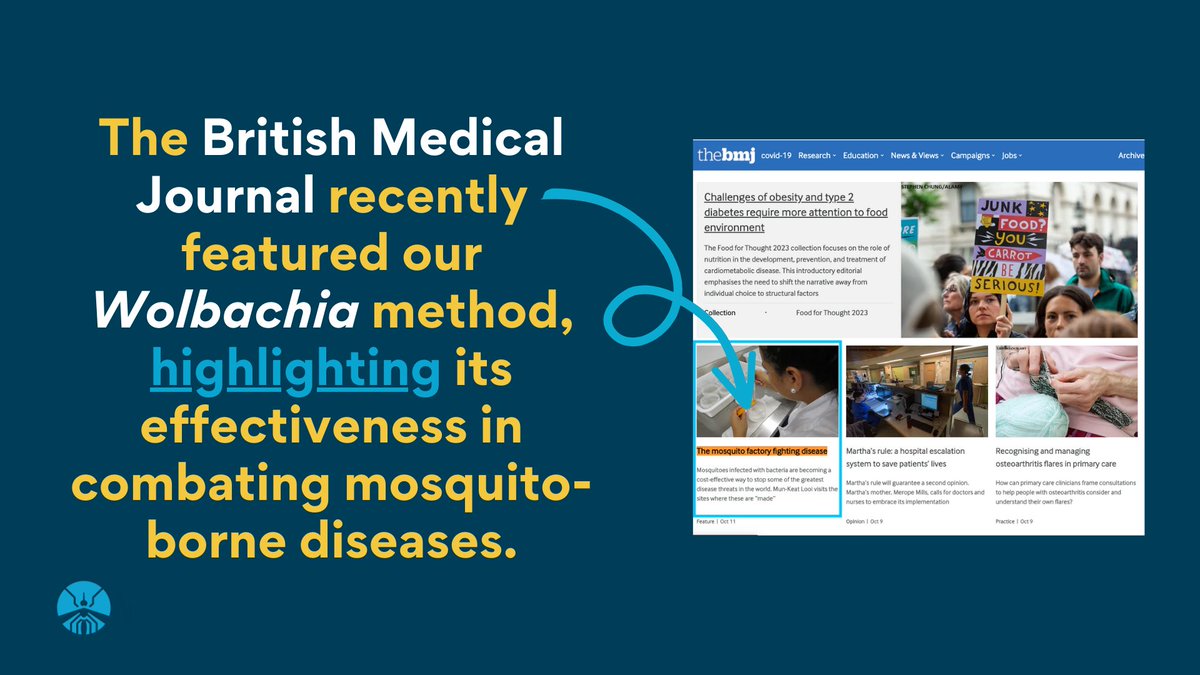
This week we're featured in the latest edition of the British Medical Journal, where they highlight the effectiveness of our #Wolbachia method in #Colombia. For those short on time (or don't have a @bmj_latest subscription) here's what you need to know:
👇 Tweet thread 👇 1/10
Recently, over 700 participants tuned into a groundbreaking webinar with @UGMYogyakarta & MoH Indonesia! The topic? "Achieving zero dengue deaths in Indonesia by 2030" and discussing the national scale-up of #Wolbachia for #dengue control. 1/5
🧵Thread 🧵
Check out our Dengue Diaries series to mark #worldmosquitoday for bite-size insights into how it takes not just good science but strong partnerships and community engagement to roll out #Wolbachia in pursuit of a #dengue-free Bali. @WMPglobal #releasinghope
@GlobalVectorHub@MalariaNoMore@chelseaeharvey@sciam ...in which the authors conclude that “this technology is generally robust to near-term (2030s) climate change. Accelerated warming may challenge this in the 2050s and beyond.”
@GlobalVectorHub@MalariaNoMore@chelseaeharvey@sciam Worth noting also - since it is misrepresented in the headline - that the article reports on a Nature CC paper titled ‘wMel replacement of dengue-competent mosquitoes is robust to near-term [climate] change’
How to solve the #dengue problem in #Bangladesh🇧🇩?
By introducing #Wolbachia bacteria in the mosquitoes dengue transmission is prevented
A successful method recommended by @WBG_Health and supported by @WHO
Check out how it works👇
https://t.co/wKDYcpBMZx.
@Omar_Akbari_@sciam@MarshallJohnM@valeri_vasquez With the current trajectory of increasing dengue and other arboviral disease outbreaks, I would have thought that the projected sustained effectiveness of this new tool over the next *3 decades* might have been more headline-worthy than the uncertainty in 30+ years time! @sciam
@Omar_Akbari_@sciam@MarshallJohnM@valeri_vasquez The authors conclude that “this technology is generally robust to near-term (2030s) climate change. Accelerated warming may challenge this in the 2050s and beyond.”