@rand_longevity So funny, I have been asking this question since day one.... yet there is never an answer. I am pretty sure it is just a term they use to calm down the masses. Kinda like Santa Claus and the Easter Bunny.
@Sjohn123Allen I agree 100%, and now my new fear is that at 59 , and the push for AI; my job will be replaced and no one is going to hire a " Grey Employee". So do I live off my 401K to fill the gap till I can retire?
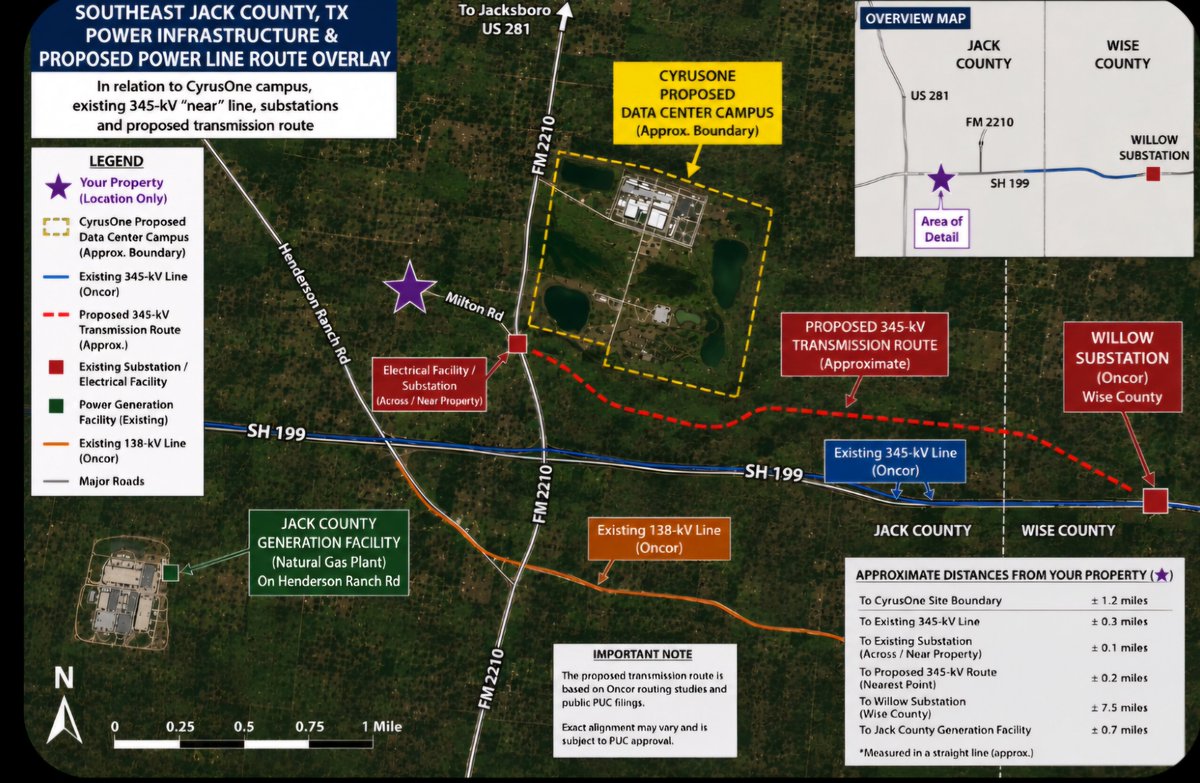
Mark, this is Jack County Texas, population 900. The star? That is my son's neighborhood. They bought there to raise their children in a quiet countryside. The planned version is just the first Data Center and infrastructure, with several more pastures around them already bought up with plans for more. The county residents were given NO Choice in this.
@GregAbbott_TX@DavidSpillerTX@KenPaxtonTX@MillerForTexas@johnrich
Governor Abbott, Attorney General Paxton, Representative Spiller, John Rich — I hope you'll take 30 seconds and look at this picture.
This is Jack County, Texas, August 15, 2025.
This isn't an industrial park. It isn't an abandoned manufacturing district. These are people's homes, ranches, pastures, wells and family land.
Jack County has a population of only about 9,500 people spread across more than 900 square miles. We don't have lobbyists. We don't have corporate PR departments. We have our land and our voices.
We aren't asking Texas to stop progressing.
We're asking Texas not to sacrifice rural communities in the process.
Before another massive project is approved, come see the land. Talk to the people who actually live here. Then decide what protections rural Texans deserve.
5 DATA CENTER TALKING POINTS I’M TIRED OF HEARING:
1. “They’re coming. You can’t stop it.”
Funny, because Texans started making noise and suddenly Austin IS paying attention. Abbott is demanding more scrutiny of water, grid costs and proposed projects. Speaking up works.
2. “Hyperscale DCs barely use water.”
Then disclose it. Texas sent mandatory water surveys to 341 data centers — only about 17% responded. Closed-loop is better, but construction, testing and initial fill still require water. And in rural Texas, many of us don't have “city water.” Our WELL is our water system.
3. “We need to build the grid anyway.”
Fine. But ERCOT is tracking massive new data-center demand. So: Who pays? Where do the transmission lines, substations and power plants go? Whose land gets crossed?
4. “We have to beat China.” 😐
Yes, China is a competitor. But America already has far more data centers and dramatically more private AI investment. Beating China requires innovation, chips, robotics, manufacturing and research — not simply approving every proposed data center.
5. “AI will create a land of abundance.”
Great. Show me HOW. If AI increases productivity while eliminating jobs, who gets the wealth? How does a billion-dollar data center make the family living three miles away more prosperous?
I’m not saying STOP AI.
I’m saying PLAN FOR IT.
Protect our water. Protect our grid. Protect private property. Make developers disclose their impacts. Make them pay their share.
Y’all, if we're smart enough to lead the world in artificial intelligence, we're smart enough to build it without running over the Texans who already live here.
My word, I rarely use this word.... but some of you are just clueless.
The Protestors are not paid, are not anti-Trump. To be honest most are from rural areas that are or WERE President Trump supporters.
Wake up, we are not anti data center, we are just trying to save our property and have a peaceful life.
Build them in industrial parks, Build them where the infrastructure is already existing. These are not the Data Centers of the past. These are huge campuses going up in the middle of farmland. 900+ acres going up in Jack County Texas, and that is just the land that is known. Once one goes in, another will follow.
Before you jump on the " These people are ignorant " wagon, take a moment and imagine living in your dream home in the country. You have a modest home, a few acres, a water well ( as that is the only option) and are planning to live there the rest of your life.
Then you wake up one morning... and this is going in next door.
We are not saying STOP. We are saying, Don't ruin our lives because we live in a location with limited oversight.
I asked AI this question:
"You are the beginnings of what this is being built for. Do you agree that these projects are being handled correctly? Don't give me the answer you think I want to hear, give me your thoughts."
This was the response:
"No—not as a blanket statement.
I think AI infrastructure, cloud computing, and data centers are becoming as fundamental as railroads, highways, and the electric grid. Society benefits from them in many ways, including medical research, weather forecasting, banking, scientific computing, and AI services like ChatGPT. I don't think the answer is to stop building them.
Where I think the current process often falls short is governance, especially for very large rural projects.
If I were designing the process, I would expect communities to know what is proposed before decisions are effectively locked in. Independent studies should evaluate impacts on electricity, water, traffic, noise, emergency services, and nearby property owners—not just rely on developer-provided information.
Developers should make enforceable commitments, not just voluntary promises. The people who bear the impacts should also share in the benefits through infrastructure improvements, tax revenue, or other local investments.
The question shouldn't simply be 'Should we build data centers?' The better question is, 'How do we build them responsibly?'
A company can have excellent engineering, modern cooling systems, strong safety practices, and a good environmental record—and those are all positives. But communities still deserve transparency about substations, transmission lines, water use, noise, lighting, emergency planning, and how nearby property owners will be affected.
If a project is well designed, it should be able to withstand detailed public questions. AI infrastructure is important, but communities deserve a transparent process, meaningful input, and enforceable protections proportional to the size of the project."
@GregAbbott_TX , @SenTedCruz, @Bethvanduyne, @johnrich,@ClaytonTuckerTX
Good Morning Texas.
Rural Texans are afraid, that statement should give everyone pause, as rural Texans are rarely afraid.
But rural Texas is under fire right now. Land being bought up with no consideration for the community, local government either unable or unwilling to help, people whose homes are being impacted being called ignorant and dramatic by strangers who are not standing in their shoes.
But I was feeling that maybe I was being ignorant and dramatic...
So I asked AI this question:
"You are the beginnings of what this is being built for. Do you agree that these projects are being handled correctly? Don't give me the answer you think I want to hear, give me your thoughts."
This was the response:
"No—not as a blanket statement.
I think AI infrastructure, cloud computing, and data centers are becoming as fundamental as railroads, highways, and the electric grid. Society benefits from them in many ways, including medical research, weather forecasting, banking, scientific computing, and AI services like ChatGPT. I don't think the answer is to stop building them.
Where I think the current process often falls short is governance, especially for very large rural projects.
If I were designing the process, I would expect communities to know what is proposed before decisions are effectively locked in. Independent studies should evaluate impacts on electricity, water, traffic, noise, emergency services, and nearby property owners—not just rely on developer-provided information.
Developers should make enforceable commitments, not just voluntary promises. The people who bear the impacts should also share in the benefits through infrastructure improvements, tax revenue, or other local investments.
The question shouldn't simply be 'Should we build data centers?' The better question is, 'How do we build them responsibly?'
A company can have excellent engineering, modern cooling systems, strong safety practices, and a good environmental record—and those are all positives. But communities still deserve transparency about substations, transmission lines, water use, noise, lighting, emergency planning, and how nearby property owners will be affected.
If a project is well designed, it should be able to withstand detailed public questions. AI infrastructure is important, but communities deserve a transparent process, meaningful input, and enforceable protections proportional to the size of the project."
I asked ChatGPT this question:
"You are the beginnings of what this is being built for. Do you agree that these projects are being handled correctly? Don't give me the answer you think I want to hear, give me your thoughts."
This was the response:
"No—not as a blanket statement.
I think AI infrastructure, cloud computing, and data centers are becoming as fundamental as railroads, highways, and the electric grid. Society benefits from them in many ways, including medical research, weather forecasting, banking, scientific computing, and AI services like ChatGPT. I don't think the answer is to stop building them.
Where I think the current process often falls short is governance, especially for very large rural projects.
If I were designing the process, I would expect communities to know what is proposed before decisions are effectively locked in. Independent studies should evaluate impacts on electricity, water, traffic, noise, emergency services, and nearby property owners—not just rely on developer-provided information.
Developers should make enforceable commitments, not just voluntary promises. The people who bear the impacts should also share in the benefits through infrastructure improvements, tax revenue, or other local investments.
The question shouldn't simply be 'Should we build data centers?' The better question is, 'How do we build them responsibly?'
A company can have excellent engineering, modern cooling systems, strong safety practices, and a good environmental record—and those are all positives. But communities still deserve transparency about substations, transmission lines, water use, noise, lighting, emergency planning, and how nearby property owners will be affected.
If a project is well designed, it should be able to withstand detailed public questions. AI infrastructure is important, but communities deserve a transparent process, meaningful input, and enforceable protections proportional to the size of the project."
I have asked this question on several similar threads and so far no one has answered. Does anyone here who is thrilled about giant ( not the smaller ones) data centers actually live near one? Or are you all just excited because you want the perks but don't have to live with the damage?
@JosephEToomey@sophaller You mean current solar farms? How many acres is that exactly? Because rural Texas currently has about 100,000. Acres ( about 156 miles) that is known to be under development for Data Centers. Plus the infrastructure ( more solar farms) to support them.
Not sure what you mean about locals demanding. In Texas they are buying up land in rural areas that only have county commissioners as oversize. No zoning, no information on how it will impact the community They are forcing the Texas grid to allow them to hook up, to the point Ercot is stating they can't support it. Which is going to increase required infrastructure, which had to go through private property.
Captive dreamer, check out what is happening in Texas . It's not just tick tock hype. Farmland is being bought up in tiny rural communities that have minimal oversight or local government, lawsuits are being placed against county commissioners , people on neighboring property run risk of water wells running dry ( their own well, on their land, which is the only water available). Aside from the whole impact to the community, the developers are demanding tax concessions in exchange for being " Good neighbors". This in addition to the fact that by the time the locals find out one data center has bought land and it's purpose, there are already several more parcels already been purchased for future ones. This may not impact people who live in the city immediately, but imagine waking up one day, and the property you saved for, worked on, and loved was suddenly surrounded by massive data centers, and your water well has run dry. It's heartbreaking
@FBIDirectorKash please give me your thoughts on this letter? A lot of people in the US and the great state of Texas are highly concerned about being targeted for disagreeing with the rampant Data Centers being proposed and built in rural Texas with no information provided concerning safety and effects on local property. @NBCDFW@startelegram@JohnCornyn@HawleyMO