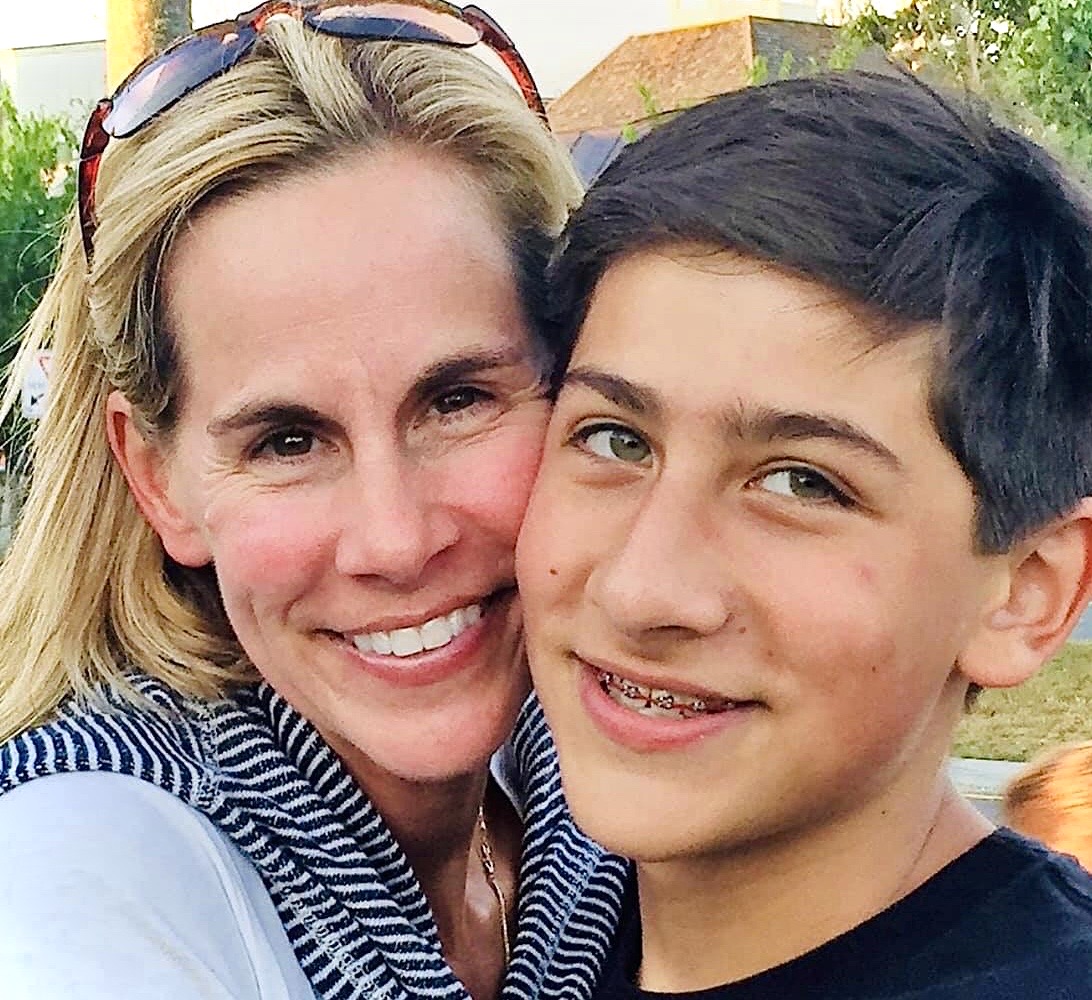
"At about 3:00 this morning I was driving my 1 year old child to the hospital because he was having a hard time breathing. I ended up getting pulled over by 19th and Nebraska St. due to having a tail light and license plate light out. As the deputy was telling me why he pulled me over I explained to him where I was going. He opened up the back door to my vehicle and heard my sons labored breathing and told me to go ahead and get to the hospital. The officer that pulled me over was deputy Kyle Cleveringa. He followed me to the hospital, helped me carry my things into the ER, offered to hold my son while I filled out paper work, gave my son a stuffed toy truck, and was helping to comfort him by talking to him and giving him "hi-fives." My family and I are very thankful for deputy Cleveringa and everything he did for my son and I this morning. He went above and beyond and I cannot thank him enough. Could you please make sure he reads this and is made aware of how grateful we are that he pulled me over and helped me through that terrifying situation? Thank you so much Kyle! ...... P.S. My son is fine and I will fix those lights asap! Thank you again!!"
Credit: Mindy Mathewson via Woodbury County Sheriff's Office
If we fined insurers and providers $100 every time they over-billed, incorrectly denied care or misrepresented any amount of patient out of pocket, we could pay of the national debt
They play on the fear and information asymmetry that exists in healthcare
Break them up. Make them divest non insurance companies. And when we are done with the insurance companies , we go to the hospitals and then to the pharma wholesalers. Break em up. Make the markets efficient again.
I often wonder how many extraordinary people wasted their entire lives fearing the judgement of people who were never even thinking about them. Nobody is thinking about you. Everybody is too busy thinking about themselves. That thing you’ve always wanted to do? Go do it.
According to Bentov, consciousness evolves to the 'absolute' which is the source of all consciousness. Matter, composed of quanta of energy, is the vibrating, changing component of pure consciousness. The absolute is fixed, manifest and invisible.
Bentov proposed that the brain acts as a transducer, converting the energy of consciousness into the electrical and chemical signals that are used to communicate information within the body. He also believed that the brain has the ability to tune into different frequencies of consciousness, allowing individuals to experience different states of awareness.
Bentov's theory is based on the idea that consciousness is a fundamental aspect of the universe and is not limited to the brain or the body. He argued that consciousness is non-local, meaning it is not bound by space and time and can exist independently of the physical body.
Bentov's theory has been influential in the field of consciousness studies, but it remains a subject of debate and is not widely accepted by mainstream science.
A mortgage payment doesn't go up for 30 years.
My parents still pay $420 a mo on a 200 acre farm + house they bought in 1998.
Rent goes up 5%+ per year. Compound that over 30 years and its 4.5x higher.
People who argue that renting is better are simply wrong.
Dunkin just won the best Super Bowl ad.
It’s hysterical, has big name celebs, has cameos that actually add to the ad, and is ridiculously memorable. Perfect in every way.
https://t.co/w9OMF6TzHN
Take a look at New Yorkers in 1930 after a decade of economic exuberance. There were no gyms, SoulCycles, yoga classes, or running shoes.
There were no diets, Ozempic, USDA pyramids or degrees in nutrition science.
Yet, look at how lean everyone is. There is no obesity.
Makes you wonder about the food and soft drink industrial complex and our government’s oversight of our citizens’ health.
"This is my wife taking a nap. In an hour she will wake up, put on her scrubs and get ready for work.
The tools and items she needs to perform her job will be gathered and checked meticulously - her hair and makeup will be done quickly. She will complain that she looks awful. I will disagree, emphatically, and get her a cup of coffee.
She will sit on the couch with her legs crossed under her and try to drink it while happily playing with the toddler that's crawling all over her.
She will occasionally stare off blankly as we talk; silently steeling herself for the coming shift. She thinks I don't notice.
She will kiss the baby, she will kiss me and she will leave to go take care of people that are having the worst day of their entire lives:
Car wrecks, gunshot wounds, explosions, burns and breaks - professionals, poor, pastors, addicts and prostitutes - mothers, fathers, sons, daughters and families - it doesn't matter who you are or what happened to you.
She will take care of you.
She will come home 14 hours later and remove shoes that have walked through blood, bile, tears and fire from aching feet and leave them outside.
Sometimes she will not want to talk about it. Sometimes she can't wait to talk about it.
Sometimes she will laugh until she cries and sometimes she will just cry - but regardless of those sometimes she will be on time for her next shift.
My wife is a nurse. My wife is a hero."
Credit: Bobby Wesson
My name is Kristin Song.
On January 31, 2018, my son Ethan was shot in the head in his best friend's house. The father/gun owner stored 3 handguns and ammunition in a shoebox. Ethan's friend had been accessing the guns for over 6 months.
At the hospital, the ER doctor slid down the wall, put his head in his hands, and whispered, "Your son is gone." At that instant, all I knew, loved and trusted was imploded into a million tiny pieces.
I begged to say goodbye to my beautiful boy. I wanted to kiss his forehead, tell him how cherished he was, and tuck him in one last time. But the doctor begged me to remember Ethan as he was, you see, he was unrecognizable even to my eyes.
The day before Thanksgiving in 2018, the prosecutor told me she would not charge the negligent gun owner, and if I wanted negligent gun owners to be held accountable, I would have to change the law.
So I did.
6 months later, Connecticut passed Ethan's Law, which requires gun owners to secure their weapons if children can gain access.
Then, I learned that so many states stood silent on this issue, so in 2019, I turned my attention to passing Ethan's Law nationally. I met with over 400 congressional offices, 130 of them Republican.
In 2022, Ethan's Law was passed in the House of Representatives as part of the Safer Communities Act. Sadly, it was not picked up in the final package.
When the Democrats lost the House of Representatives in 2023, I pivoted to passing safe gun storage laws in the States. As a result, Michigan, New Mexico, and Maryland passed safe storage laws.
Currently, I am working with 5 states to pass Ethan's Law.
I am emotionally and mentally exhausted, but I will not stop until there is a cultural shift in this country where it becomes second nature to secure your weapons around unsupervised children.
If you believe in protecting children from gun violence, please follow and repost.
How real estate deals work:
LP = Limited Partner
It is a passive investor in a business deal (usually real estate but also Venture or Private Equity).
Limited partners give money to General Partners (GPs) who run the deal and manage it.
GPs make all the decisions. Who to hire. When to sell. How to manage the business.
General partners often co-invest a little bit of money into a real estate deal and own some LP shares too.
GPs run a service business that gives LPs exposure to real estate so they charge fees.
A fee to acquire a deal. A fee to manage a deal. A fee to finance a deal.
Anything that requires work, they get paid a fee to do.
How do returns work and who gets money?
There is generally a “preferred return” or “pref” that is an annualized rate that is owed to the LP on their capital.
An 8 pref means the first 8% of yield annually is owed to the LP.
The promote is how the GP gets paid on the upside of a deal.
A 30% promote means that anything over 8% the GP gets 30% of and the LP gets 70% of.
This is mentioned “70 - 30” in passing when people talk about it.
“I invested in a deal with an 8 pref and 70 - 30” means there is an 8% preferred return and 30% of the upside goes to the GP.
Let’s say a building is bought for $1m with no bank debt.
I put in $100k as an LP at an 8 and 70-30.
The first 8%, or $8k annually of cashflow, is owed to me before the GP starts to get paid (aside from fees).
If the building is sold for $2 million 5 years later we have $1 million of profit.
$700k (70% of profit) is sent to the LPs, I’m a 10% partner so I’d get $70k of profit.
$300k goes to the GP (or the syndicator who runs the deal).
The IRR (internal rate of return) is the annualized return I made on my $100k investment through the life of the deal.
If I made $25k per year of profit (all-in) that would be a 25% IRR because I invested $100k and $25k is 25%.
If I made $5k per year on average my IRR is 5%.
Most GPs target a 12-15% IRR on “good” deals.
A capital call means the GP ran out of money and went back to the LPs and asked for more in the middle of owning a deal.
This shouldn’t happen if everything goes well. But real estate is risky.
Interest rates go up, revenue goes down, unexpected expenses arise.
People expect a 12-15% IRR on real estate deals because of the risk of it.
Leverage amplifies it and makes it more profitable for LPs but more likely to go under water because the debt service is overhead.
In the $1m example, most GPs would use $700k of bank debt and $300k of cash.
My $100k investment gets me 33% ownership now instead of 10%.
If we sold for $2m there would be $1m profit and I’d get 70% of $333k instead of $100k in the previous example.
So leverage increases risk and also increases returns. It costs both ways.
Today we’re seeing it cut in a bad way because the economy is slowing down and that debt got a lot more expensive.
I hope this helps!
Typical Gen Z Bank Statement:
$2,500 rent
$13 lunch
$400 student loan payment
$26 Uber
$1,000 medical bill
$8 coffee
$600 car payment
The issue is obvious. Had they made their coffee at home, they could have saved $7.