The fact that colleges have really nice food and expensive gyms and other nice amenities gives a rude awakening to new grads when they suddenly see their real consumption drop by 50% upon graduation. It makes them feel poor when they're not.
Post of the day: @TrevinWax draws on Dostoevsky to explain why we hate people because we harm them, not just the other way around. Superb: https://t.co/xJ1olNH0cE
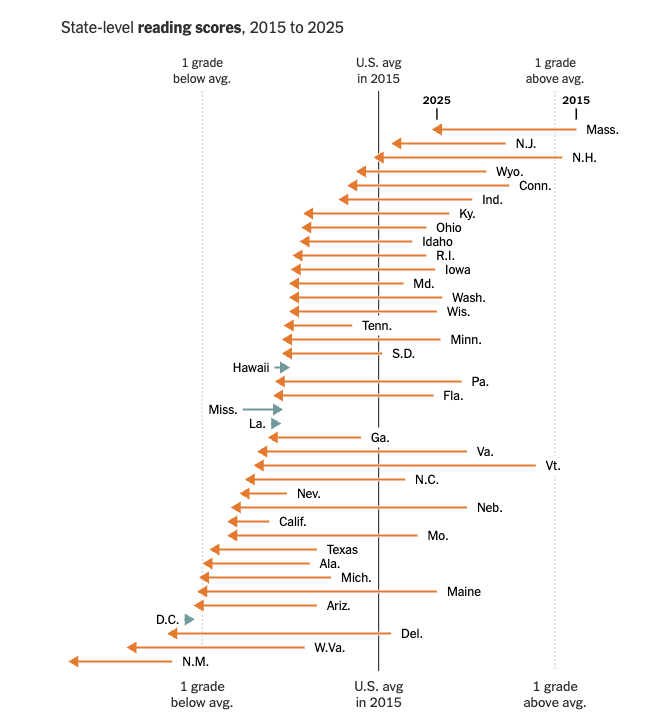
We don't know whether it was smartphones/social-media or edtech that was the bigger contributor to the decline in education outcomes that began in the 2010s. But new revelations show the tricks Meta, Snap, and Tiktok used to lure students during the school day.
Still more reasons to be technoskeptical
https://t.co/m9TrbNWm1N
He’s typing in a search bar, quick show him the search option he’s looking for.
Perfect. He typed the next letter that is also the next letter in the option we just showed him so take that option away and show him an option that doesn’t match at all
“You can do whatever you want. You can be whatever you want. I think it’s not true.”
Michael @Shellenberger says modern parenting and education increasingly sell children a fantasy of limitless freedom that leaves many kids more anxious, not more fulfilled.
“Giving them too much freedom will scare them from a very young age,” he tells @coldxman.
“Too much choice also creates a kind of stress on people.”
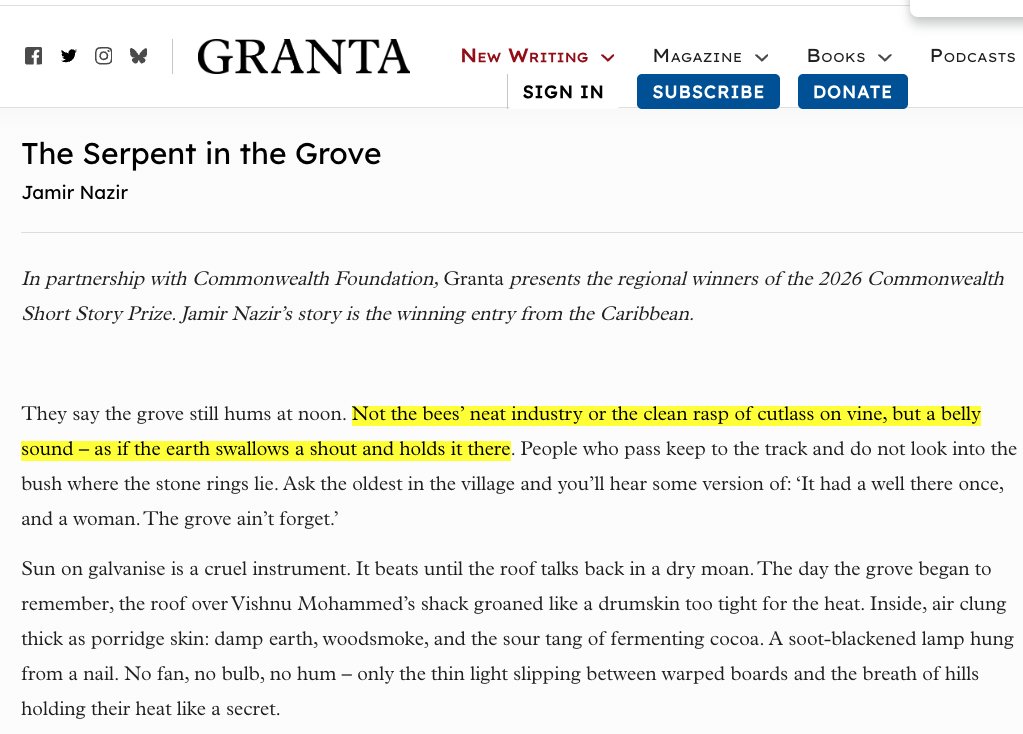
Well, this is a first: a ChatGPT-generated story won a prestigious literary prize (The Commonwealth Prize).
"Not X, not Y, but Z" sentences everywhere, the "hums" trope, and plenty of other obvious markers of AI writing.
A major milestone for AI, at any rate...
@GrantaMag
The White House demanding that a network fire one of its hosts, while taking regulatory action against ABC's corporate parent to pressure, threaten and force them to do so, is an obvious attack on the First Amendment.
It's at least as bad as what the Twitter Files showed: the Biden Adm pressuring and threatening social media platforms to ban dissent:
The Hilton donated the ~2600 dinners that went unserved at WHCD. They freeze dried the steak and lobster for longer shelf life before giving them to 2 shelters for abused women and children. HUGE thank you to the staff that worked through the night under terrible circumstances.
I still cannot fathom how media outlets fail to see that their dishonesty on this issue destroys their credibility and makes them look like students who never grew up.
A single ant has 250,000 neurons. Your brain has 86 billion. That’s a 344,000x gap. And yet what you’re watching is a colony solving a category of problem that no computer can crack perfectly at scale.
It’s called the Steiner tree problem. Given a set of points, find the shortest possible network connecting all of them. First posed in 1811, proved essentially impossible to solve perfectly in 1972 (the computing time grows so fast with size that the world’s fastest supercomputer stalls on a few hundred points). Still one of the hardest open problems in mathematics.
Ants solve it with chemistry. When an ant walks a path, it leaves a chemical trail called a pheromone. That trail evaporates over time. Shorter paths get walked faster, so pheromone builds up before it fades. Other ants prefer stronger trails. The colony converges on the shortest route without any single ant knowing the full picture. Jean-Louis Deneubourg at the Free University of Brussels proved this in the early 1990s with a dead simple experiment: two bridges between a nest and food, one twice as long as the other. Within minutes, the colony picked the short one.
In 1991, computer scientist Marco Dorigo took that discovery and turned it into an algorithm (a set of step-by-step instructions for a computer) called Ant Colony Optimization. It’s now used to route wires inside microchips with billions of transistors (one study found an 8% reduction in wire length over traditional methods), plan delivery truck routes, and manage internet traffic. The phone you’re reading this on was partially designed using math that ants figured out 100 million years before humans existed.
A 2023 study out of Stanford and several other institutions found that turtle ants in the tropical forest canopy build trail networks across tangled branches and vines that approximately solve the Steiner tree problem with zero central control. No ant has any information about the full network. Each one just follows a rule: at each junction, go where the pheromone is strongest. The collective intelligence comes from thousands of these tiny decisions stacking up.
Stanford biologist Deborah Gordon has studied this for decades. She compares it directly to how brains work: no single neuron tells the others what to do, but together they produce thought. A 2024 Rockefeller University study found that individual ants decide whether to leave the nest using the same yes-or-no process that brain cells use to decide whether to switch on. The colony is, in a real mechanical sense, a brain spread across thousands of bodies.
In early 2025, a Weizmann Institute study pitted ant groups against human groups on a task almost identical to this video: navigating a T-shaped object through a series of obstacles. The bigger the human group, the worse they performed. Too many competing ideas about which direction to push. The bigger the ant group, the better they got. No ego, no debate, just pheromones and simple rules scaling into something that looks a lot like intelligence.
250,000 neurons each. No leader. No blueprint. Solving problems that stumped mathematicians for two centuries.