Super excited to be a part of this project! Most tandem repeats expansions lead to disease but we found one in MUC19 undergoing positive selection. The repeat adds >12,000bp to a coding exon and is present on a haplotype inherited from Denisovans. https://t.co/qG2hrG4y6E
@wsdot Hi, any chance you can let me know which ferry will be the 6:30 departure from Anacortes to Orcas Island? And whether it is running behind schedule?
My former student and co-author, @kaufmanelij, has a new article out! It's about 🦇BATZ🦇. Do you like bats? Diseases? Check out their paper!
https://t.co/ffb0utuORh
Our @kaufmanelij “White as milk: Biocentric bias in the framing of lactose intolerance and lactase persistence” has officially been assigned an issue in @SHIjournal ! https://t.co/vG4WXVZldU
🚨Our @kaufmanelij (@Vassar '21) article is now published @SHIjournal! Examining the case of lactose intolerance, we show how news media help normalize biocentric biases through messages about eating behaviors & health.
https://t.co/D1DpHIuPax
Good job presenting our forthcoming @SHIjournal paper “White as milk: biocentric bias in the framing of lactose intolerance and lactase persistence” at #ASA2022, Eli @kaufmanelij (@Vassar ‘21)!
Congrats, you win some tamales! 🫔 🫔 🍹 yay!
"White as milk: Biocentric bias in the framing of lactose intolerance and lactase persistence" with @kaufmanelij ACCEPTED at @SHIjournal! Can't wait to share it.
Preparing for our (@kaufmanelij VC ‘21) talk tomorrow: “White as milk: Biocentric bias in the framing of lactose intolerance and lactase persistence.” #ESS2022@Vassar
LES1 | Homo naledi from the Lesedi Chamber of the Rising Star Cave, around 236-335kya. It has the largest endocranial volume of H. naledi (~610mL) making it larger than the two smallest adult craniums attributed to Homo erectus craniums.
#FossilFriday https://t.co/2syEoUa9s3
Xiaje mandible | Denisovan mandible from 160kya Tibetan Plateau represents the earliest fossil evidence of Homo sp. living in high altitude, low oxygen environment. The Denisovan EPAS1 allele lives in on modern populations in the same region. #FossilFriday https://t.co/Qc0NVLG6ou
BOU-VP-2/66 | Homo erectus (Daka) calvaria from 1mya Ethiopia. Sharing derived features w/ concurrent Homo erectus in Europe and Asia, it helps reject ideas that geographic speciation/ cladogenesis was significant in H. erectus at that time. #FossilFriday https://t.co/9Tp8YA9vJV
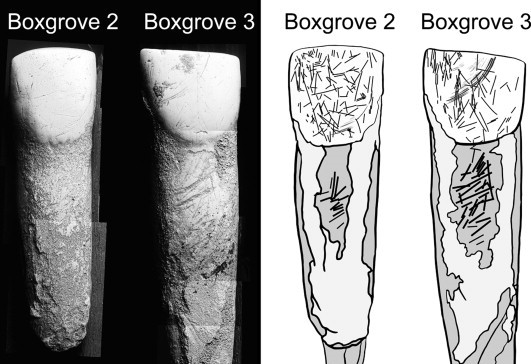
Homo heidelbergensis | Boxgrove 2 & 3, lower incisors from 500kya England. Scratches on the crown, seen here, are possibly from tools slipping while individuals cut things held in their teeth, a behavior observed in modern hunter gatherers #FossilFriday https://t.co/y8DU56rhiA
El Sidrón J1 | Homo neanderthalensis, skeleton of a 7-8yr old from a 49kya in Spain. Human brains normally reach 95% adult brain size by 7, but J1 was at ~87.5% of average Neanderthal growth. Perhaps Homo n. brains grew for longer, which is why they're bigger. #FossilFriday
@ToumaiTalks@robertosaezm Could be a longer period of sustained high growth rate, but I am definitely curious how this impacted adolescence and social structures in Neanderthals