Jet-powered Russian drones with Nvidia chips are now breaking into Ukrainian airspace and killing people because Starlink restrictions hinder Ukrainian air defense.
Після виходу із СІЗО генералу СБУ Сергію Дуці одразу видали короткоствольну зброю.
Ось так в 90х - бандюки зустрічали своїх авторитетів , коли ті із СІЗО виходили...
@GamersNexus Amazing video. As a gamer and as someone who lives in Ukraine, please Steve, find the Nvidia hardware smuggling thats happening for military use. Russia somehow has unlimited nvidia chips that they put in their killer drones launched in hundreds over Ukraine every day.
🚨 Another major scandal is coming out of NVIDIA.
And this one has nothing to do with Jensen Huang's affairs.
According to a Wall Street Journal report, Nvidia was offering billions in financial guarantees to AI companies that could not afford its chips, so they could keep buying them.
Some of these deals were being pushed by Jensen's own son-in-law, Nico Caprez, who became a vice president in January. His team was telling small cloud companies and data center builders that Nvidia could arrange credit support for them within a couple of weeks.
The goal was simple: turn them into long term buyers of Nvidia GPUs.
And the size of Nvidia's commitments has exploded. Its own filing shows $530 BILLION in commitments and guarantees, up from $184 billion just one quarter earlier.
Inside the company, CFO Colette Kress was raising concerns. She kept asking how these guarantees were priced and what Nvidia was really getting back.
In an August meeting, Jensen cut her off and called her "a deer in the headlights."
She was also the one who cut Nvidia's guarantee on OpenAI's Ohio data center from $250 billion to $105 billion.
Now Jensen is gone, and the CFO who questioned these deals is running Nvidia.
To understand why this is a big deal, you need to understand the AI funding loop.
Here is how it works:
1. Nvidia puts money into an AI company, or guarantees its loans and leases.
2. That company uses the money and credit to build a data center.
3. The data center is filled with Nvidia GPUs.
4. Nvidia reports those GPU sales as revenue.
5. If the company cannot rent out all its computing power, Nvidia agrees to buy the unused part.
SO NVIDIA IS THE INVESTOR, THE LENDER, THE SUPPLIER AND THE BACKUP CUSTOMER, ALL IN THE SAME DEAL.
The money goes out of Nvidia and comes back to Nvidia as sales.
CoreWeave is the clearest example. Nvidia owns a stake in it, sells it chips, and agreed to buy up to $6.3 billion of its unused computing capacity through 2032.
OpenAI is the biggest. Nvidia is guaranteeing up to $105 billion for its Ohio data center, supplying all the chips inside it, and invested $1.5 billion in the company building it.
Nvidia's own filing for the quarter ending July 26 shows where the money is tied up:
• Supply commitments for memory and chip wafers: $279 BILLION, up from $119 billion.
• Guarantee on the OpenAI Ohio data center: up to $105 BILLION.
• Deals to buy unused cloud capacity from neoclouds: $36 BILLION.
Nvidia's actual liabilities on its balance sheet: $91 BILLION.
That means the commitments outside the balance sheet are almost 6 times bigger than the debts on it.
Nvidia does not lose this money unless something breaks. A guarantee only costs Nvidia if a customer cannot pay.
But this is where it gets uncomfortable.
The WSJ says Jensen himself had started to panic. He warned executives that the biggest cloud companies were moving to their own chips to depend less on Nvidia.
At the same time, the wafers and memory Nvidia had committed to buy were coming at him like an "avalanche."
So the biggest customers were trying to leave, Nvidia was locked into buying huge amounts of supply, and smaller customers were being kept alive with Nvidia's credit.
And things were already starting to crack:
• Nvidia paused some of its financing deals in August.
• Nearly half of the $80 billion in data center bonds issued this year were rated junk.
• Neocloud stocks crashed this week, with Nebius down over 20% and CoreWeave down 17% at the lows.
• OpenAI raised less than it wanted, at a lower valuation.
And now Kress is the one deciding whether this continues.
If she pulls back on the financing, the companies that depended on Nvidia's money will have to borrow elsewhere, in a debt market that is already nervous.
If they cannot, they stop buying chips.
And if they stop buying chips, Nvidia's revenue drops.
That is the risk of a loop. It works perfectly when money keeps flowing, and it hurts on the way down.
Невідомі в камуфляжі і масках зустрічають генерала СБУ Дуку біля СІЗО
Очікувалося, що його мають випустити о 16:00. Біля СІЗО на підозрюваного по справі «Карфаген» чекають не лише адвокат і журналісти, а й невідомі в камуфляжі і з закритими обличчями. Вони не представляються.
Журналісти питають: «А це все заставодавці?».
Відомо, що гроші на заставу Дуці збирали серед співробітників СБУ.
THE IMF HAS FLAGGED $1.4 TRILLION IN CIRCULAR AI DEALS.
Big Tech is funding its own customers so they can keep buying from Big Tech.
Here is every known AI circular financing loop right now:
1. Nvidia ↔ OpenAI: Nvidia invested $30 billion in OpenAI and guarantees up to $105 billion of its Ohio data center leases. OpenAI fills those data centers with Nvidia chips.
2. Oracle ↔ OpenAI: OpenAI signed a $300 billion cloud deal with Oracle. Oracle is borrowing heavily to build the data centers for it.
3. Microsoft ↔ OpenAI: Microsoft owns about 27% of OpenAI. OpenAI committed $250 billion to Microsoft's Azure cloud.
4. SoftBank ↔ OpenAI: SoftBank invested $64.6 billion in OpenAI. OpenAI rents data centers from SoftBank's SB Energy.
5. Amazon ↔ OpenAI: Amazon is investing up to $50 billion in OpenAI. OpenAI expanded its Amazon cloud deal by $100 billion.
6. AMD ↔ OpenAI: AMD gave OpenAI the right to buy up to 160 million AMD shares for $0.01 each. In return, OpenAI buys AMD chips.
7. Google ↔ Anthropic: Google is investing up to $40 billion in Anthropic. Anthropic committed at least $121 billion to Google Cloud.
8. Amazon ↔ Anthropic: Amazon is investing up to $33 billion in Anthropic. Anthropic committed at least $110 billion to Amazon's cloud.
9. Broadcom ↔ Anthropic: Banks lent $63 billion to a special company that buys Broadcom chips and leases them to Anthropic. Broadcom backs the chips' resale value.
10. Microsoft + Nvidia ↔ Anthropic: They are investing up to $15 billion combined. Anthropic committed at least $44.9 billion to Microsoft's cloud.
11. SpaceX ↔ Anthropic: SpaceX borrowed $40 billion to buy Nvidia chips and sells the computing power to Anthropic. Nvidia is a SpaceX shareholder.
12. Nvidia ↔ CoreWeave: Nvidia owns about 11% of CoreWeave and agreed to buy $6.3 billion of its unused capacity. CoreWeave buys Nvidia chips.
13. Nvidia ↔ neoclouds: Nvidia agreed to buy $36 billion of cloud capacity from smaller AI cloud companies. They use that guaranteed income to borrow and buy Nvidia chips.
14. Microsoft ↔ Nscale, Nebius, IREN: Microsoft signed up to $70.9 billion in contracts with them. They use the money to buy GPUs.
15. Google ↔ former bitcoin miners: Google guarantees billions in leases at TeraWulf and Cipher and gets their shares in return.
16. Meta ↔ Blue Owl: A $27.3 billion data center was built through a joint company, with Meta backing it with a $28 billion guarantee.
17. Anthropic IPO: Its chip and cloud suppliers, Nvidia, Google, AMD, Micron, Broadcom and Microsoft, are buying $26 billion of its shares. Anthropic owes those same companies hundreds of billions in future spending.
When money keeps flowing, these loops make everyone's revenue look strong.
Генерал СБУ Сергій Дука під аплодисменти людей у масках вийшов із СІЗО.
До речі, адвокат Дуки заявив, що попри звільнення з посади генерал-майор був і лишається співробітником СБУ, "був учасником певних спецоперацій", тому його продовжать охороняти.
Тобто заяви про "звільнення Дуки" - це фактично фейк, щоб приглушити обурення суспільства. Все один в один, як і з генералом Вітюком.
@daniel9990_@VadimYuryev Thats iPad though, with very minimal static elements. OLED is different it degrades over time naturally but this is not so apparent to the user but in a laptop with static elements everywhere in the UI burn in becomes a real concern.
Breaking: Michael Burry says the Jensen Huang affairs are distracting you
Claiming “The real story is that the AI Bubble started to come apart for real this year” and mentioning what Jensen said about his replacement behind closed doors
Here’s what the WSJ revealed:
1. Nvidia was in talks to guarantee billions of dollars for companies that couldn’t afford its chips
2. Some of those deals were led by Jensen Huang’s son-in-law, who offered financing to upstart cloud companies to turn them into customers
3. Huang said major cloud providers were running away from Nvidia and planning to use rival chips
4. He said the chip and memory orders Nvidia had committed to were coming at him like an “avalanche”
5. 5. In that same meeting, he called his CFO “a deer in the headlights” and said she couldn’t help him make decisions
And now that same CFO, Colette Kress, is Nvidia’s interim CEO while $NVDA is down 15% this year
Nobody wants to work anymore.
CORRECT. No one wants to work 50 hours a week for a salary that hasn't kept up with inflation since 1979, pay 40% of it in rent, get 10 days PTO, no sick days, no pension, no job security, and be told they're replaceable at any moment.
You solved it. That's the full sentence.
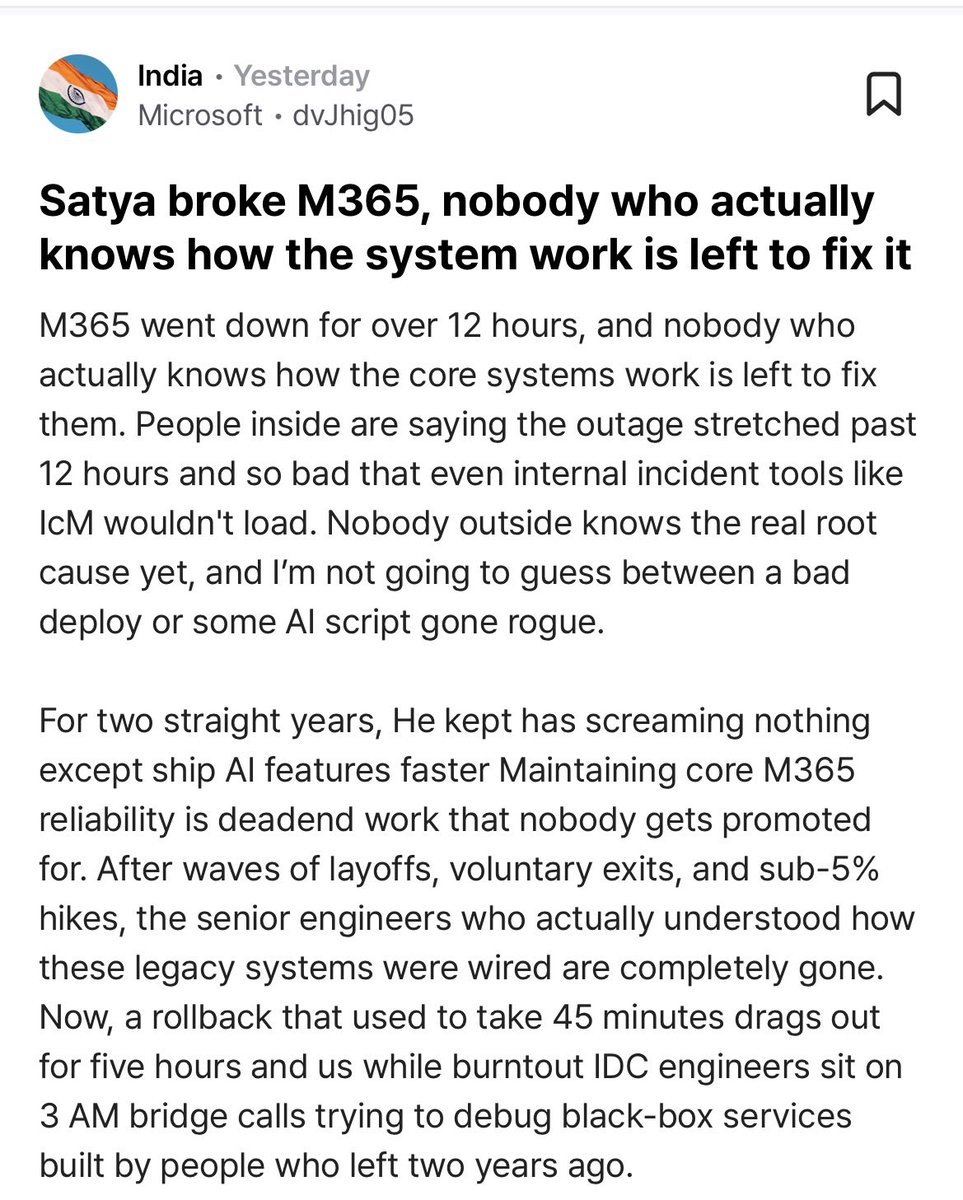
An internal Microsoft India engineer just leaked why the Microsoft 365 outage is taking too long to fix, and it's every software company in 2026:
Big Tech executives:
1. Lay off the senior engineers who built the core infrastructure
2. Give sub 5% hikes to the ones who stay
3. Refuse to promote anyone doing "boring" reliability work
4. Force everyone to ship half baked AI wrappers instead
What actually happens when production breaks at 3 AM:
По селам виковирюють останніх Микол для мобілізації, бо на фронті не вистачає людей, тим часом роту СБУшників зігнали у центр Київа, що б ті поаплодували звільненому своєму колезі наркоділку.