10 SMALL-CAP NAMES UNDER $5B WORTH WATCHING
1. $CLPT navigation platform for neurosurgeons
2. $OSS rugged edge compute for the battlefield
3. $OUST eyes & perception for physical AI machines
4. $NVTS GaN power for $NVDA 800V data center shift
5. $AMBQ ultra-low-power silicon for always-on edge AI
6. $AMBA edge AI vision chips for cameras, cars & robots
7. $TMDX expanding organ care with fleet & network effect
8. $TE building America's solar supply chain from cell to module
9. $AEHR wafer-level burn-in for photonics, HBM & high-power AI chips
10. $ONDS autonomy & counter-drone systems for the modern battlefield
Very interesting statement today: $MU CEO predicts a multi-decade memory demand cycle driven by humanoid robots.
"Humanoid robots, he says, will require roughly ten times more memory than today’s Level 2+ autonomous vehicles."
"And that demand wave is set to begin before the decade is out."
Something as well as was "Over time, we expect the value of on-device AI combined with pent-up unit replacement demand to drive memory demand growth"
Which is also another trend (Apple Intelligence is currently dog, but I'm sure we'll see innovations with localized/edge AI).
Feels like all the industry leaders from $TSM Chairman, $TSLA Elon Musk, to $MU CEO see humanoids as the next major trend so physical AI is probably next.
I wonder if the world is going to have enough memory. Or if we'll see enough breakthroughs to shrink memory usage.
Equal-weight “Neocloud” ETF:
1. $GLXY
2. $WULF
3. $CIFR
4. $APLD
These were the most compelling to me based on four metrics:
1. Counterparty quality (likelihood of cashflows)
2. Secured -> Energized gap & schedule (when does it start paying?)
3. EV / Total Secured MW
4. Balance sheet capacity
It's very hard to pick a clear sector winner since every name ranks differently:
> WULF are top for the Secured -> Energized schedule but have the weakest balance sheet.
> Similarly, GLXY has the best balance sheet w/ low dilution risk, but they have some counterparty risk due to 100% concentration on $CRWV.
> Then you've got $APLD who built around their CoreWeave exposure w/ a more diversified book now i.e. 200 MW hypserscaler agreements.
That's basically the reasoning for constructing an ETF.
Then looking into H2'26 and 2027+, my thinking is that the sector should continue to outperform since lease revenue flows around then. Which is where the cash flow becomes contracted + longer-dated, which warrants AI infra multiples rather than lower miner multiples.
Will be fun to track how the ETF performs over time though (dollar amount is for illustrative purposes only).
Disclosure:
The ETF forms a fairly small portion of my wider portfolio given how violent the betas are.
If we see significant dips (>10%) then I'll buy more, if not, I'll let it compound. If I need cash for more compelling/higher conviction buys (e.g. a $SNDK / $MU dip), then I'll likely trim the ETF.
AI Infrastructure Roadmap
What you need to research to outperform over the next few years
Now → memory + optical transceivers
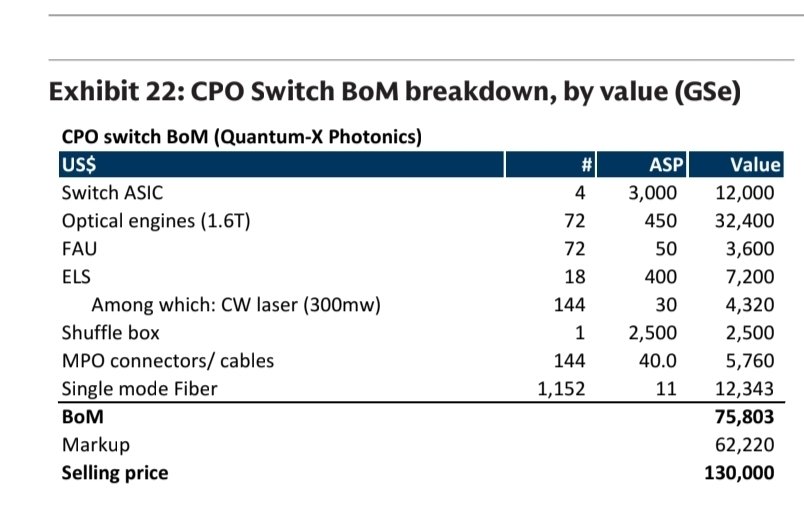
2027 → 800V + early CPO
2028 → PLP + scale-up optical
2029 → glass substrates + HBM5
2030 → optical I/O chiplets + embedded cooling
2031 → 3D DRAM + microfluidic cooling