Founders often focus on the product and the growth, but in the world of M&A, a premium exit starts with your books. For sophisticated buyers, clean financials are virtually mandatory.
If a founder can't produce a clean P&L on demand, it signals to the buyer that the business is being run on "intuition" rather than data.
This can lower your valuation and can be a complete showstopper.
Why your P&L is the ultimate signal of preparation:
1. It proves the "Machine" works: Buyers aren't just buying your code, they are buying a financial asset. A clean P&L shows exactly how $1 of marketing turns into X of profit.
2. It eliminates "Deal Friction": Most deals die during due diligence because of "landmines" found in the numbers. If your data is organized upfront, you maintain deal velocity.
3. It signals professional leadership: When a founder has a clean data set, it tells the buyer the transition will be smooth. If you can't document your financials, a buyer will assume you haven't documented your SOPs either.
The goal of a professional acquisition process is to move from "guessing" to "market discovery". You can't do that if the buyer is stuck trying to decipher a messy spreadsheet.
Audit your own books 6 months before you list. Clean up the personal expenses, categorize your COGS correctly, and ensure your tax returns match your internal dashboards.
PS - If you aren't sure if your P&L is "sale-ready," the advisory team at @acquiredotcom can help you identify gaps before you hit the market. Get a free SaaS valuation to see where you stand: https://t.co/rMzrKNVtkA
To get the full benefit of AI agents you often need to change your underlying workflows, and keep up with a very fast moving AI space. Because of this, there are at least 2 entirely new categories of business models that will emerge around the software companies that build agents.
1. The services firm that implements AI agents in existing companies.
As enterprises look to deploy AI agents across all forms of work, it’s not possible for every company to figure out how to do this on their own.
Most companies don’t have the IT teams to deliver on this, so there will be entirely new system integrators that emerge to help companies redesign their workflows, implement the tech, drive the change management, and keep the AI agents up to date for the organization.
But what’s super interesting is that because AI agents span almost every single line of business, these will not just be the classic system integrators whose primary focus is on IT systems. The system integrators will have to be domain experts at many different types of job functions, from marketing and legal to healthcare and coding.
2. New agency or firm that forms from the ground up to take advantage of the leverage of agents.
Lots of companies will take too long to transform themselves with AI, so there will be an all new crop of companies that start from scratch the capture the gains. These services firms and agencies will use the technology themselves to offer cheaper, faster, or better quality of service to a broader range of clients than was possible before.
This will be the new law firm that uses AI to change the business model of, marketing agencies that can support high quality campaigns for smaller size companies, engineering shops that can take on bigger project work at a lower cost, and so on.
In all there are going to be lots of new forms of businesses that will emerge as a result of AI agents because of how different working with agents can be.
BREAKING: Asset manager Janus Henderson agrees to be acquired by Trian Fund Management and General Catalyst in an all-cash deal valuing the firm at ~$7.4B
new perp DEX testnet is live
flagship app of RISE, the fastest Ethereum L2.
> fully onchain, fully composable with DeFi
> ultrafast, lowest latency
> good UX, passkey wallet, sponsored gas
> autoYield on collateral
https://t.co/PhVAjdo4gK @risex_trade
While I'm just as bad as everyone else at forecasting prices, I don't think there needs to be a post 10/10 zombie trading firm or FTX-like situation out there to explain coin prices falling while other assets rally.
A simpler explanation is that crypto is going through a painful adolescence where the value destruction of bad ideas has become too great to ignore but the value creation of good ideas has yet to materialize.
Here's a list of both, starting with the bad ideas:
Memecoins: Memes were a mass extraction event. If you add up the money taken out by industrial farmers, MEV sandwiches, KOLs waxing poetic about a new asset class while secretly leading pump and dump schemes, and platform fees & gas fees, you end up with a casino that has an insanely high take rate.
Back when the mob ran traditional gambling, it understood that you can't rig the odds too badly. The memecoin industrial complex didn't, and bled its customers dry. Now there are no players left.
DATs: This was a mass exit event. Beyond a few majors, most of them bought "locked" tokens. This was a step-function increase in the supply of that token. Whatever the market thought was the supply had to be adjusted higher.
Once the "lock" sham was exposed, markets then had to discount all remaining "locked" tokens as for sale.
Also, the bankers, lawyers, and insider grifters launching these DATs all had to get paid somehow. As will the lawyers who will soon sue many into oblivion.
Lastly, even the BTC and ETH DATs are now more liable to sell than to buy. There is no free lunch.
High FDV/Low Float: The vast majority of new tokens launched over the past 5 years designed their process to maximize insider and early investor profit, as opposed to long-term success or value accrual.
They succeeded.
Raising too much has always had a high failure rate in crypto. What changed over the past year is that the industry ran out of suckers to convince otherwise.
Bad equity/foundation/DAO models: This one is playing out before our eyes. Whatever the motivation, it has spooked token investors, and rightly so.
Ecosystem Funds: Slush funds with little transparency and zero accountability.
BizDev: It almost never works, but everyone keeps doing it, just so they can get CT brownie points for announcing some clueless TradFi/Web2 firm "chose" that chain.
Corpo Chains: Tokens issued by permissioned (or fully DINO) networks are worthless.
Politics: If you align yourself too closely with one side, it's logical for prices too fall when its fortunes wane.
...
I am quite optimistic that the next few years will see many of these practices cleaned up. To quote a late old friend, the one thing everyone responds to is pain, and there's now plenty of it across the board.
As that happens, adoption will also grow, and lead to value creation. Some areas I'm excited about:
Non-sovereign money: I never loved "digital gold" analogy for Bitcoin because it undersells what makes it unique and special. As the world continues to polarize and fracture, demand for an apolitical money that rides its own censorship-resistant platform will grow.
Neutral settlement layer: Many of the worlds most valuable corporations operate centralized networks. All of them are enshettifying themselves to death. As they do, users, assets, and entrepreneurs will eventually find their way to the one platform that won't screw them.
Markets will then orient themselves around that platforms native coin, the greatest HQLA asset ever invented.
Stablecoins/RWAs: Self-explanatory
DeFi: It's just better-FI, as measured by the ideals that have defined the evolution of financial services for centuries: fairness, transparency, guaranteed outcomes, minimized settlement and counterparty risk.
Better FI will eventually attract most of the asset and investors.
NFTs/Digital Art & Collectibles: The idea was always good, but the execution terrible. The generation that grew up online will make it work for them.
Privacy: The world is slowly realizing how badly it has become compromised. The industry built on cryptography is the most likely place it will find solutions.
Scarcity: AI creates over-abundance, crypto will reestablish a balance.
...
The value creation of these benefits will take years to play out, and there's no guarantees any one coin will benefit. But I'm confident those who stay the course and stay humble will benefit.
We’re moving to a world where there will be 1,000x more agents than people working with software.
In that world the value of systems of record goes up not down. The ability to control what AI agents have access to, govern their workflows, integrate their work into a broader process, ensure consistency and reliability, and so on, will be even more important than it was when we just had people involved in these workflows.
And as long as agents are extensions of existing users in the work they’re doing (a legal contract agent working on behalf of a user), agents will run alongside SaaS in a heavily complementary way.
As a result there are 3 outcomes that will happen:
1. Existing systems of record will be the natural launch off point for agents that deal with many existing categories of workflows, assuming they can move and adapt fast enough. This will be the case the more existing data and workflows are required for an agent to be effective; with the X factor being how quickly the incumbent can pivot and evolve their platform.
2. In some categories the system of record won’t move fast enough, or needed solution for agents is so different from the existing system, that AI-native platforms will better serve customers. This will be more pronounced in areas where there’s no data or workflow moat, or where agents aren’t natural extensions of the existing user seats. We’re seeing this in customer service, and a handful of other categories.
3. The biggest play for the new entrants, however, will be all the new categories for AI agents that don’t have a traditional software complement today. Because AI agents will bring automation to all areas of knowledge work, there are many categories of work that don’t have a natural software player. This will mostly be services categories traditionally or new forms of software going after roles that never had tools.
Overall, AI agents + software are going to work together and this mostly just represents a major TAM expansion for all software.
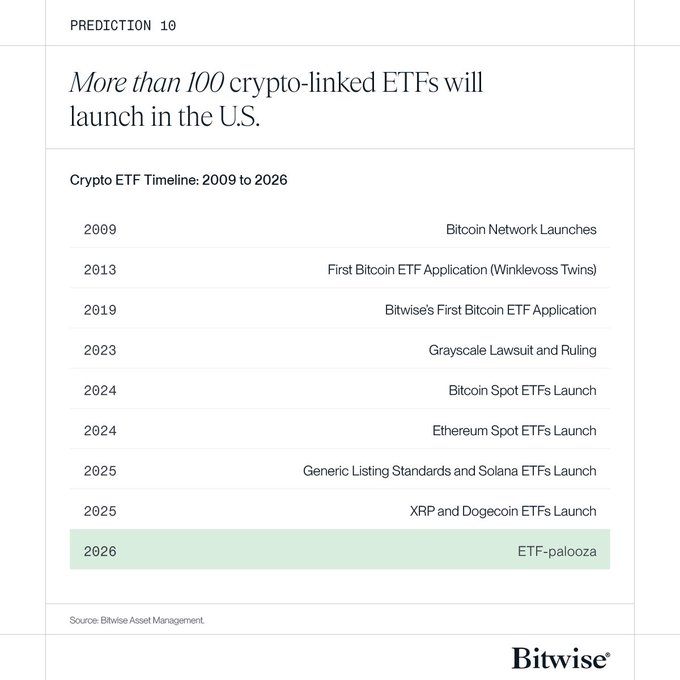
Crypto space moving at warp speed…
Past 2 weeks:
-Vanguard opens brokerage access to spot crypto ETFs
-First spot link ETF launches
-Schwab confirms plans to offer direct spot crypto trading next yr
-First sui ETF launches
-BofA expands advisor access to spot crypto ETFs
Robinhood didn’t want to be “alone on a private island”
they think they’ll gain more users as an Ethereum L2 than an L1.
if even Robinhood thinks that, nobody should build an L1.
“We want to recreate the entire financial system onchain. We need everyone to be able to come to our island.”
they chose Ethereum as the place to recreate the financial system because:
→ the most decentralized & secure
→ access to the deepest liquidity & users
“If we really want the stock market onchain, we need to have this liquidity. It’s not going to be possible on a closed chain with like 20 different hoops before you can bridge.”
Robinhood Chain is in private testnet, an Ethereum L2 built on the Arbitrum stack.
they’ve already tokenized 1,000+ stocks.
Even without the ability to do new things like output polished files, GPT-5.2 feels like the biggest upgrade we've had in a long time. Curious to hear what you think!