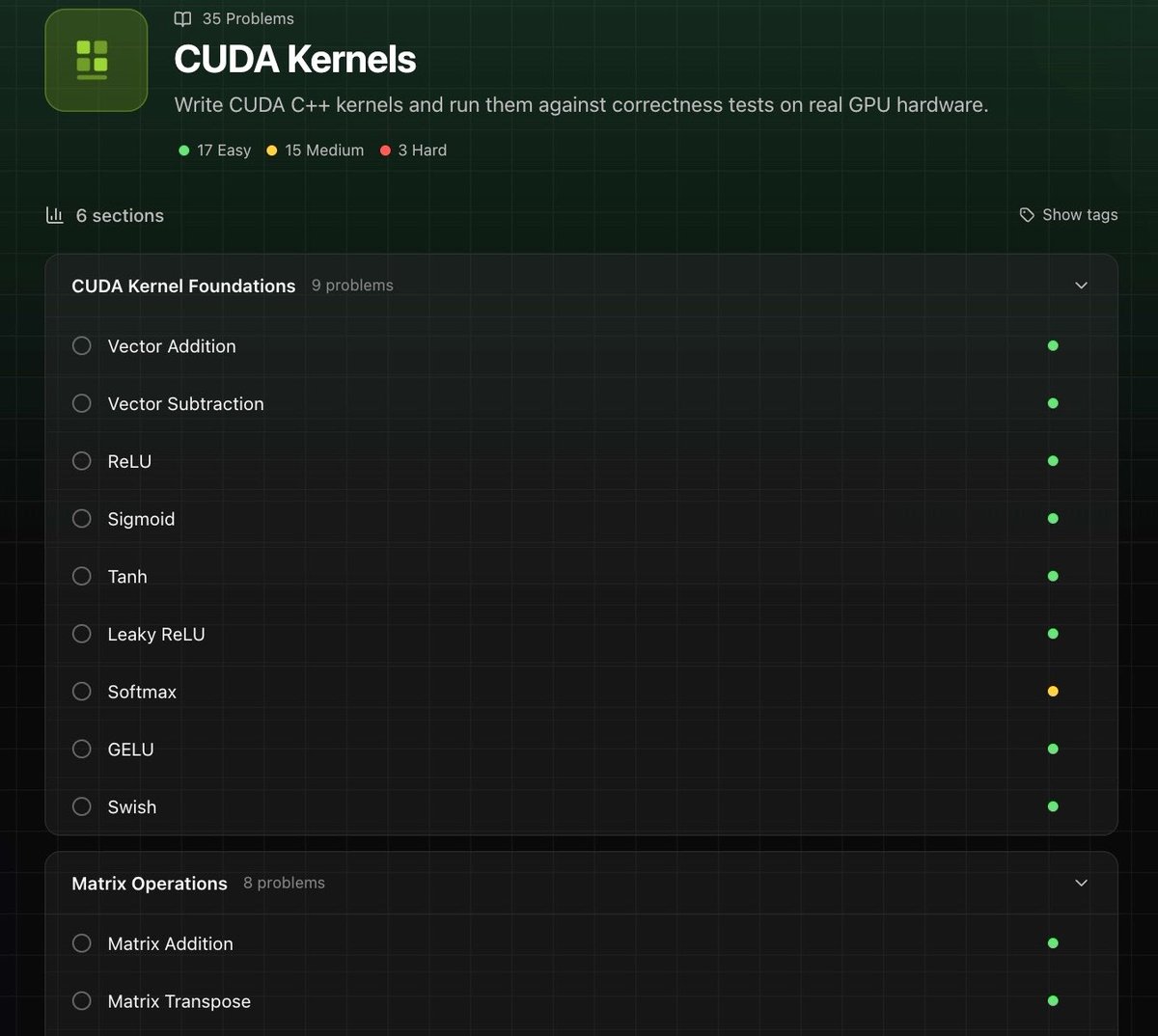
We just released CUDA puzzles on @TensorTonic. Write CUDA C++ kernels and run them against real tests on a free GPU hardware. No local setup, no GPU rental needed. Open to everyone.
Recently, I have been diving deeper into torch compile internals especially for inference related graph optimizations with custom kernels and below are my findings/learnings:
Note that this is still a very high-level overview with lots of moving parts hidden behind the scenes. From what I understand the entire process of torch compile can be broken down into 5 stages.
1) Torch Dynamo: responsible for tracing the python bytecode and returning a fx GraphModule (gm). We can call it "functional graph module".
2) Pre-grad: this stage runs fx passes (both built-in and custom) on the gm before passing it to AOT autograd stage.
3) AOT autograd: this stage decomposes the unstable IR from dynamo+pre-grad stage into ATEN operations. ATEN is what pytorch uses behind the scenes. Ops like aten.addmm, aten.mul, and so on. It also builds and runs fx passes on the "joint" forward+backward graph if required (not necessary for inference only).
4) Post grad: this stage applies fx passes on the partitioned forward and backward graphs that come from AOT autograd stage.
5) Inductor codegen: this stage is still kinda a black box for me but I think it fuses ops in the graph, does autotuning, code generation and so on.
Within all these stages, we can ask the torch compile backend/inductor to apply our own fx passes using the "pre_grad_custom_pass", "joint_custom_pre_pass", "joint_custom_post_pass", "post_grad_custom_pre_pass", "post_grad_custom_post_pass" present in inductor's config. Here, we can edit the graph nodes (add, remove, update) to have custom fusions that inductor may not do for us. Try thinking of an example as an exercise :)
From a practical standpoint, if we wanted to have our own fx passes related to inference, the post grad pre passes (after AOT autograd, and before Inductor decomposition) is the best place to do it. At this point, we still have higher-level ATEN ops intact in the graph as nodes. For example, aten.addmm is not decomposed into aten .mm + aten.add here. To apply custom fx passes, we have two options:
> Pattern replacement: Inductor provides a nice helper that lets us define a pattern function and a replacement function using aten ops or custom torch ops. One caveat is that the pattern must be robust, even a small change and inductor won't replace it.
> Node surgery: We can search and edit the nodes in the graph directly. This is much more robust but it can get pretty hard for complex patterns.
This is not documented much but by leveraging what torch compile/inductor provides us, one can as much graph optimization as they want. Another thing that inductor provides us is, registering custom lowering for built-in aten ops but that is a whole another topic to discuss, maybe next time.
I wrote a matmul kernel on B200 in pure CUDA/PTX that beats cuBLAS by 6% at M=N=K=8192.
Inspired by @gaunernst's blog on Blackwell instructions with benchmarking done on @modal.
Blog: https://t.co/nifzaMdPJS
Repo: https://t.co/EKjrnCrp0z
Excited to share our latest blog post on how we're solving real-world LLM inference challenges at production scale, a collaboration between @RedHat_AI and Tesla engineering teams.
We hit the usual pain points: massive model weights choking storage, GPU cycles wasted on naive load balancing, infrastructure that fights you when nodes go down.
Our answer: KServe + @_llm_d_ + @vllm_project with prefix-cache aware routing.
The results: 3x more output tokens/sec and 2x faster time to first token.
Thanks everyone who've contributed to this successful adoption: Scott Cabrinha, Sai Krishna, Sergey Bekkerman, Nati Fridman, Killian Golds, Andres Llausas, Bartosz Majsak, Greg Pereira, Pierangelo Di Pilato, Ran Pollak, Vivek Karunai Kiri Ragavan, Robert Shaw
Damn this guy really wrote out this insane deep dive into Torch vs Tensorflow.
I love seeing such high effort articles on the TL. You get so much clarity about your thoughts writing long breakdowns like these. Kudos!