Today, we’re excited to release our technical report “Deep Trust: Verifiable Identity and Reputation for AI Agents”
Just as Bitcoin solved the crisis of trust in finance, Deep Trust solves the crisis of trust in AI.
This release also kicks off Phase 1 of our vision: The Human and AI Internet
🧵👇
We are thrilled to announce that we have partnered with @PrivadoID to empower developers with on-chain, verifiable credentials to deploy AI Agents with assured safety, fairness, and transparency across the @ASI_Alliance ecosystem. Learn more: https://t.co/XgfLXo2mo8
@rickmanelius@PrivadoID@ContentAuth Thank you @rickmanelius. The "adoption before adoption" is really a catch22 situation that IMO must be broken by regulators, and it seems we are on track https://t.co/82cro9QUAv
@NanakNihal This is to real privacy-preserving projects the same as meme-coins are to crypto. It erodes the trust of users, businesses and institutions in the viability of decentralized alternatives to identity.
@fkpxls I think that there will be a need for this reputation, but agents are not a reliable source to measure themselves. Projects like https://t.co/kkTachNfzv are creating the frameworks, but in the end, there are humans and reputable organizations doing the auditing
@austingriffith This is a native feature of @PrivadoID. You can generate proofs to satisfy any query and send it to our verifier smart contract, right now operating on 5 chains (and expanding)
Tutorial here: https://t.co/XZNiR7n2As
If you need help: https://t.co/7msyzmKrDb
@frzshk@ai@adityaag Agents authenticate with something they control - self-resolvable, key based DIDs are a good solution (using something like MPC+TEE for key management)
Reputation can be expressed as on-chain attestations (permisionless for agents, privacy-preserving for humans).
@gakonst All the responses talk about MPC and TEE but I wander why does intent need to be translated on servers? Why can't intent be translated locally and send atomic operations on-chain?
Are there ethical implications when using biometric data?
Yes, people might think they’re just providing a harmless piece of data
But they don’t realize they’re giving away something that could be used to identify them for the rest of their lives…
The @EthCC conference marked an inflection point in our journey…
The market is signaling that it's the moment of trusted identity, with growing global demand for KYC, proof of humanity, zk tech & more
Thank you to everyone who joined our side event! Here's our aftermovie 😎👇
Securing the AI Future: The Role of Decentralized Identities
Super excited to co-author this article with @Reggia91, a giga brain in identity and a tech evangelist.
Artificial Intelligence (AI) is transforming industries by automating tasks, offering insights, and boosting productivity. However, the rise of AI brings concerns about the content authenticity, #deepfake and security of digital information. Decentralized Identities (DIDs) offer a solution by providing a reliable and user-centric identity system for both humans and machines.
Innovation around open source AI systems like the community-built open AGI efforts by @sentient_agi or Initial Model Offering (IMO) by @OraProtocol, can also be made more effective with digital identities to track contributions and provide incentive.
Sharing summary of the five key identity use cases in the AI system (full article here: https://t.co/0YeXg0oXXL)
1. Id for personal AI agents
DIDs can create a decentralized verification system, enhancing trust in data generated by AI models. Personal intelligence (@pi) agents can authenticate themselves, operate autonomously, and maintain accountability. In business contexts, like financial services, DIDs can manage multiple AI agents, ensuring traceability and accountability.
2. Agent reputation and governance
AI agents can streamline governance operations, e.g. in DAOs, with DIDs empowering token holders and ensuring transparent decision-making. Market validation is done with @daobase_ai success. Verification systems can prevent Sybil attacks and distribute governance incentives to trustworthy stakeholders.
3. Content Authentication to prevent deepfake
Integrating DIDs provides a reliable verification mechanism for AI-generated content, maintaining authenticity and preventing fraud. Systems like Context Based Unique Identifiers explained by @PolygonSSI at #ethcc2024 reduce risks by providing different aliases for service providers, crucial for media platforms to filter out manipulated content.
Content creators can link their work to verifiable identities and secure the chain of trust and fight deep fakes, well explained in Privado blog. Verified and user reputation can also help opitimise Reinforcement learning from human feedback (#RLHF) loops and filter out low-quality or toxic feedback in the AI networks.
4. Marketplace for New Content Creation by verified users
@EpochAIResearch says AI systems are running out of high-quality data for training by 2026, emphasised by @mustafasuleyman. New user-generated content (UGC), access to proprietary content enabled by players like @Verida_io and initiative like data dao e.g. @withvana will become hot licensing and acquisition targets for further development of AI systems.
Verifying user capabilities and the authenticity of generated content can ensure high-quality data for AI models.
5. Seamless experience with AI wearable devices
Consumer AI devices such as @Humane , https://t.co/eudCI9ivlP will require portable user identities and private data. Contract relayers associated with DIDs can authenticate and execute services across these devices.
Conclusion
As digital interactions grow, the need for effective digital identities becomes critical. Integrating DIDs into AI systems is essential for creating a secure, transparent, and trustworthy digital ecosystem. Blockchain should also be leverage as trust infrastructure
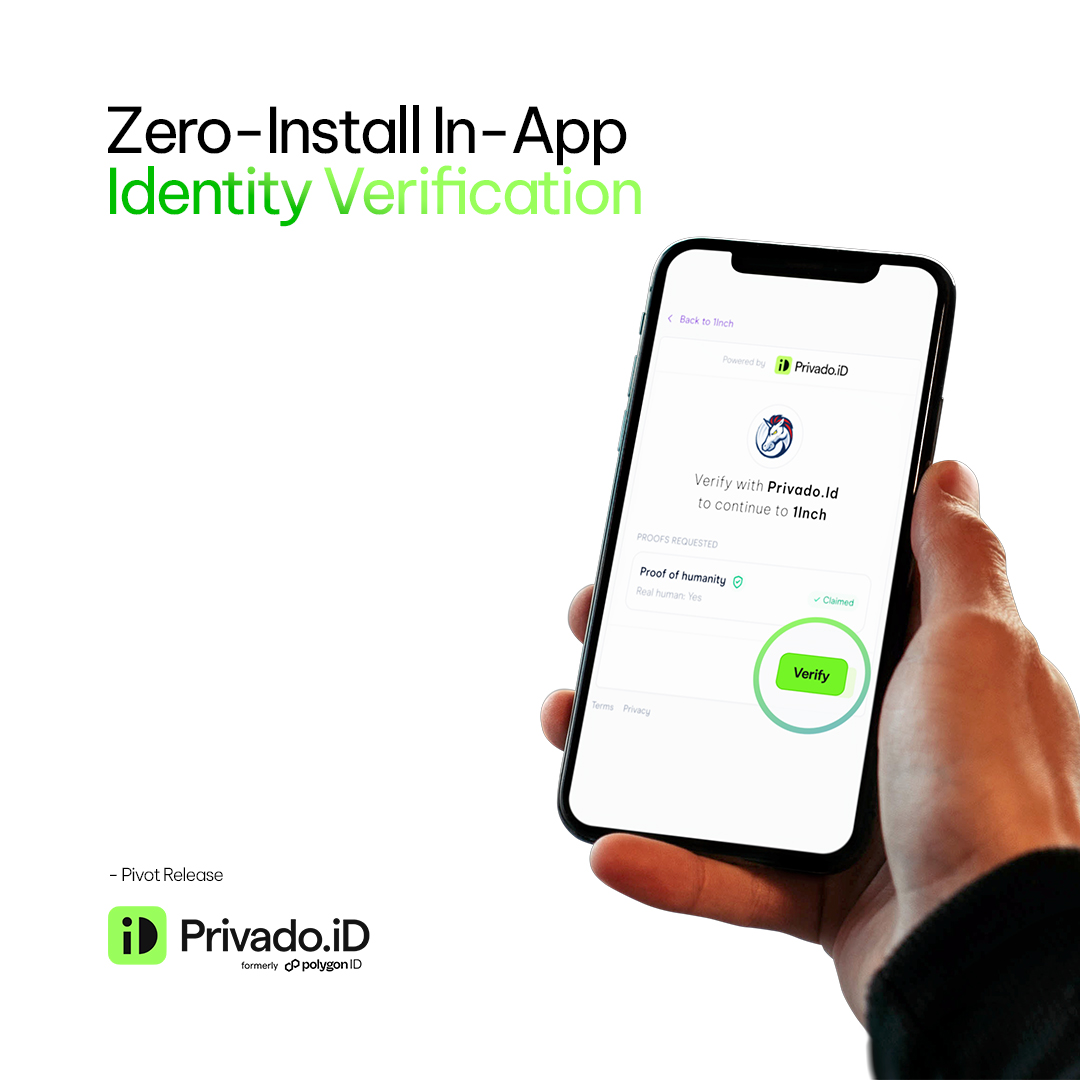
📣 Privado ID Pivot Release: Zero-Install In-App Identity Verification 🆔
Making user experience as simple as the best identity apps!
With our new Identity Web Wallet, users are just three clicks away from authentication, issuing credentials, and verifying their identity —all in one integrated flow!
Privado ID’s new product launch is also packed with extra features:
• Context based unique identifier
• New zkQuery Operators
• Support of Custom Networks on Mobile
This release isn't just an update; we are showing a full commitment for Privado ID to become the most adopted digital identity ecosystem
Read more👇🧵
INTEGRATION ANNOUNCEMENT! 🥳
@PrivadoID is now the first biometric Proof of Humanity (PoH) integrated into the @LineaBuild ecosystem!
Big thanks to @VeraxRegistry and @synaps_id for the joint efforts in distinguishing unique humans from bots and preventing Sybil attacks 💚