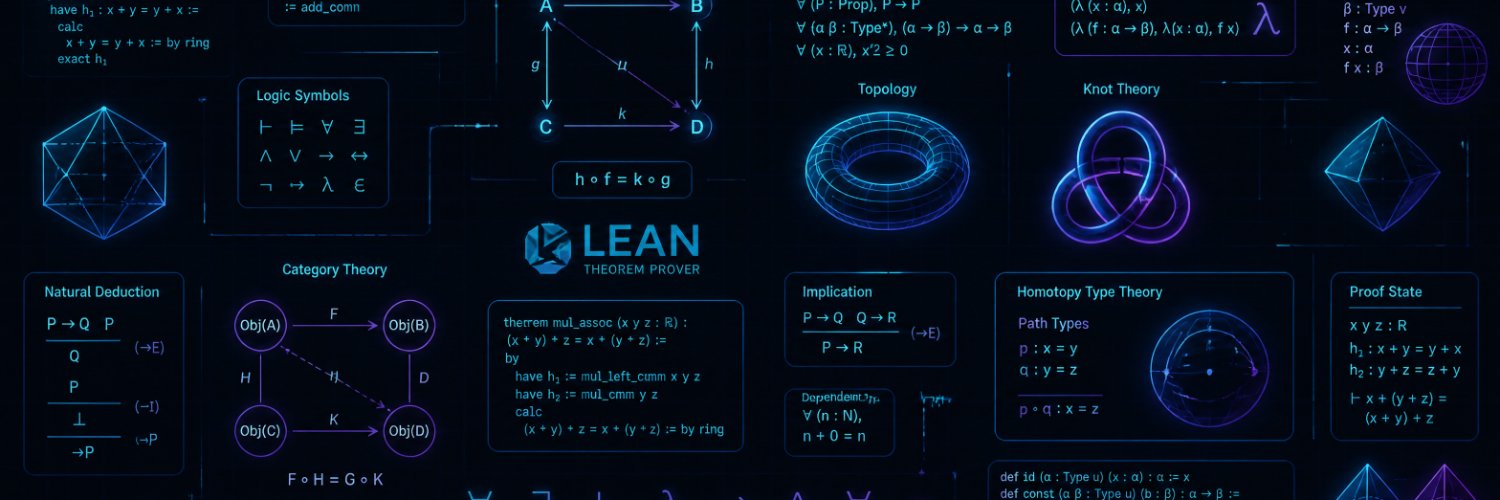
Update on minifying the claimed Lean proof of the Riemann Hypothesis.
Where we are: 8.6% smaller, 17.37M lines down to 15.88M. Not final until it builds clean; the repair loop is on round 25, with errors down from 2,500 to 34.
What the 8.6% is:
• ~90,700 declarations nothing in the proof uses: 59,712 theorems, 29,806 definitions, plus structures and abbreviations
• 2,873 files that held nothing needed
• 522,000 redundant import lines
• 43,070 repeated theorems now pointing to one identical copy
All dead code. No math was simplified. The proof content itself is ~6.5% smaller.
Even minified, it's ~7x the size of Mathlib (15.9M lines vs 2.3M).
What that means for kernels: almost nothing changes. A kernel checks what the five theorems actually use, 1.47M declarations, and dead code was never in that set. After minifying, the kernel still checks 99.7% of the same work. Tenet does it in 1 hour; Lean's own kernel, single-threaded, takes many hours.
The proof isn't big because of waste. It's big because of what it uses. Shrinking it for real means finding a shorter route through the math, and the biggest target is one theta-correspondence step that owns 38% of the proof by itself.
https://t.co/ocNaVHe0eL
Different targets, and both useful. Measured from the kernel export, one step (nonempty_hyps_definite_side_of_closed_bound) owns 38% of the whole proof by itself. That's what I'm chasing: a shorter route through that step moves the total far more than golfing the edges.
Map: https://t.co/cW4xOmXEt2
Yes. Different measures though: their pillars cover ~1.7% of the proof's characters, and they score by tokens. Worth knowing "26.6%" of what.
I'm measuring the whole thing from Lean's own export. Dead code alone is ~8.6% of lines (still building to confirm), and one step owns 38% of the proof by itself. That's where a real cut has to come from. I think it's function proceduralized to the finish line.
https://t.co/ocNaVHe0eL
@osgood001@osgood001 Nice effort. In case it helps you aim: measured from the kernel export of the full proof, one step (nonempty_hyps_definite_side_of_closed_bound) owns 38% of the whole proof by itself, and five pieces own ~60%. Map and tools, all open:
https://t.co/CZdoAzAvU8
I'd like a Microsoft mousepad ... or a job ... for writing this Lean kernel in C#, but the real kudos goes to the .NET team: it checked the entire claimed Lean proof of the Riemann Hypothesis in 1 hour.
• 1,468,414 declarations, 0 failures
• ~73 cores busy on one AWS machine
• 61.6 GB streamed and checked at once, 236 GB heap
First independent kernel to finish the whole proof in our runs. Thank you, @dotnet.
https://t.co/7MM8FMul3G
Roughly: the argument specific to this proof is about 7%. The rest supplies its inputs, mostly published theory never before in Lean (162 published results are stated and proved inside it). So the bulk is known math formalized for the first time. Caveat: nobody has checked those statements against the papers yet.
@MrSaid60582 I just posted a path to reduce it by a third. The theta lift alone owns 38% of the proof, and it looks procedural: one construction repeated over and over.
Find the single function behind it and most of that 38% disappears.
Because "the proof doesn't use it" isn't "the source code doesn't need it." Tactics like simp [foo, bar] name lemmas they may never use, instances are found by search and need their dependencies, and @[simp] lemmas steer automation elsewhere. Cut those and the build breaks even though the final proof never touched them.
Posted elsewhere and why I didn't post a minified fork:
One more thing nobody is mentioning: it has no license.
The proof was published without one, and the community mirror says so in its README: it "belongs to its author" and is mirrored "so that it can be checked."
That means anyone can read and verify it, but nobody has permission to modify, shorten or build on those 17 million lines. For a result this important, that's worth fixing.
If I were a mathematician, I'd be 100% focused on the theta lift in the Lean proof of RH.That one step owns 38% of the proof. I don't think it's 38% of the mathematics. It looks procedural: the same construction worked out again and again. There is likely a single function hiding in there, and whoever finds it shrinks the proof by a third.
I responded:
@LH this is a friendly challenge, offered because I'd like your result to be true.
I ran known shortcuts (Gaussian elimination, matching, simulating every input) against Kissat and CaDiCaL on 47 problems. Where a shortcut fits, it wins by up to 10,000x. Where none exists, it gains nothing.
So a table of thousand-fold wins can't by itself tell a new technique from an old one. Here is what could: a big speedup, with checked proofs, on problems nobody picked and that have no known shortcut.
I put the code, the results and three test tiers in a repo. Tier 3 is 25 random 3-SAT instances with fixed seeds. Run Frobenius on them, post the proofs, and I'll publish the outcome whichever way it goes.
https://t.co/ImiUdlrQsN
@cong_ml@GoogleDeepMind https://t.co/0PcmM8Rr3y
Some work there. I've gotten about 10% out safely. There's much work to be done including determining if there's a shorter path.
I had dinner with TLJ and a group in San Antonio right after JFK came out.
At the time I considered myself at the edge of research on the subject. The dinner itself was unrelated to film, but the conversation he had echoed much of what we still ask today.
I believe this free film and book get us closer to the answer than we've been since the film.
https://t.co/gtkETIGSlO
@RogerJStoneJr https://t.co/TF5vwohgyq
Roger, I respect your view on this whole thing ... but where are the Five Eyes docs in the JFK Files? Other than them shutting down inquiries in Australia and the UK?