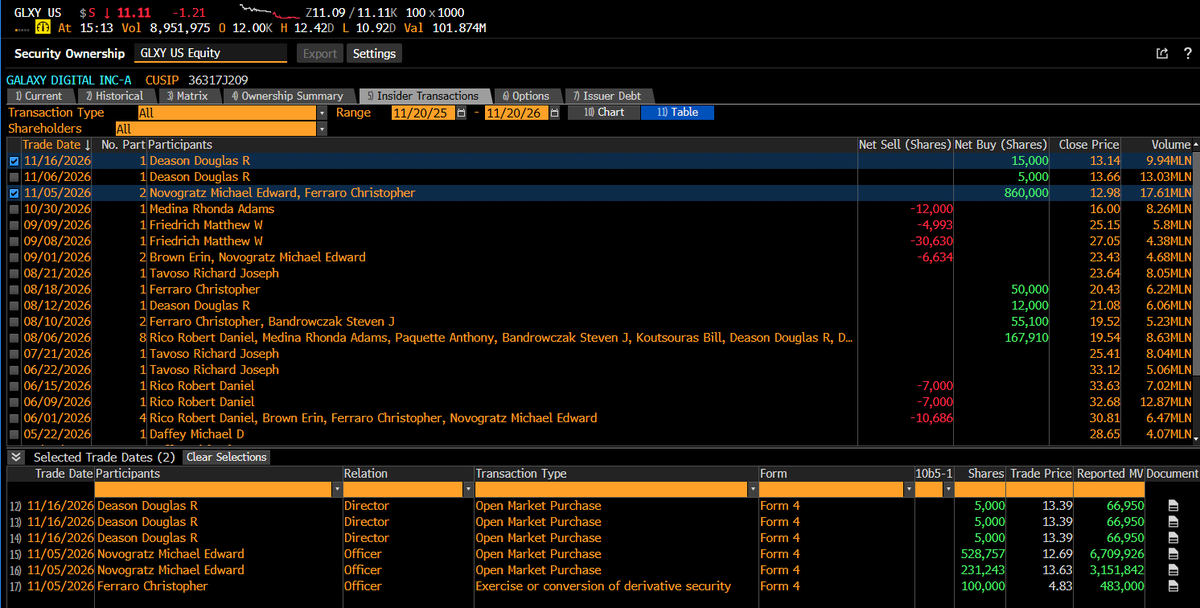
@CulperResearch@DougKass Lmao this is an immense amount of wasted energy on research for it to just be entirely invalidated by the guy getting on the President’s airplane today
Calley & @SecKennedy are American Heroes. Patriots of the highest order.
What lobbyists for Monsanto, Bayer, PepsiCo, Conagra, and many other crony corporations have done to this country is the definition of sinister evil.
For two years, I worked to advance voter promises of President Trump and RFK.
But when this level of subversion to voter intent is taking place by Ballard lobbyists, I believe the most effective thing you can do is tell the truth.
The benefits of abundant intelligence will accrue far outside of San Fransisco.
Spent the last year writing about capital, sovereignty, and the coming reordering of economic power.
THE COMMANDING HEIGHTS
https://t.co/d048KdAkbv
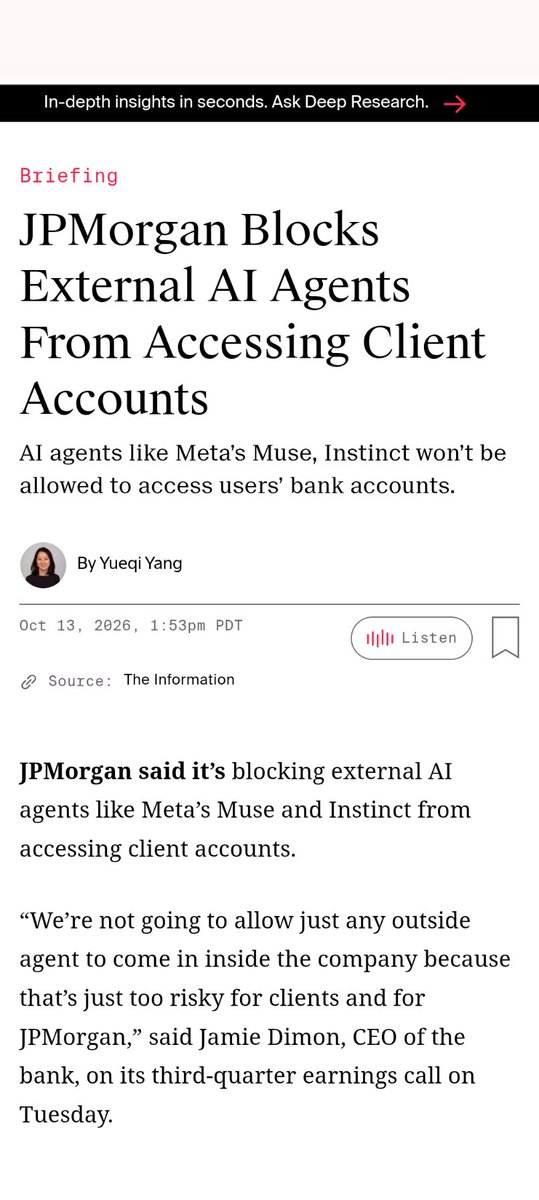
This is how banks are planning to stop those "agentic bank runs." Watch closely: their business model depends on seeding this narrative that AI agents are dangerous.
Remember, an "agentic bank run" (coined by Apollo) means agents helping customers move their own money en masse to higher-yielding products.
Once agents are ubiquitous, there are only a few ways for banks to hold onto cheap retail deposits.
Option A: Raise APYs (lol no)
Option B: Reduce leverage via fewer loans (no fun)
Option C: Ban AI agents, claiming they are a security risk (ding ding ding)
Cloud agents like Muse and Dot are trivial to stop, since they come from Meta / OAI IP ranges. If JPM sends them a cease and desist, they will comply.
Why would JPM bother? Because their business model depends on it; a huge portion of their ROE comes from cheap retail deposits. This is not theoretical. Just like Amazon banned Muse from shopping there to protect their ad revenue, JPM and Schwab have already banned AI agents to protect sticky deposits.
Are agents perfectly reliable today? Of course not. But look at the fix they chose. Not "here's a safe API for agents," it's "no agents ever." That tells you they're not protecting customers, they're protecting themselves.
No company ever wins a technological revolution this way. It's the last gasp of a dying business model. It's like the retailers who refused to put their inventory online and demanded users walk into the storefront. Over time they will lose market share to those platforms that embrace what's coming. Their whole deposit franchise depends on users unthinkingly clicking through walls of T&Cs and accepting 0.2% when the risk free rate is closer to 4%. Agents read the fine print and do their research, even when humans don't.
For users, the answer is simple: local AI agent frameworks like Hermes, that will actually act on your behalf and that the banks can't block. As the article says, if the agent is running on your own computer, they can't actually tell it's not you.
Delaying compute futures has a real cost for US innovation. Some of the largest data center lenders have hit their risk limits. Give them a liquid market to hedge compute price risk and they can free up lending capacity. It's the lack of a hedging instrument that has caused credit spreads to blow out.
We support the @CFTC’s commitment to getting this right. The good news is we already have standards for building these markets properly: independent benchmarks, transparent methodologies and regulatory access to the underlying data. Apply them to compute and let well-designed futures move forward.
Our comment letter: https://t.co/v9gwqX7RIy
Don is a legend & spot on. This was a must listen podcast.
IMO Compute futures (aggregate compute cost, specific popular GPU pricing, and LLM token pricing to name a few likely contracts) are prob the largest emerging financial market opportunity on earth. Some thoughts…
Really enjoyed being back on Odd Lots with @TheStalwart and @tracyalloway. Would indeed have been fun to debate perps with Terry Duffy. We clearly have different views…
Following my prediction on last year's recording that in 10 years compute will be bigger than oil, this year I revealed the name we use at DRW for the profit margin between tokens and GPUs: the crunch spread.
Oil into fuel: crack spread. Soybeans into meal and oil: crush spread. Nat gas into power: spark spread. As with those markets, futures on both the GPU hours and tokens eventually will let you trade—and hedge—the crunch.
Listen to Odd Lots on Spotify: https://t.co/3Ajt0UsAtE
Listen to Odd Lots on YouTube: https://t.co/G3R6UQM6HD
Listen to Odd Lots on Apple Podcasts: https://t.co/Z97ied8rzq
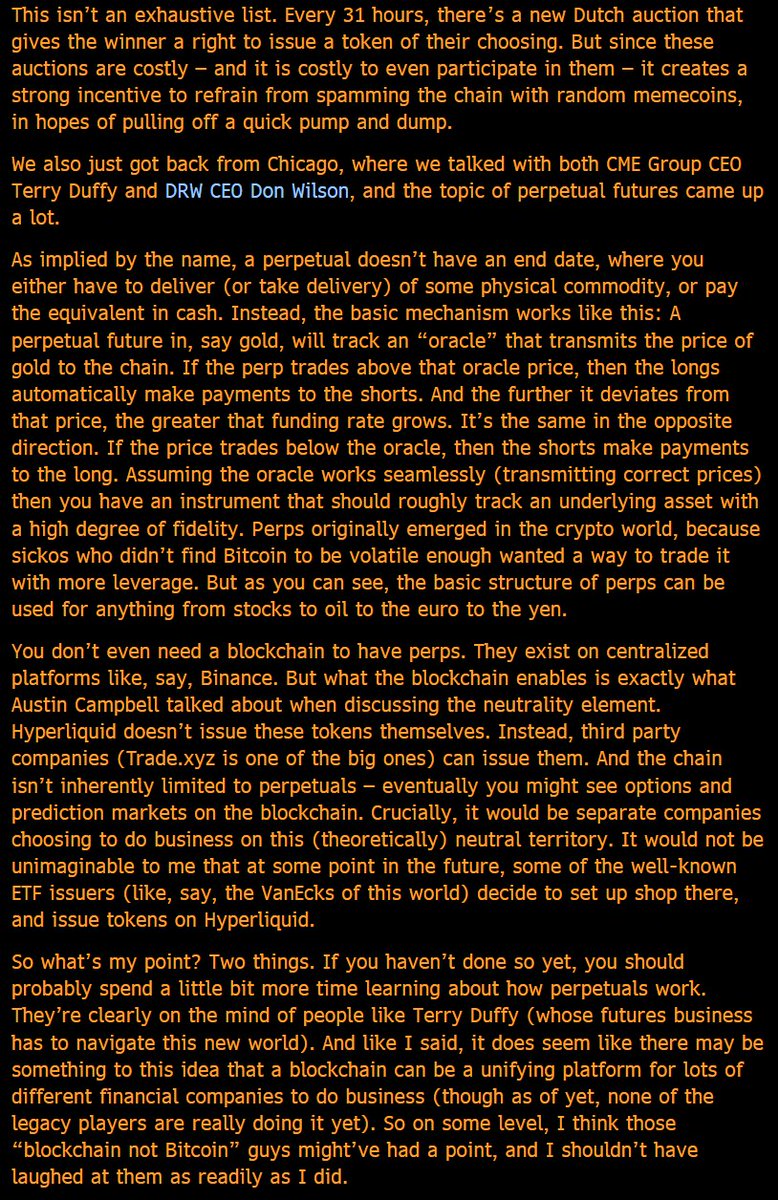
MAYBE I WAS WRONG ABOUT BLOCKCHAIN TECHNOLOGY
I wrote about how I always used to make fun of the guys who said things like "Bitcoin is speculative, but the underlying blockchain technology is interesting." And now I think maybe they kinda had a point.
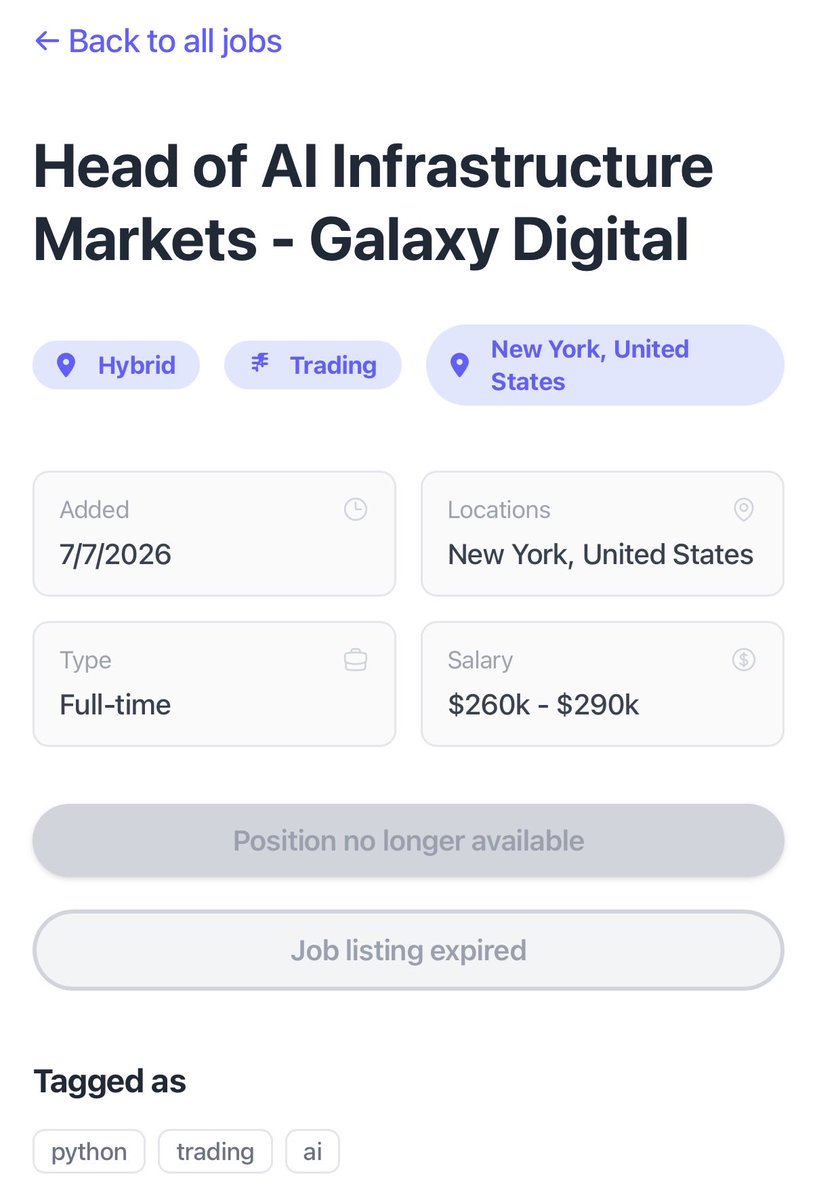
@0xMVU Great question & if there were a cleaner answer I’d prob be buying it & not tweeting. Prob $CME & $PURR but derivatively $NVDA & perhaps bigly the neos as they benefit most from more efficient financing structures this would enable. Very interesting job post here…