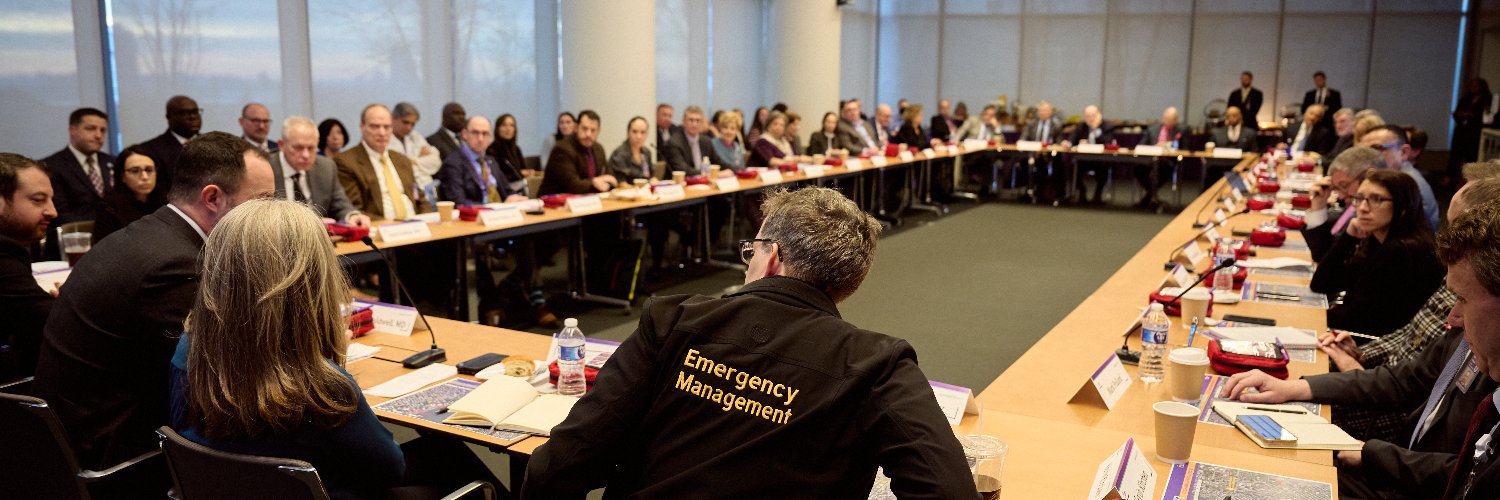
Amateurs talk about emergencies; professionals talk about command, control, and communications (CCC). For crisis managers, the problem is time: FBI research shows that most active shooter incidents are over in 4 minutes, but police take 6-20 to arrive. In that four-minute world, Run, Hide, Fight is not a poster but a continuum of split-second decisions every employee has to make, and that only works with planning, training, and practice
https://t.co/jsq5fbpd4E
We spent decades making our technology more reliable while dismantling our ability to function without it.
The outage outbreak has exposed the consequences.
We didn't prove we could operate without these systems. We proved we could wait for someone else to fix them.
https://t.co/ZkvUzX8gW6
Why would he post this now? How is this helpful? It provides no guidance, nor does he take responsibility. What a strange and sad world these people live in. Anyway, I’ll say it again, people are going to jail because there will be some AI event that causes casualties.
Over the last week, the American people have experienced multiple system failures, including a Microsoft outage, a nationwide ground stop by the Federal Aviation Administration, and the disruption of banking and Apple services.
"All the available public evidence suggests these events are unconnected, with different technical sources and causes," writes expert Adam Segal.
"Silicon Valley's old adage of 'move fast and break things' could be replaced with 'move fast and fix things, but still break them inadvertently,'" he argues.
"The last week has been a clear reminder of how dependent U.S. society is on complex systems that are vulnerable to disruptions caused by technical mistakes and malicious actors. And it is only going to get worse before it gets better, as new AI systems are integrated with legacy software."
Read the analysis: https://t.co/JW3J4KBof9
AI is changing everything, and after last week, that includes the usual relationship between earnings and stock prices. Hopefully, this is just another hallucination—and it ends soon.
Gen Xers like me grew up in the shadow of potential nuclear annihilation, but something about 2026 still feels different, and it’s taken some time for me to figure out why. As a colleague put it to me recently, imagine that it’s the start of the Cold War, but the nuclear arsenal isn’t in the hands of our democratically elected government, but rather totally controlled by the chief executives of Lockheed, Boeing, General Dynamics and McDonnell Douglas.
And then, to make matters worse, imagine that some of those executives — while undeniably brilliant — were also erratic, exhibited signs of megalomania, demonstrated no visible attachment to conventional morality and were often just plain weird. https://t.co/8EwLUCDCFg
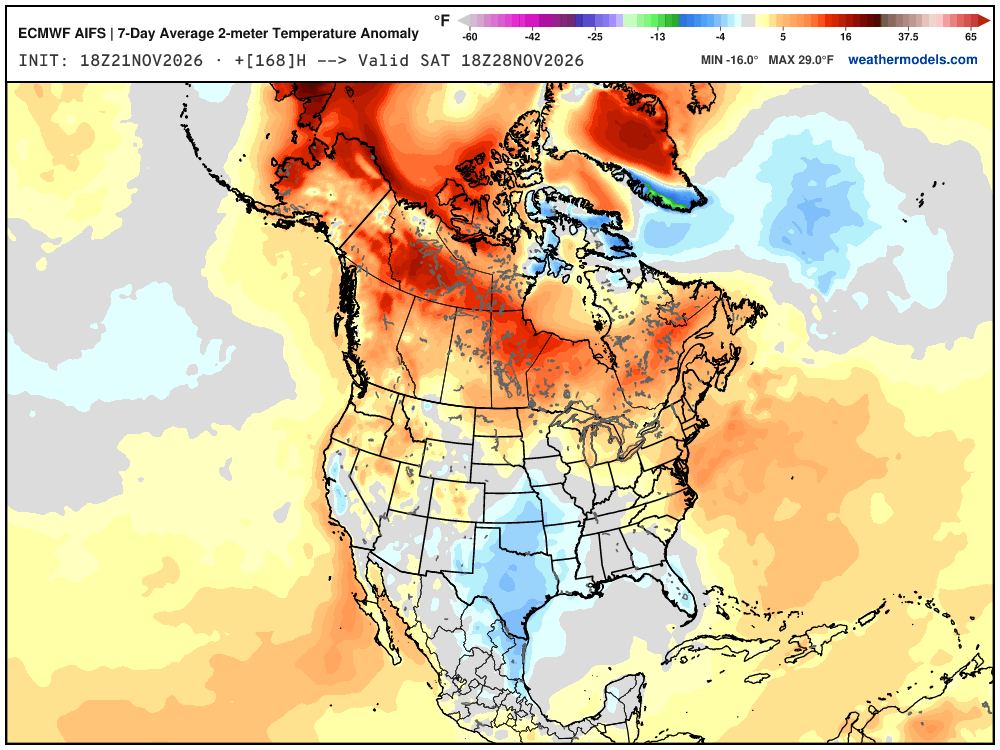
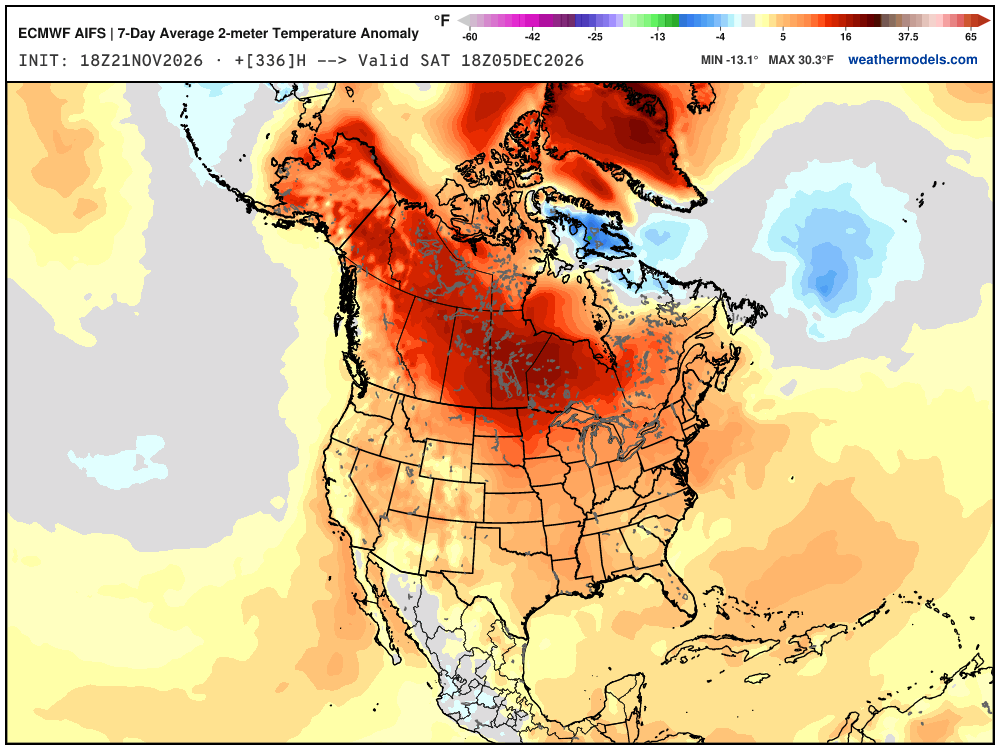
Get used to seeing my red weather maps this winter.
Heading into December it gets even more "blow torchie 🔥" as Super El Niño takes the wheel ... dumps Pacific warmth/moisture over Canada and shuts down cold pool formation.
Normal --> way, way above normal tempreatures
Geoffrey Hinton: "We haven't had chernobyl yet, we will get Ai Chernobyl. it's only a matter of time
"Sometime in the next six months or a year or so"
"We'll get something much worse than hugging face and that will bring people to their senses."
"I think of hugging face as like Three Mile Island for nuclear power stations."
"We haven't had Chernobyl yet."
"We will get Chernobyl and maybe people come to their senses then."
We need to reframe our mindset.
Treat every major system collapse as if it were a deliberate attack.
Not because it necessarily is. But because that mindset might finally give us the urgency to confront the threat—and prepare for its consequences.
https://t.co/ZX2COFPQaQ
"We are moving into an era where AI is increasingly useful, both for hacking and for a variety of other tools,” said Peter Slattery, a research scientist at MIT, “It’s quite likely, that things will get worse. We will have more attacks from AI on infrastructure, and there will be some harmful events over the next year or two.”
https://t.co/lTaY3lr5r8
Doomsday mistakes to avoid
Exhibit A: Never dismiss the public's fear
Pesident Trump has said he is not concerned, saying “it’s life” when asked if he was concerned about the outages.
“When you’re big and powerful and have all the money, things like that happen,” Trump said.
https://t.co/hgXFQH8I6E
On the front lines of the Iran war, pilots and aircrew are known to pack the snacks in their go-bags as they speed off on seven-hour missions to strike Iranian targets
One fighter pilot said he was far more anxious about forgetting an Uncrustable than he was about getting shot down by Iran
https://t.co/ObNJYvHHQP
Amazon’s $11 billion data center campus in New Carlisle, St. Joseph County, Indiana—known as Project Rainier—is the largest capital investment in the state's history and is built primarily to train and run artificial intelligence models
👇
Amazon’s $11 billion data center campus in New Carlisle, St. Joseph County, Indiana—known as Project Rainier—is the largest capital investment in the state's history and is built primarily to train and run artificial intelligence models.
Spanning roughly 1,200 acres with plans for about 30 buildings, the facility relies on hundreds of thousands of proprietary AWS Trainium2 chips to support major AI workloads, notably for Anthropic.
At full capacity, the campus is projected to draw around 2.2 gigawatts of electricity, roughly equivalent to the power needed for over 1 million homes, and use approximately 300 million gallons of water per year, primarily for cooling during warmer months.
The project is also expected to create at least 1,000 permanent high-tech jobs alongside significant construction employment and local infrastructure funding.