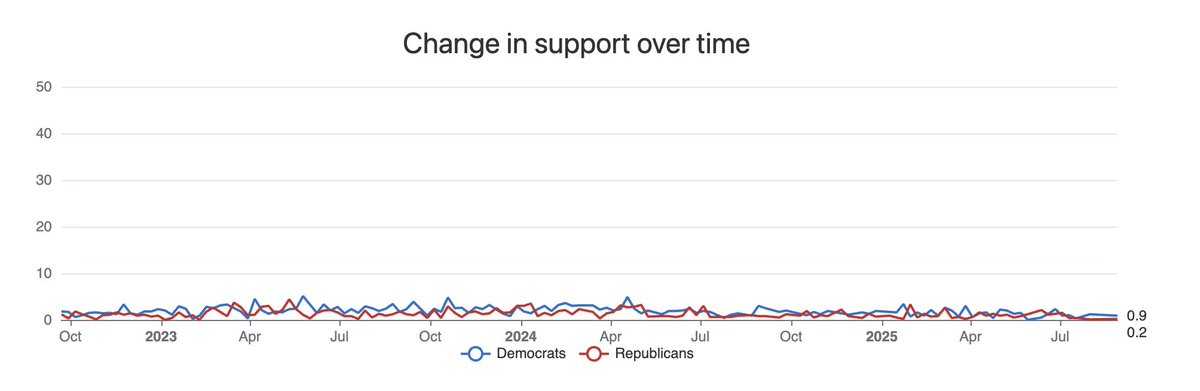
Careful polling shows that Americans overwhelmingly reject political violence - see e.g. https://t.co/pqe4vXMMkr, https://t.co/XptzAJ5Vw9, and https://t.co/gIDAdIypY2.
Unfortunately, it only takes one person with a gun to create a tragedy like what've seen today.
Support for political violence is very low, and this holds true across parties. Survey data can easily overstate support for political violence. This is a case where not attending to measurement can create a dangerous impression of where Americans are right now.
Using actually comparable questions over time from @PRL_Tweets there has been no change in support for political violence. Even if that weren't true, @ProfessorPape has no evidence (or research design) to connect any changes in opinion to the horrendous acts of violence (in Minnesota, Utah, or elsewhere). We need careful expertise right now, not buzzy talking points.
“Promoting truthful information about elections, recognizing the dedication of election officials, and even getting involved as a poll worker are all ways to help,” says @SUAction Research Director @kellyrader.
Excited to share that @SUAction just launched https://t.co/RQIxLhfmIA, mapping the full election denier threat in every state and across multiple levels of government.
https://t.co/GSgxudjZA2
Coming in 2024: we'll track sitting election deniers in Congress and any election deniers who run. We already know 128 sitting MCs voted to overturn the 2020 election results.
The @FitchRatings downgrade of US sovereign debt cites persistent concerns with governance.
As I write about in the @BrookingsGov & @statesunited report, the erosion of democratic institutions leads to a higher cost of capital, for governments as well as the private sector.
We are extremely proud to have served as pro bono counsel to the State of North Carolina in Moore v. Harper. The Supreme Court’s decision is a major victory for voters, for fair elections, and for our democracy.
More from our CEO @JLydgate: https://t.co/7jootTAaAm