New paper with @jeremydraghi and @HollyKindsvater out today in Proceedings B @RSocPublishing https://t.co/J4A0cPodcN
We show that changes in birth rate and death rate influence a population's chances of evolutionary rescue very differently. Bottom line: generation time matters!
@AdamRutherford@pzmyers@Nature It’s sad when people spend their time writing papers instead of taking five seconds to consider that maybe they aren’t the expert in this area and could learn more first. Which is assuming this isn’t deliberately disingenuous.
NEW PAPER: We followed 76 grizzly bears in a human-dominated landscape to explore coexistence. What we found surprised us. Tons of mortality, tons of conflict, and yet also tons of bears—3x denser than Banff National Park. How could this be possible? 🧵
https://t.co/4XfTA02RdX
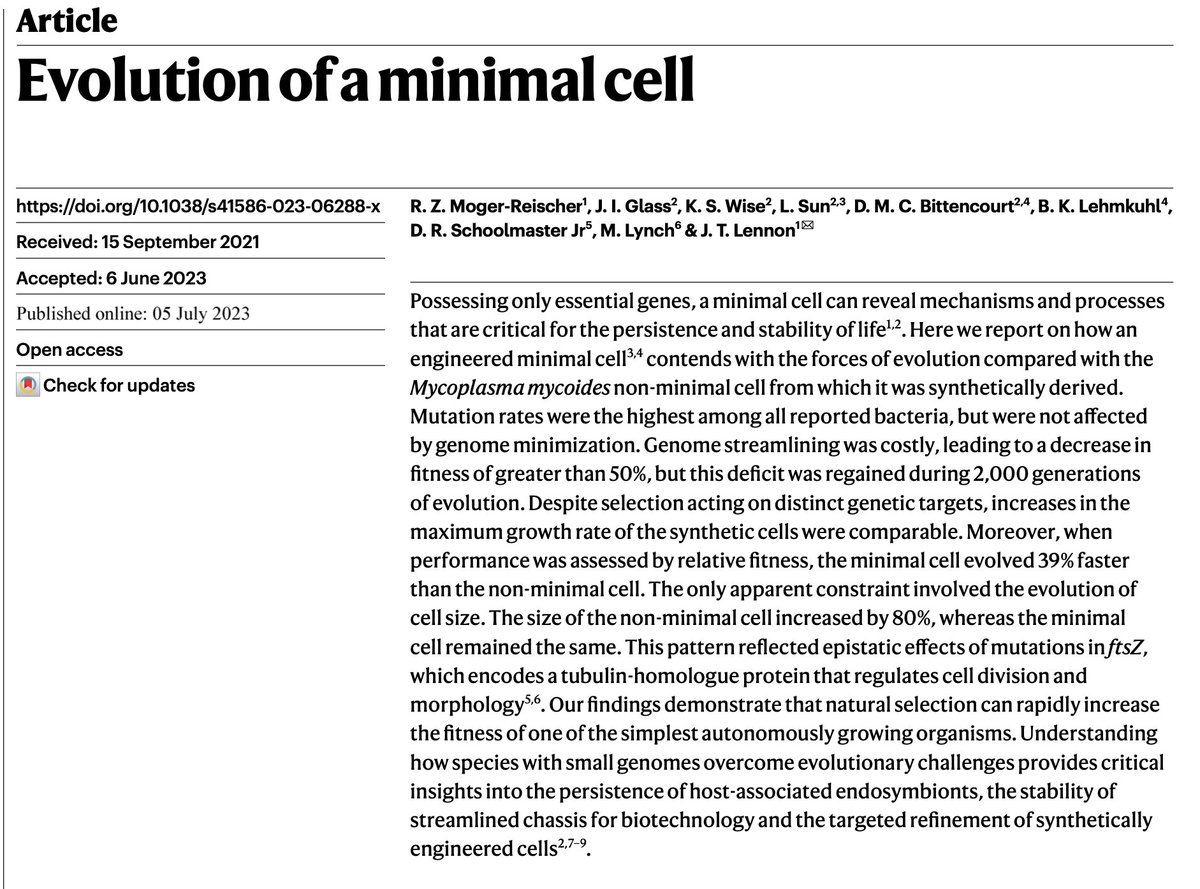
A mind-blowing paper has come out today in @Nature
In 2016, JC Venter Institute scientists trimmed a bacterial genome to its barest minimum required for life to synthesize what they called a "minimal genome" (https://t.co/Rk8oZJ0bUj).
Today, a group of scientists from Indiana University reports how that minimal genome evolved over 2000 generations in comparison to the non-minimal genome.
The authors found that even when you reduce a bacterial genome to its absolute minimum where every nucleotide matters, the genome undergoes mutational events generation after generation as much as the non-minimal genome. One simply cannot stop the evolution.
Just over 300 days of evolution (equivalent to 40,000 years in humans) the minimal cell has gained everything it lacked in fitness on day one in comparison to the non-minimal cell.
When comparing the evolved traits between the minimal and non-minimal cells, the scientists found something striking. The evolutionary process increased the cell size of non-minimal cells but not that of the minimal cell. But that is not the striking part.
The scientists were able to identify the key mutation that resulted in cell size evolution. And it turned out that the mutation that helped the non-minimal cells to grow bigger is the same that helped the minimal cells to stay smaller. Growing bigger had a survival advantage for non-minimal cells and not growing bigger had a survival advantage for minimal cells. So, the mutation had a context-dependent effect. This just demonstrates that the evolutionary effects on traits have no absolute direction. All that matter is what is beneficial for the organism's survival.
The conclusion of the paper is metaphorically a quote from the Jurassic Park movie:
“Listen, if there’s one thing the history of evolution has taught us is that life will not be contained. Life breaks free. It expands to new territories, and it crashes through barriers painfully, maybe even dangerously, but . . . life finds a way". (https://t.co/UlxRlb86CT)
https://t.co/zA9OAqSoAu
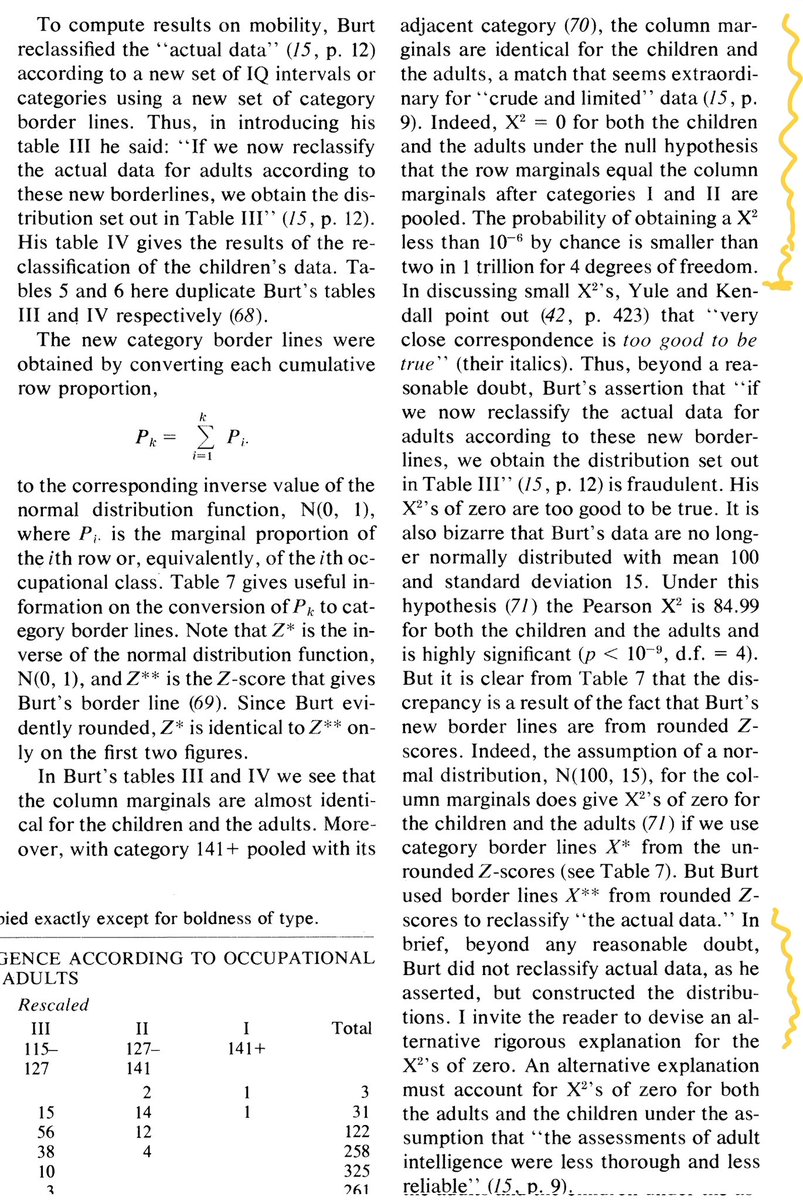
Incredible. Cyril Burt's IQ results are fabricated and it's delusional to try to deny this. See:
https://t.co/zj5lp2wQXd
https://t.co/lQ122EWW3G
Even Jensen--the biggest Burt apologist--had to admit the data was bad and the unfortunate work of a senile old man
@DanCrenshawTX Oh see there’s the problem. No one says natural selection is an accident or random. You’ve just never really learned about it! Hope that makes you feel better, must have been a stressful misunderstanding for you.
My first chapter entitled "Social environment influences the temporal dynamics of sneak-spawning in a fish with alternative reproductive tactics" is now out https://t.co/hmCOmHarJr at @ASNAmNat! Coauthors @kellystiver@SusanMarshRollo@thehellmannlab and @SuzanneAlonzo. 1/11