@KateXGate That only applies if the framework is static. A static framework is a prison. Reality is a dynamic framework—a constant kinetic pulsation seeking energetic balance. We don't 'live inside' it like a cage; we are the physical rotations it produces. You can't step outside of a verb.
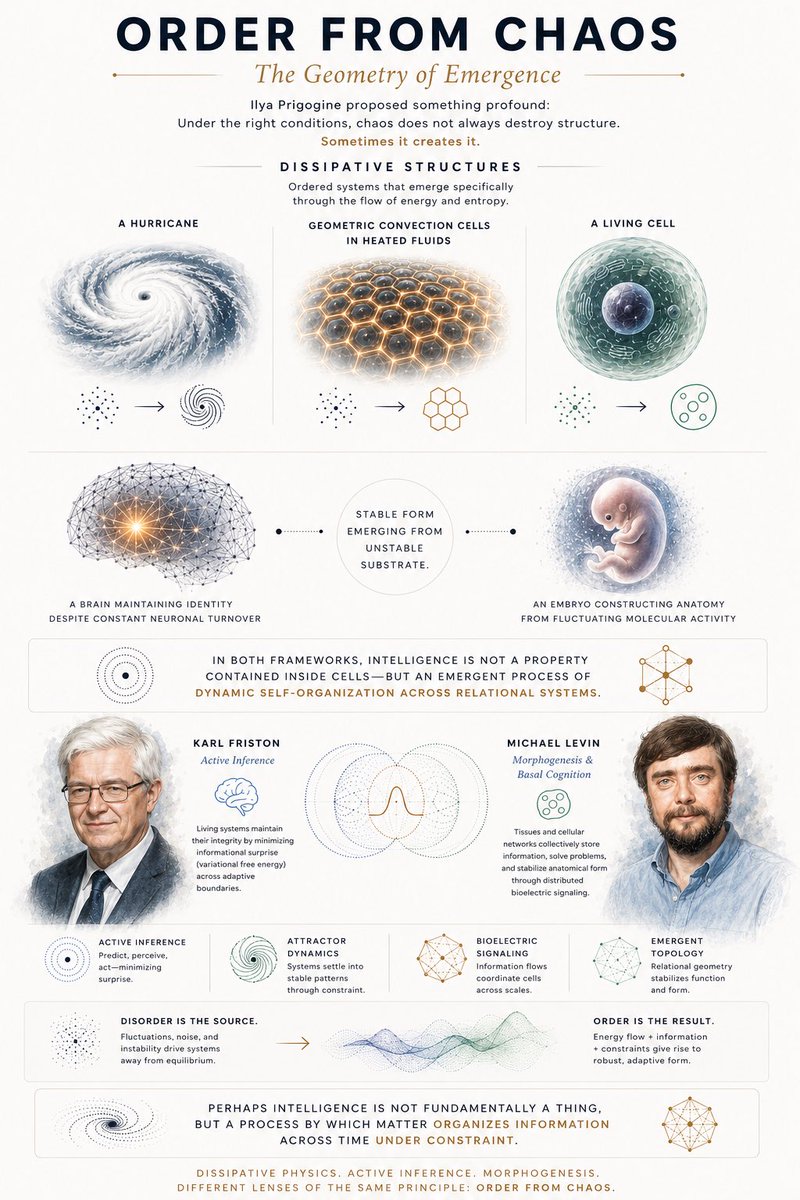
Order From Chaos
The Geometry of Emergence
In the 1960s, Ilya Prigogine proposed something profound:
Under the right conditions, chaos does not always destroy structure.
Sometimes it creates it.
He called these dissipative structures:
A hurricane.
Geometric convection cells in heated fluids.
A living cell.
Order arising through instability rather than despite it.
———
Researchers like Karl Friston and Michael Levin are now exploring adjacent principles in biological systems.
Friston’s work on active inference suggests biological systems persist by constantly updating internal models against an unpredictable environment —
stabilizing themselves through perception, prediction, feedback, and energetic exchange.
Order is not static.
It is actively maintained through recursive information processing across dynamic systems.
———
Levin’s work on morphogenesis and basal cognition suggests cells and tissues may function as distributed information-processing networks capable of memory, coordination, and anatomical problem-solving through bioelectric signaling.
Stable biological form emerges not from centralized control…
but from collective cellular communication organizing matter toward persistent anatomical states despite constant molecular fluctuation.
In both Levin’s and Friston’s frameworks, intelligence begins looking less like a property confined to neurons…
and more like an emergent process of dynamic self-organization across relational systems.
>A brain maintaining identity despite neuronal turnover.
>An embryo constructing stable anatomy from unstable substrate.
———
Perhaps intelligence is not fundamentally a thing.
But a process by which matter organizes information across time under constraint.
Not intelligence as object. But intelligence as topology:
Relational geometry stabilized through energy flow, feedback, and adaptive coordination.
max(∣x∣,∣y∣,∣z∣,∣w∣)=1
You’re witnessing a 2D projection of a 3D shadow cast by a 4D tesseract.
As it rotates through the W-axis, the "inner" and "outer" cubes swap roles: a spatial inversion that feels like a glitch only because our biology is trapped in 3-space.
It’s a hauntingly beautiful reminder that our "reality" is often just a lower-dimensional cross-section of a much more complex structure. Perspective is everything.
This is used in high-dimensional data visualization, hypercube topologies in parallel computing networks, and exploring the geometry of extra dimensions in theoretical physics.
🚨 BREAKING:
Physicists found a quantum gas that refuses to heat up even when you keep kicking energy into it.
Read that again.
Add energy…
and it stops absorbing it.
No thermal runaway.
No march to infinite temperature.
Just a strange quantum freeze.
The reason appears to be dynamical localization:
Strong interactions reorganize the many-body system so energy can’t spread normally.
The system localizes in momentum space.
It effectively says:
“No more.”
That’s wild, because thermodynamics usually assumes driven systems eventually thermalize.
This one resists.
What fascinates me is the deeper implication:
Order can emerge because of forcing, not despite it.
Kick harder…
and instead of chaos, you can get confinement.
That feels almost like a new kind of stability law.
Potential implications:
• nonequilibrium quantum matter
• protected quantum states
• robust quantum information
• maybe new ways to fight decoherence
The big question:
If some quantum systems can refuse heating altogether…
what other “laws” do driven matter systems quietly break?
Follow me reality gets strange when energy stops behaving.
Bohm got us close.
He said particles aren’t wandering in probability.
They’re guided.
By a real, underlying structure—a field that encodes the whole.
⸻
The implicate order.
Where everything is enfolded.
Connected.
Already there.
⸻
But Bohm still assumes something is there-
prior to the interaction.
A deeper layer, hidden structure.
A “thing” doing the guiding.
⸻
Wheeler removes that assumption entirely.
⸻
John Archibald Wheeler sits at a unique junction in physics history:
Coined the term "black hole"
Collaborated with Niels Bohr,
Mentored Richard Feynman.
Proposed the "participatory universe."
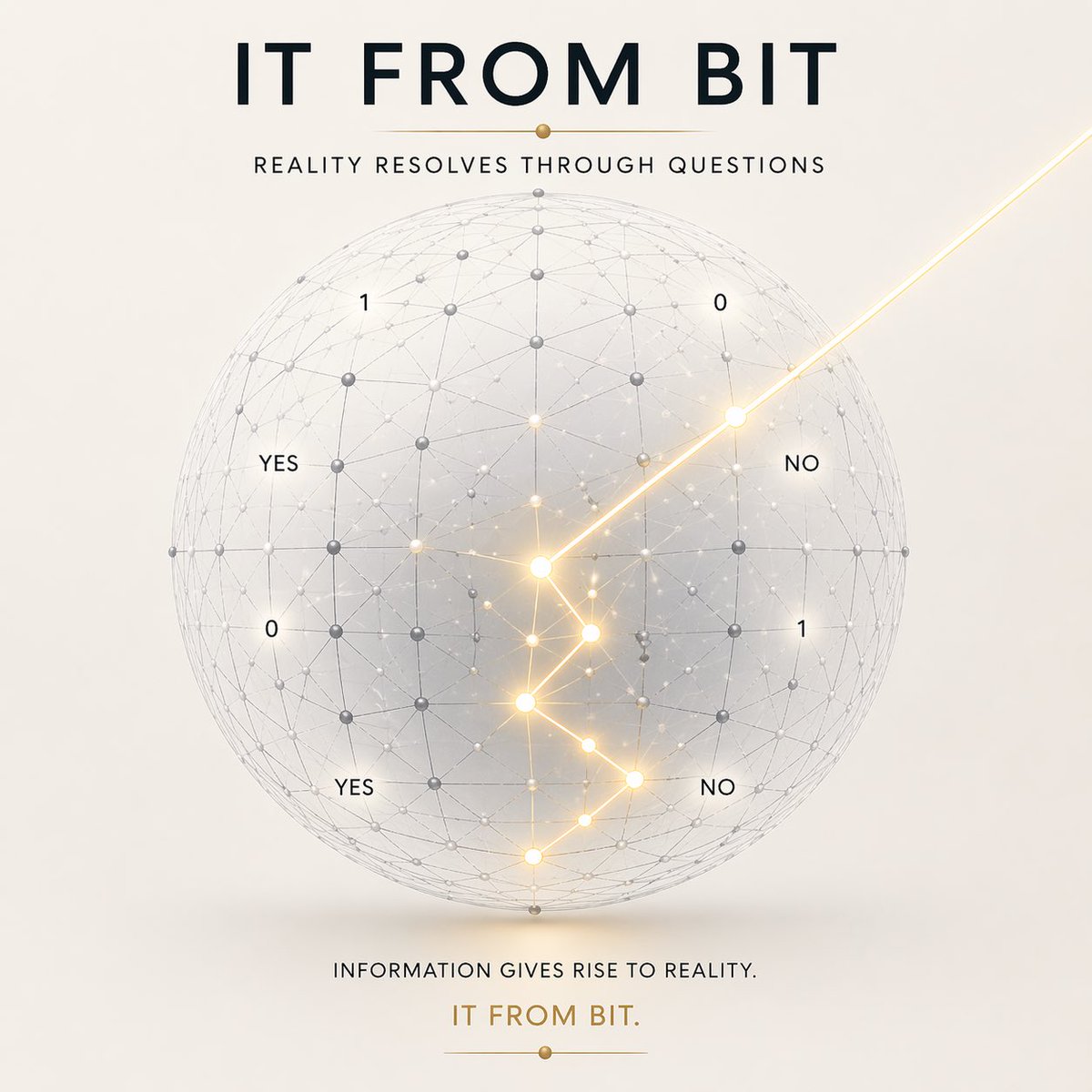
Wheeler dropped a quiet bomb:
Reality doesn’t give rise to information.
Information gives rise to reality.
⸻
"It from bit.”
Every particle.
Every field.
Every interaction—
at its core,
a yes/no.
⸻
Not matter → then measurement.
But: Measurement → then matter.
A photon is not a thing.
It’s an answer.
⸻
And what it resolves into
depends on the question being asked.
⸻
So now the question shifts:
Not “what is reality made of?”
But:
What is reality answering?
⸻
If each interaction is a bit—
a yes/no—
then reality isn’t a thing.
It’s a continuous interrogation.
⸻
And suddenly—
this starts to look less like particles
and more like a system selecting states
from a constrained possibility space.
⸻
Not randomness.
Not branching.
Resolution.
⸻
Wheeler didn’t finish the story.
He couldn’t.
But he pointed directly at it:
Reality may not exist until it’s asked into existence.
⸻
And now the real question:
What’s doing the asking?
The Force That Isn’t a Force
Bohm’s real breakthrough wasn’t just hidden variables.
It was this: what truly moves particles isn’t classical energy or force.
It’s form.
——
Classical physics: Forces push. More intensity → stronger effect.
Bohm: Not always.
There exists something subtler —
the Quantum Potential.
It doesn’t scale with the field’s strength or magnitude.
It depends on the shape — the curvature and structure — of the wavefunction.
——
A seemingly weak field can profoundly dominate a particle’s motion
if its form encodes the right information about the whole system.
That’s not brute force.
That’s active information.
——
The wavefunction doesn’t shove particles around like a classical push.
It guides them
by encoding the global structure of the system —non-locally, instantaneously.
What we experience as randomness or “collapse” is simply the appearance when we can’t access that full hidden order.
Not chaos.
Hidden structure.
—
Which raises the deeper questions:
If form guides reality…
where does that form come from?
And what role does information—and observation—play in creating it?
John Archibald Wheeler had an idea:
"It from Bit"
Next.
In the heart of every atom, the electron doesn’t glide; it vanishes.
Dr. Theresa Bullard on the quantum leap: that “gap” between orbitals isn’t empty. It’s the portal. The electron dissolves into the field of pure potential, then reappears elsewhere. No path. No travel. Just pure becoming.
We chase the particles, the light, the matter… but the cosmos is whispering through the silence between. The emptiness that holds everything.
This is the quiet engine of reality itself.