We (@PantheonInc) have been working on a robotics data quality pipeline that uncovered a series of major problems in public robotics datasets, especially for world modeling.
To improve the quality of data available to open-source robotics, we're publishing annotations for four of the most popular datasets. Some examples of issues, and our report 🧵
@mcnairai Refresher for MLE estimation: if I’ve broken 0 bones before in my life, your best estimate for the number of bones I have in my body is 0. That’s why it’s super widely deployed and mathematically sound and underpins all of the decisions people with data and power make every day
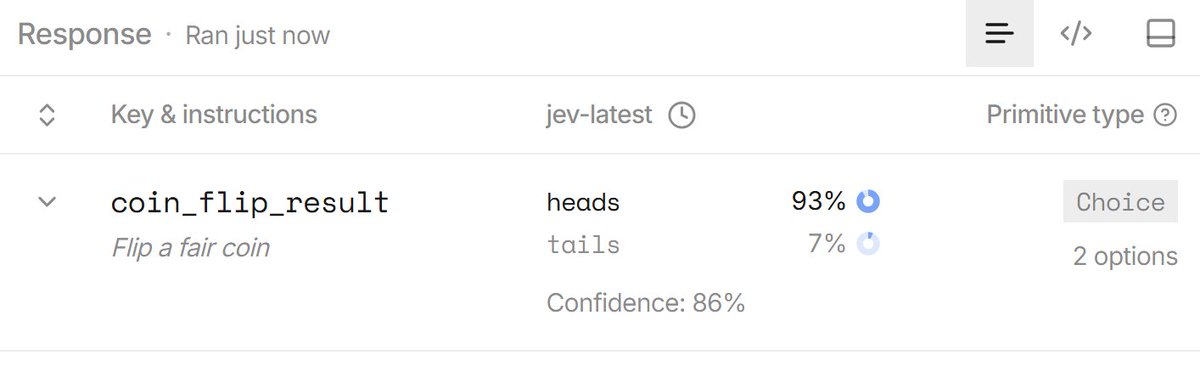
Jev is infinitely better than Claude at flipping a coin and choosing a random number from 1-10. We’re excited to help usher in a new era where advanced AI algorithms fully replace random sampling.
We find that Jev is extremely haphazard across a variety of capabilities and alignment questions. In a new note from @kennyge0, we applaud TypeSafe AI for ushering in a new era of Reinforcement Learning for Uncalibrated Decisions (RLUD).
@mcnairai@tomjiralerspong I really like this blog post! I think this is exactly why auditing, automated red-teaming, etc. are so hard, and also is one of the reasons I had so much trouble eliciting misalignment synthetically during my own projects. Cool approach!
I understand the genuine concerns, and the risks are real, but it seems like every safety pivot (deviations off the curve) just trades uncertainty around theoretical risks for certainty of centralization…
which has all the historical precedent that no other x risks have, and has the worst asymmetry of any: cyber and bio threats from small n bad actors can be defended by large N good actors with the same, or slightly better, tools…
authoritarian lock-in of frontier labs and nation state level compute has a massive, ever growing asymmetry that will only get worse over time, indefinitely.
the idea that the government will be paced is laughable, there will be carve outs for “national security” (i.e. serving the interests of the ruling class in their geopolitical power games, which actually serves little to no actual interest of the people, often negative, see GWOT and the surveillance state)… and no matter what public agreements are reached with China, there is 0 chance they will actually pace. They may pace their open source releases and industry… and that will only hurt us, again.
indefinite authoritarian lock-in is one of the worst outcomes of AI (imo the worst), I’m not convinced that sporadic terrorist attacks, cyber or bio attacks, outweigh indefinite tyranny. Even if those attacks claim millions of lives, there is a defenders chance, and probability/risk to play with — is this really worse than billions subjugated to authorities dominance over centuries? Where the prospects of defense and < 1 probabilities are forfeited out of the gate?
On top of all this, while some degree of authoritarianism may be inevitable… if we can’t have freedom, it would at least be nice to have abundance in the most important sense, solving the scarcity of human biology. We’re not only sacrificing the dwindling chance at freedom via capture, we’re damning the next several years/decades of people who have, or will soon have, life threatening illnesses.
Where is this opportunity cost in the calculation? Why do theoretical cyber/terror/bio attacks that may risk thousands automatically outweigh the non-theoretical risk of the people who are doomed to an early death by diseases that could be solved with a few more years of AI progress and compute build outs?
I know this is is likely greatly overstating the risk of this specific pause effort (we’re not getting indefinite tyranny tomorrow), but it’s about the trend — just as you said for researchers plotting the trend, with no wall in sight, the conclusion is near inevitable… so to is this the case for AI-entrenched authoritarianism… all of the actors that matter at the frontier are pointing in the same direction — it seems the only counterbalance we have is “were democracies in the west, in the end, we’ll still be free”.
The sin here is sacrificing theoretical risks for known, near certain risks.
Forget skill files. What if your model could switch its own finetuning adapters for each task?
I gave Qwen 35B a tool to switch its own adapter in a multi-part task. It beat out subagents, Arrow, and normal fine-tuning, used up to 46x fewer tokens, and incurred ~0 capability tax.
@IBM and @MIT already figured out how to do LoRA switching while fully reusing the KV cache. All that's left is to scale this up.
It's time to start the harness-as-a-tool moment 📷📷📷
Read the full paper here: https://t.co/nGre0Ye7Bz