Today we are open-sourcing the weights to OCRia-1, our flagship 4B VLM for document OCR 🔥
This is our SECOND open-weight release in two days (we just launched OCRia-nano-1 yesterday!!).
OCRia-1 is on the pareto curve of accuracy and cost relative to other 4B models on multiple benchmarks: ParseBench, olmOCR-bench (tables), PulseBench-Tab, and fr-bench-pdf2md. It is an extremely general purpose model that can parse even the most complex document types, including complex tables/charts/formatting/layout.
We’re releasing the weights to help advance open research around OCR, on both @huggingface 🤗 and @ollama 🦙
If you want to use it in prod, come talk to us. If you want to use the latest SOTA of the OCRia model family, tuned for production, check out LlamaParse!
Release on @huggingface : https://t.co/h8SMhfRLDo
Release on @ollama: https://t.co/p4B9GtHFfU
LlamaParse: https://t.co/pAJJyXjzVD
Chen et al., "Decoding Without a Decoder: Direct Pixel Prediction from Diffusion Transformers"
It turns out you can linearly probe the DiT latent space to skip the decoder. Does this mean that training with a V(Q)AE was to just speed things up that you can throw away?
Latent diffusion needs no decoder😵
New paper: DWD, a linear head on DiT predicts pixels directly
• Same or better quality on every tested latent model, less flicker in Wan video
• Even pixel models improve: ImageNet FID 1.55 ➡️ 1.43 (pixel SOTA), photorealistic texture in T2I
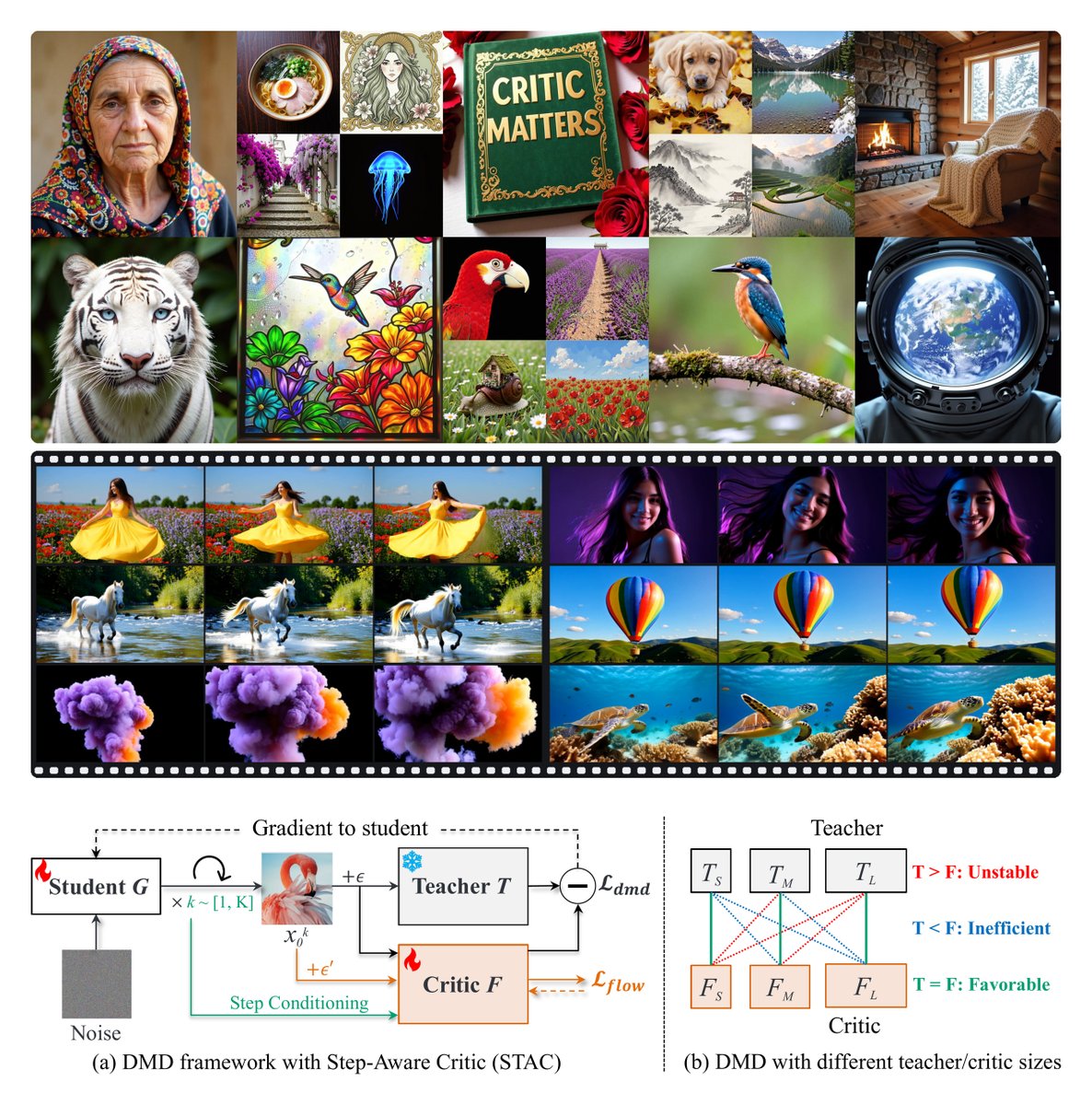
A bigger teacher should give you a better DMD student, right?
👉 NOT if your critic is small. The student gets worse, and can even collapse.
2 dead-simple critic fixes everyone overlooks:
1. Scale the critic with the teacher (joint scaling)
2. Tell the critic which generation step it's judging (STAC)
🌐 Project: https://t.co/GQT7XYSCWB
📄 Paper: https://t.co/WPPyWUCGPx
Black Forest Labs just released the FLUX 3 Image Klein Prompt Upsampler on Hugging Face
A 9B vision-language model that turns short image requests into rich, detailed prompts.
Train your own few-step diffusion models faster, with OPD training workflow now offered in DiffSynth-Studio! Try example “TurTurbo” Qwen-Image-2.1 LoRAs trained with this pipeline:
🤖 https://t.co/R4lhbg83wr
📚 Docs: https://t.co/raLYNmX9Zg
⚡ Fast training feedback: with OPD, we are seeing training convergence typically within 2 GPU-hours.
🎯 Fewer sampling steps: distill FLUX.2-klein-base-4B and Qwen-Image-2.1 from 50 to 8 steps, or Qwen-Image-2.1-Turbo from 8 to 3, while upholding generation qualtiy.
🧠 Simple workflow: train on student-generated trajectories with teacher guidance, without pre-generating teacher trajectories or designing an additional discriminator.
📜 Release under Apache 2.0 license.
What does the world look like inside an AI model?
Here are 3 world model architectures based on how they represent the world (+ the subtypes) ↓
1. A generated observation – a model predicts what comes next: an image, video frame, or token sequence.
• Visual tokens (Dreamer 4, @GoogleDeepMind)
• Diffusion / flow (Waymo World Model, Cosmos-Predict2.5 @nvidia)
2. A compact latent state – a world model compresses the world into an internal representation and predicts how it changes.
• Reconstructive state-space (DayDreamer)
• Predictive representations (JEPA, @ylecun)
• Task-oriented (MuZero)
3. An explicit structure of objects and space – a model represents the world via objects, their properties, positions, and interactions.
• Spatial / geometry-aware (Atlas, @theworldlabs)
• Object-centric (TextOCVP; FIOC-WM)
We broke down what’s inside these architectures and how they work in this guide ↓
https://t.co/rInKfQ9ecz
Sharing our new work: UniForge3D generates detailed 3D meshes from sparse-view inputs with high fidelity! The code has been released and welcome to try it!
Paper: https://t.co/IM0o81zJxj
Project Page: https://t.co/pK9Eqcmabk
Code: https://t.co/ie00AWFP49
A 0.5B Model Turned a Room Scan Into a Structured Layout in 16 Seconds
SpatialLM turned a bedroom video into structured text in 16s on a laptop GPU, with a half-billion-parameter LLM. Point encoder → adapter → LLM, one record per object. Bed size within 5 cm, 5 of 6 walls and the window line up. A few misses too. One room, one run.
https://t.co/exm1qJFyUu
Woow Nvidia has a 2.6B open-source world model 🔥
Turn an image, a text prompt, and a camera trajectory into a controllable world.
All on a single GPU.
- Code available on GitHub
- Paper on arXiv
- Useful for embodied AI, robotics research, and simulations
Runs on GPUs like an RTX 5090 or H100, making world-model experiments possible without a multi-GPU setup.
Cool stuff - T3lescope. Turns photos into usable 3D meshes.
- gens clean scene meshes without per-scene optimization
- uses one 3D flow model across every scale, from a single pen to an 80m city block
- handles glass, mirrors, occlusions (Gaussian Splatting fails here)
- no image re-encoding as you zoom in
- meshes are ready for games, 3D printing etc
https://t.co/CbNjC9IPlD