WoW Forever on iPad Pro M5: 60 FPS on High settings (graphics quality 8) ⚔️
Runs with Tolkara, played with keyboard + trackpad, and starts in 8.5 s with Local signing.
Shoutout to @maxencesh for getting it running first!
Heroes III: HoTA, the original Windows x86 game running on iPad 🐉. The latest iPadOS, no Jailbreak.
Wine translates the Windows calls, FEX turns x86 into ARM64, Tolkara maps macOS onto iPadOS. Keyboard + trackpad, full sound, saves work.
Tolkara now has a second way to run macOS app code on iPad: Local signing.
It is simpler, as you don't need to wait for memory preparation and no VPN tunnel workaround is required to make it work.
The app's final code pages go into a small library signed with your own developer identity. Tolkara checks it against the unmodified executable. No tunnel or enrolment needed.
The previous way (developer service memory preparation) without signing is still available as well if you prefer it.
https://t.co/cgUzhxXPvl
@maxencesh Cool! How good is the performance?
In terms of ban risk I believe it should be similar to people playing on Proton Linux. I heard there were some bans, but in general Blizzard tolerates Proton at the moment.
WoW Classic is running natively on an iPad Pro M5 at 120 fps.
This is the original unmodified macOS client running directly on an iPad Pro, native execution.
macOS system calls are translated to their iPadOS equivalents. The game's code, assets and network protocol are untouched.
This now seems to be my favourite way to play the game. On the best screen I have, fully playable on a couch or in bed. Using the iPad's keyboard and trackpad is surprisingly comfortable for WoW. Smaller screen works great for this old style game.
Are there more people interested to make this work?
For more details about the technical setup check tolkara repo on github.
@SnazzyLabs This is kind of what was promised with Apple Intelligence, if you watch their WWDC videos. I wonder if they can really deliver when Apple couldn't
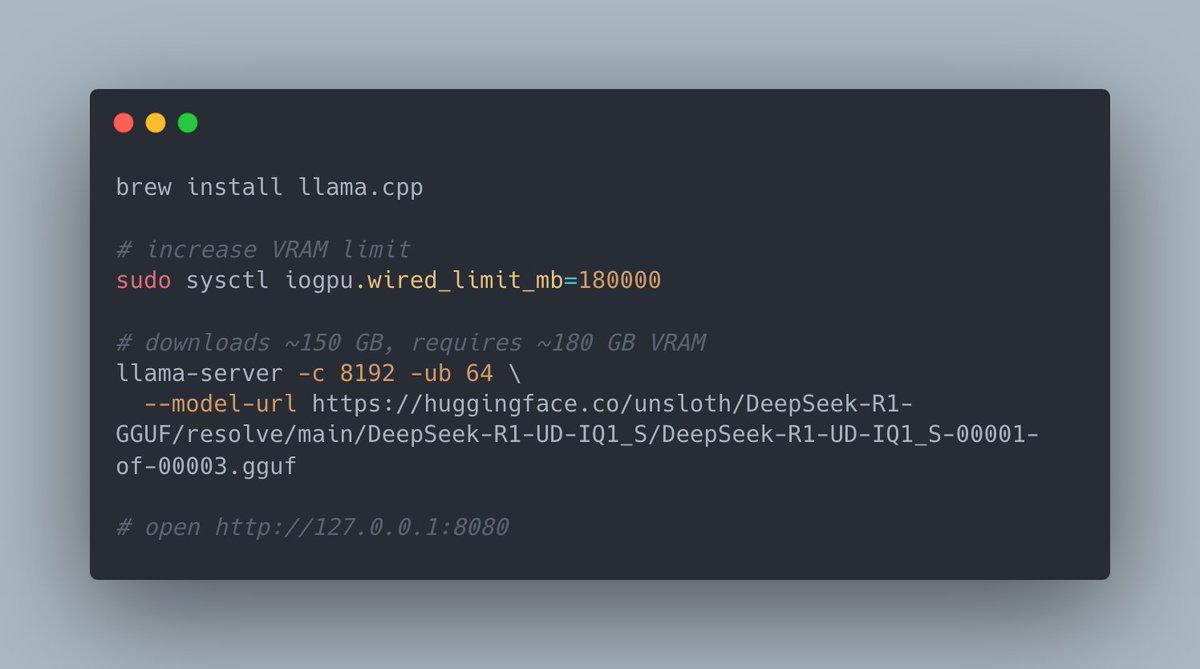
@ggerganov Tried R1 32B 8bit on M4 Pro with 48 GB memory (ggml-org/DeepSeek-R1-Distill-Qwen-32B-Q8_0-GGUF), seems to run great 👍
Memory usage is 43.3/48.0GB, eval time is about 7 tokens per second.
@TheGregYang I would appreciate a possibility to as grok a question about a specific post. Otherwise, I have to tell grok to look for the post himself and sometimes it doesn’t find it, which is annoying
JSDoc in Fiori applications. It would be helpful to have some SAP documentation on how to implement it (as well as some support from tooling). It seems to be a better option for some use cases than going full Typescript.
I feel like a large amount of GDP is locked up because it is difficult for person A to very conveniently pay 5 cents to person B. Current high fixed costs per transaction force each of them to be of high enough amounts, which results in business models with purchase bundles, subscriptions, ad-based, etc., instead of simply pay-as-you-go. As an example, I'd like my computer to auto-pay 5 cents to the article/blog that I just read but I can't, and I think we're worse for it.
In a capitalist system, transactions between entities are the gradient signal of the economy. Because our pipes don't support low magnitude terms in the sums, the gradients are not flowing properly through the system. I'm not familiar enough with payments to have an idea of specific solutions, but I expect we'd see a lot of positive 2nd / 3rd order effects if the gradients were allowed to flow properly, frictionlessly and with much higher resolution.
An idea for an AI that can self-replicate "in nature":
1. Create an isolated network with a significant number of primitive servers able to communicate over HTTP. Route all inbound requests on each server to a binary file execution. Remove all security: allow all types of communication, all authorisations to all autonomous requests.
2. Perform random changes to binary files on some of the servers (mutated), while doing typical outbound HTTP requests from the other servers (standard).
3. Iterate servers between mutated and standard until you see new (unintended) requests on standard servers (not mutated). Probably will take ages, if it happens at all.
4. Look into requests to find servers which will have some randomness to its new messages. Probably will take ages as well. Make more copies of those.
5. Let it cook for a while. Reset random older servers to ensure self-replication is there.
6. Then start training: introduce servers with increased resources, look for those that can answer GET requests on port 80/443. Select those that answer closer to the response structure intended. Probably will take ages as well.
7. More training. Download Wikipedia, give GET 80/443 read access to it. Select those that utilise more resources and can answer questions asked about Wikipedia. Again, will take ages.
8. Give it access to more knowledge.
I wonder is someone already tried something like this before.
The goal is to make it first self-replicate and then self-learn. My guess is that it is impossible, as naturally it took billions of years. But in my point of view this kind of AI will be truly alive comparing to the current LLMs, that are not sustainable without humans intentionally supporting them.
You can make it faster if you design replication mechanism, neural network and some kind of DNA model in there from the start, but it would be much more interesting to see what kind of life will come naturally.