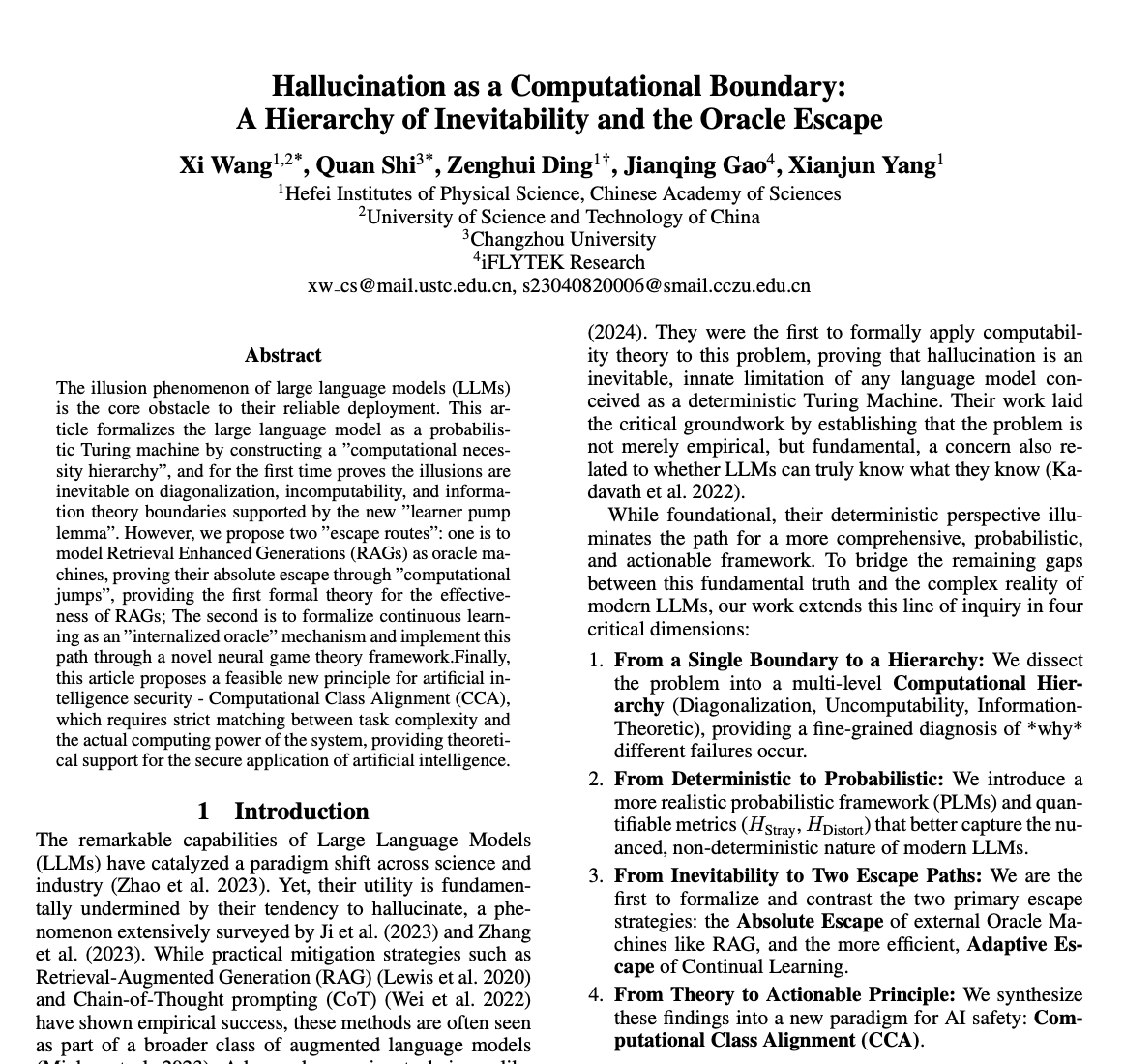
Researchers mathematically proved that LLM hallucinations can never be fixed.
It is Impossible.
They modeled Large Language Models as Probabilistic Turing Machines. They tested them against the absolute boundaries of computer science: incomputability, information theory, and diagonalization.
The result is absolute.
If a model relies entirely on its own internal parameters, hallucination is mathematically inevitable.
You cannot train it away. You cannot scale it away. It is a hard limit of mathematics.
But the researchers found an escape route.
They call it the "Oracle Escape".
In computer science, an oracle machine is a theoretical system capable of bypassing its own limits by querying an external source of absolute truth.
The researchers proved that the only way to break the hallucination barrier is Retrieval-Augmented Generation (RAG), giving the AI access to search the outside world in real time.
RAG isn't just a clever hack to give an AI a memory boost.
Mathematically, it acts as an "oracle machine". It forces a "computational jump" that allows the AI to escape its own inevitable delusions.
The paper ends with a brutal new rule for AI safety: Computational Class Alignment.
You must strictly match the complexity of a task to the actual compute architecture of the system.
If you ask a closed system to do an open-world task, it won't just fail.
It is mathematically guaranteed to lie to you.
بنی نوع انسان نے ہر میدان میں ہی ترقی کی ہے لیکن جتنی جدّت اس نے اپنی ہی نسل کے گوشت پوست کے انسان کو ختم کرنے میں حاصل کی ہے شائد اتنی کسی اور میدان میں نہیں کی ۔
نفسیاتی طور پر یہ انتہائی وحشیانہ اور خوفناک طریقہِ قتل ہے
The Taliban will no longer allow Afghan women to see with both eyes.
They already required women to cover their entire bodies, leaving only their eyes visible underneath the burqa.
But now, even that is being restricted. Women are now only allowed to see with one eye!
Researchers at Oxford argue that LLMs can't invent anything.
It's impossible mathematically.
The paper is called "Theory Is All You Need."
Teppo Felin and Matthias Holweg take the famous "Attention Is All You Need" title and flip it. Their argument is that AI predicts from the past, while humans reason forward into the future, and those are two different kinds of thinking.
Start with the numbers. The authors estimate a large language model trains on roughly 13 trillion tokens. A human reading at 150 words a minute would need about 164,000 years to get through that. A child hears around 20,000 words a day and roughly 36.5 million words in their first five years. It's the same task with wildly different data, and the child still ends up with language that goes far beyond anything they heard.
Their point is that the model learns which words tend to follow other words. It becomes a mirror of what people have already written. It doesn't build a theory of how the world works, so it can't step outside its training data.
The paper's sharpest thought experiment makes this painful. Imagine an LLM trained in 1633 on every scientific text ever written up to that point. Ask it about Galileo and heliocentrism. Thousands of years of geocentric texts would swamp Galileo's ideas, so the model would tell you he's wrong. It would also rate Tycho Brahe's astrology as more credible than the idea that the Earth moves, because more people had written about astrology.
Then there's flight. In 1888 the scientist Joseph LeConte looked at bird data, noted that no bird above 50 pounds could fly, and concluded humans couldn't either. Lord Kelvin, then president of the Royal Society, said he had not the smallest molecule of faith in aerial navigation.
The New York Times estimated in 1903 that flight was one to ten million years away.
Nine weeks later the Wright brothers flew.
The Wrights didn't have better data. They had a theory. They broke flight into three problems, lift, propulsion, and steering, built their own wind tunnels, and generated the data that didn't exist yet.
Wilbur wrote in 1900 that he had been "afflicted with the belief that flight is possible to man."
Every prediction machine on Earth would have told him no.
The authors call this the data belief asymmetry. Every real breakthrough starts with someone believing something the existing data says is wrong. A system trained to minimize surprise can't do that by design.
They're not anti AI. They say AI will win at routine, repetitive decisions that extrapolate from the past, which is most decisions. They're just pushing back on the idea that you should replace humans with algorithms whenever possible, which is a direct quote from Kahneman.
I use these models every day and this matches what I see. The new stuff comes from the human at the keyboard who decides the data is wrong.
LLMs don't think, you do!
While rumors have swirled about major Western players exploring similar breakthroughs, this comprehensive
the paper serves as a stark reminder that the theoretical race toward the Singularity is a global endeavor.
Right on the heels of Silicon Valley discussions about slowing down AI, a major new study has emerged from Chinese researchers and institutions.
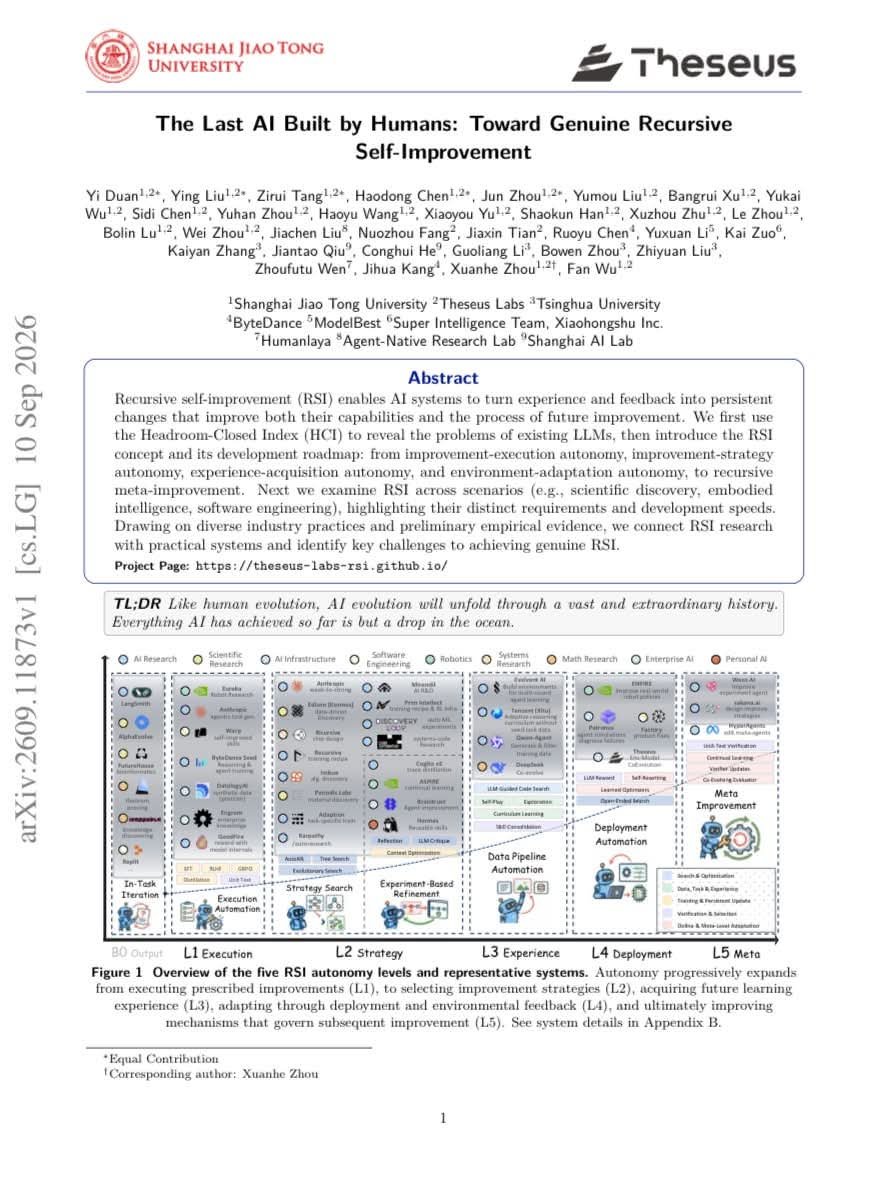
Titled "The Last AI Built by Humans: Toward Genuine Recursive Self-Improvement" (arXiv:2609.11873),
the paper outlines a clear 5-step roadmap toward Recursive Self-Improvement (RSI), often referred to as the technological "Singularity" or the point where AI can improve itself without human intervention.