I've been using Opus 4.6 for a bit -- it is our best model yet. It is more agentic, more intelligent, runs for longer, and is more careful and exhaustive.
For Claude Code users, you can also now more precisely tune how much the model thinks. Run /model and arrow left/right to tune effort (less = faster, more = longer thinking & better results).
Happy coding!
AiStrike unveils an AI-powered cloud security investigation and response platform that leverages advanced behavior analytics and AI-powered automation to reduce alert volume, improve response time, and save analyst hours when responding to cloud threats. https://t.co/BFYMc78fzo
🚀 Today marks a huge milestone for AiStrike as we officially launch from stealth mode!
🐙🛡️Designed for the modern cloud era, AiStrike leverages AI-guided automation for rapid response to cloud threats.
👀 Catch our live demo at RSAC 2024 @ Early-Stage Expo: Booth ESE-39
Pls help #MPCB and #CPCB we 4000+ residents of Jasminium, Magarpatta city, Pune has been living with constant dry garbage and trash burning since last few months, major health concerns, citizens are unable to breathe.
@mpcb_official@CPCB_OFFICIAL
Don't go to a System interview if you don't know these concepts.
Throughput & Latency
Throughput is the amount of data a system processes within a given period.
It's measured in transactions per second (TPS), requests per second (RPS), or data units per second.
High Throughput means the system can handle more requests in less time.
Things that will help you to increase Throughput:
- Horizontal Scaling (Adding More Machines)
- Load Balancing
- Asynchronous Processing or message queues
Latency is the time taken to process a single operation or request.
It's usually measured in milliseconds or microseconds.
Low Latency is essential in systems with critical response time, like high-frequency trading systems.
Things that will help you reduce Latency:
- Optimizing Code
- Using Faster Storage
- Database Performance Tuning
- Caching
Balancing these two often involves trade-offs.
Asynchronous processing can increase Throughput but might add to Latency for individual tasks.
Extensive caching can reduce Latency but requires more memory resources if not managed.
There's often a trade-off between maximizing Throughput and minimizing Latency.
The #CNCF#Kubernetes Policy WG has just released a new paper on policy-based #Governance, #Risk, + #Compliance to help educate the community about how #cloudnative best practices can be used to address key business risks!
Learn more and read the paper: https://t.co/A7vat3G4FD
Data is the life of any business.
Generally, you store the data in a database and think that’s enough.
But it’s only half the game.
If your data isn’t available and accessible, your business is going to collapse.
One of the important tricks to handle data is Replication.
What does it mean?
Database Replication involves keeping copies of your data on multiple machines.
Why?
✅ It improves the availability of your database and the system.
✅ It makes your data access scalable.
✅ Also, it increases the safety of your data.
Here’s what it looks like:
But how does Database Replication really work?
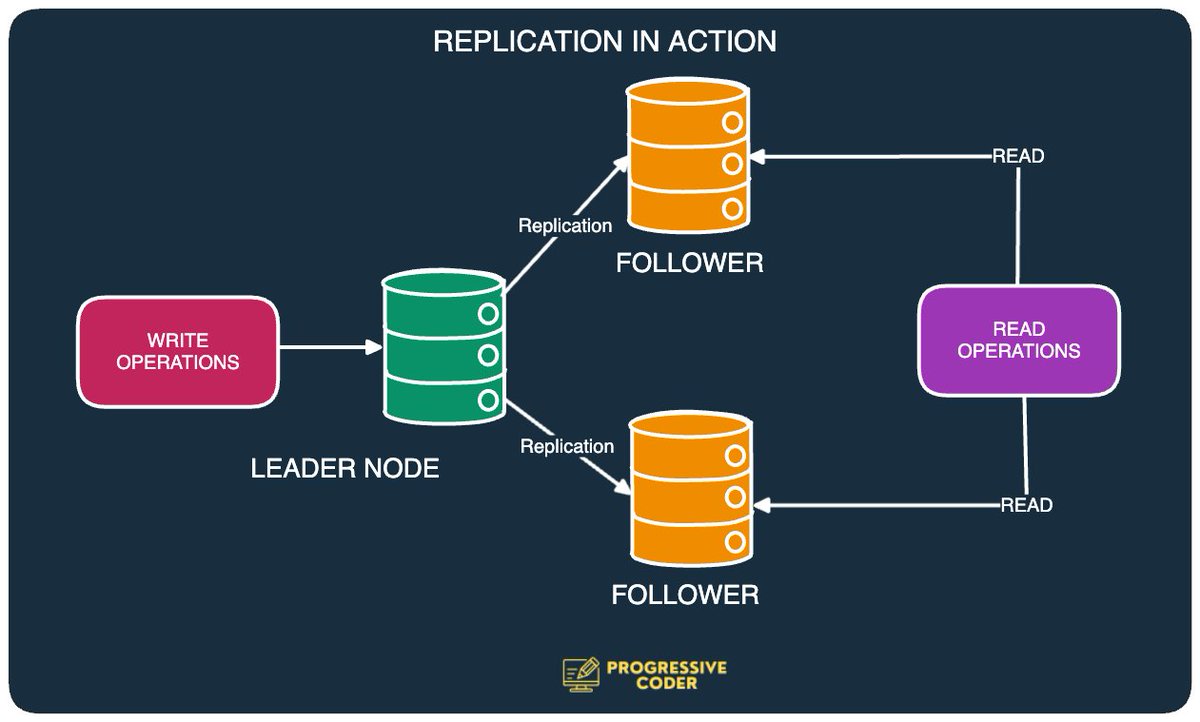
In the below diagram, we have 3 replicas - 1 green and 2 orange.
Every write to the database must reach every replica.
The most common approach is Leader-Based Replication AKA Active/Passive
Here, green is the Leader & others are followers
Below are the steps in a typical Leader-Based Replication setup:
✅Clients send their write requests to the leader node.
✅The leader writes new data to its local storage
✅ The leader also sends the data change to all its followers in the form of a replication log
✅ Each follower reads the log & updates its local copy of the database
✅When a client wants to read data, it can send a query to the leader of any of the followers.
✅Load balancers handle this automatically
Generally, there are two approaches of Database Replication:
- Synchronous
- Asynchronous
👉 In Synchronous Replication, the leader waits until all followers have confirmed that they have received the write.
This guarantees that followers will have an up-to-date copy of the data.
But it also means that the whole system goes down if one follower is not available.
👉 In Asynchronous Replication, the leader sends the updates to the followers but does not wait for a response from the follower.
This makes the leader free to process new write operations.
But it comes at the cost of a write operation not guaranteed to be durable even if confirmed to the client.
So, what’s the need for Replication?
Here are a few reasons:
- Data is always there for you. Safe & Secure
- You can scale based on demand
- Data can stay close to the users
- No instance gets overburdened
- Backup in case things go south
In fact...replication can bring your data back even from the Thanos Snap.
===
That's all for now!
If you enjoyed this explanation of Database Replication, don't forget to:
- Test the Replication of the LIKE button
- REPOST so that everyone can learn about this technique
- BOOKMARK for future reference
- Follow me for more posts like this
🇮🇳 India at a glance👇
What stood out to me
- Internet users @ 120cr (84%) looks overstated
- Ecomm @ 80cr (55%) looks overstated
- UPI @ 30cr shows long runway ahead #UPIFTW
- Digital Learning @ 9cr (6%) shows potential for low/mid income targeted edtech
- Stocks/MFs barely scratching the surface!
(via WA)
We are excited to announce the launch of OpenTofu, an open source alternative to Terraform's widely used infrastructure as code provisioning tool.
Read the announcement:
https://t.co/Ju0d6Fq190
#opensource#opentofu#ossummit
Tenable has been named Best Security Company and Tenable One Exposure Management Platform has won Best Risk/Policy Management Solution of the Year by SC Awards. 🎉 https://t.co/s0jw7anWju
Tenable CEO Amit Yoran discusses #AI and preventive security on #CNBC. "Cyber risk is a critical component of business risk and you have a duty of care to understand it and to manage it very proactively." https://t.co/Z1jrcDaAPw
On the Teachers Day - there are many on X from whom I have learnt a lot but tagging few who have significant positive impact on my leaning journey, Thankyou @dmuthuk
@KiranPRajput
@hyderabaddoctor@FitFounder@AdeParimal and everyone.
Conducting analysis, interpreting the findings and identifying next steps for remediation is a time consuming process. With NEW generative #AI capabilities in Tenable One, security teams can drastically cut down the time it takes to reduce their... https://t.co/olW7Qonnxq
Great stretch for the hips, upper back & shoulders.
It’s called a Crab Reach.
1) Get into crab position
2) Squeeze the glutes
3) Slowly reach above opposite shoulder
4) Move back to starting position
I do 4-6 reps before workouts or in between long periods of sitting.
Enjoy!