Creative people used to need a team or years to make a game. Now they can prototype and invent new ones — this Splatoon-like is the point. Opus 5.5 collapses the distance between idea and playable.
The major OS companies already know. It’s just T until they ship an agentless harness at the OS layer — natural-language computer use, the system doing the work, not a swarm of agents on top.
Personal software was the warmup. Personal OS is the product.
The “Jarvis” version of this shouldn’t be “a thousand agents.” It should be agentless at the UX layer: you talk to the computer, not to a roster of workers. One Debian (or whatever) that follows you from a physical box to a cloud sandbox. Views that appear for the task and vanish. Context that stays.
Open weights, open web, open desktop - otherwise it’s just another assistant bolted on.
Bullish on open source, open weights, the open web
And the open desktop
Personal Operating Systems feel like the natural next step after Personal Software
I've been building a Debian-based OS for myself that can run across physical machines and cloud environments like Vercel Sandbox
I can use and control it with natural language, and I'm designing the UI around a blend of ephemeral and persistent views rather than treating the desktop as a fixed set of apps and windows
There's something really special about having control over the UI/UX of the Whole Computer
No echo de menos escribir código.
Pero sí echo de menos estar yo solo delante de un problema sin tener ni idea de cómo resolverlo.
Probar. Fallar. Darle vueltas durante horas. Y conseguirlo.
Al terminar no solo habías resuelto el problema. Notabas que algo había cambiado en tu cabeza. Habías desbloqueado algo en tu forma de pensar.
Ahora siento que tengo que esforzarme para usar mis propias neuronas. La recompensa es demasiado inmediata.
Antes estaba en resolver algo después de horas de frustración. Ahora puede estar en escribir un prompt y ver aparecer el resultado en segundos.
Hemos trasladado parte de la dopamina del scroll infinito a los prompts infinitos.
Y me preocupa lo fácil que resulta dejar de valorar el esfuerzo.
No solo programando.
Pensar cuesta.
Entender al otro cuesta.
Cambiar de opinión cuesta.
Y ahora incluso podemos preguntarle a una IA hasta encontrar una respuesta que confirme exactamente lo que ya pensábamos.
Siempre he dicho que lo bonito de programar nunca fue escribir código. Era resolver problemas.
Y, curiosamente, eso sigue siendo lo que más me gusta de la IA: me permite resolver problemas que antes ni siquiera podía plantearme.
Solo intento que, por el camino, no resuelva también por mí el esfuerzo de pensar.
Introducing Contrastive Language Model (CLM): an ultra-fast System One Model trained with a contrastive learning objective that connects states and actions.
CLM-8B is pre-trained on internet-scale data and delivers up to 9× faster inference than Jev ⚡ while achieving comparable performance across computer-use, gaming, and tool-calling tasks.
With lightweight fine-tuning, CLM-8B sets a new SOTA on challenging agentic coding benchmarks, such as DeepSWE (81.6%) and Terminal-Bench 2.1 (87.6%). In contrast, Jev fails to serve as an effective verifier for these long-horizon tasks.
We also build an efficient training and serving infra for CLMs by disaggregating states and actions, allowing their embeddings to be cached and reused independently. This substantially reduces inference latency in settings where the state evolves continuously while the action set remains fixed.
Finally, we establish scaling laws for CLMs and show that the test contrastive loss decreases predictably as a power law in training compute, model size, and dataset size.
📄 Blog: https://t.co/zwi9JOHKGx
💻 Code: https://t.co/rsHRYCGR8I
🗣️ Discord: https://t.co/Uqtdefvo3J
🤗 Data & Models: https://t.co/wdSWGGO3hu
More details on CLM’s architecture, data recipe, and scaling laws in the thread below 🧵
Introducing Claude Opus 5.5, the first model in our new Claude 5.5 family.
It performs at the level of Claude Fable 5.1 for most tasks, and costs 40% less to run than Opus 5.
found the perfect use case for @typesafeai Jev:
instant compaction
in 2026, why is compaction still a summarization prompt?
Jev can make it instant by scoring every tool call and dropping what’s irrelevant
Introducing Shaders: a creative tools for anyone making things on the web.
14 interactive experiments to explore:
- make pixel heat map graphs
- turn words into particles
- bend images through glass
- or give an artwork a different texture
Tune the effects live and use your own images, videos, or SVGs where supported.
Make something for a portfolio, a brand campaign, an identity, or an idea that doesn’t fit a category yet.
Open source, with shadcn installation and editable code when you’re ready to build.
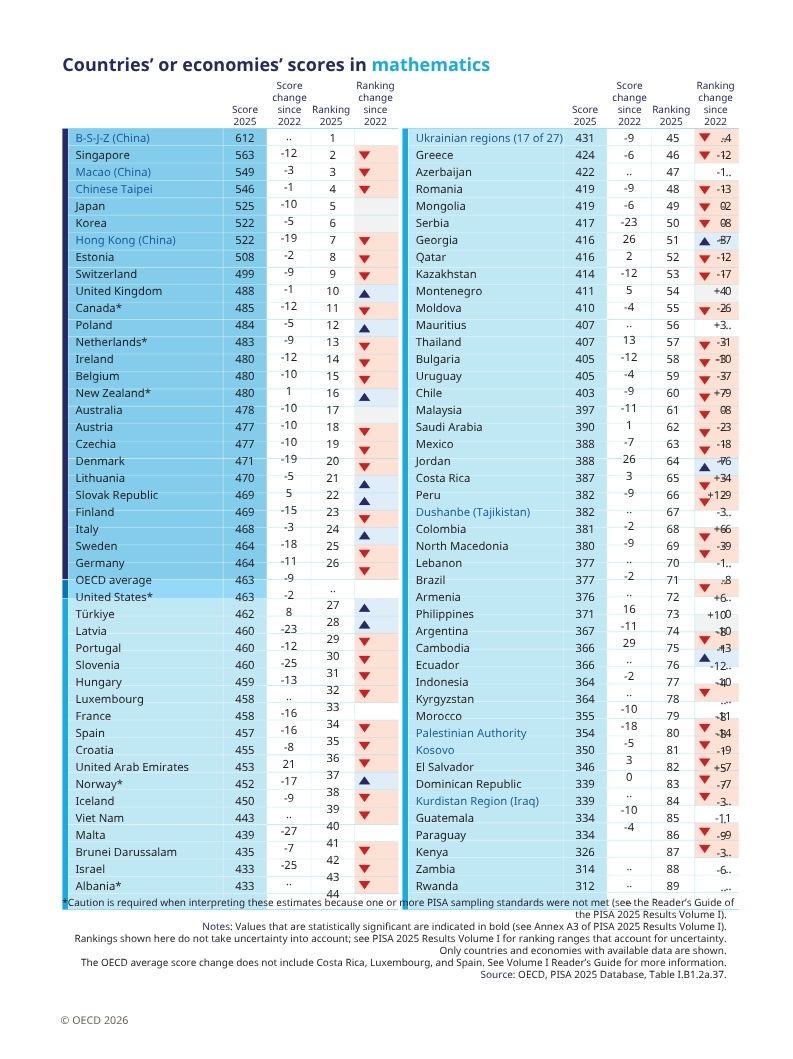
#OECDPISA results are out today!
The participating Chinese jurisdictions, Chinese Taipei, Singapore, Japan, Korea, Estonia and the United Kingdom are among the top-performing systems across science, reading and mathematics.
🔗 https://t.co/OtcLqsN2yi
We’re sharing a solution to the Navier-Stokes Millennium Prize Problem, one of the deepest problems at the frontier of mathematics.
The proof was produced by a group of agents, using an OpenAI next-generation model significantly more capable than GPT-6 Astra.
The problem concerns whether the description of smooth three-dimensional fluid motion modeled by the Navier-Stokes equations can break down. It has remained unresolved for roughly 90 years.
3rd Place: ThinkVoice lets you speak without moving your mouth by combining Grok Voice with brain-sensing technology.
It understands the conversation, suggests what you might want to say next, and lets you select a response using subtle motor movements.
@Daniel_farinax@yangchasiu@elithpalomino
2nd Place: Signal embeds followers’ bios, posts, and engagement into a living graph and A/B tests different launches using simulated populations of your following, so every post hits maximum engagement.
@adibilawar@jasonlai150_@SChen1249@JeffreyZh0u
1st Place: Nova taught Grok to reverse-engineer binaries into clean C. Started with 262KB GameBoy ROMs, ended up rebuilding a 1995 car’s ECU runtime.
@theoc____@supratikp07@henryzhang