@emollick I may be misunderstanding, but isn’t this something you can set up in the governing MD file or via prompting? I would normally direct Claude Code to use Fable for thinking and planning, Opus for execution and building, and Sonnet for QA and it generally follows it to a T.
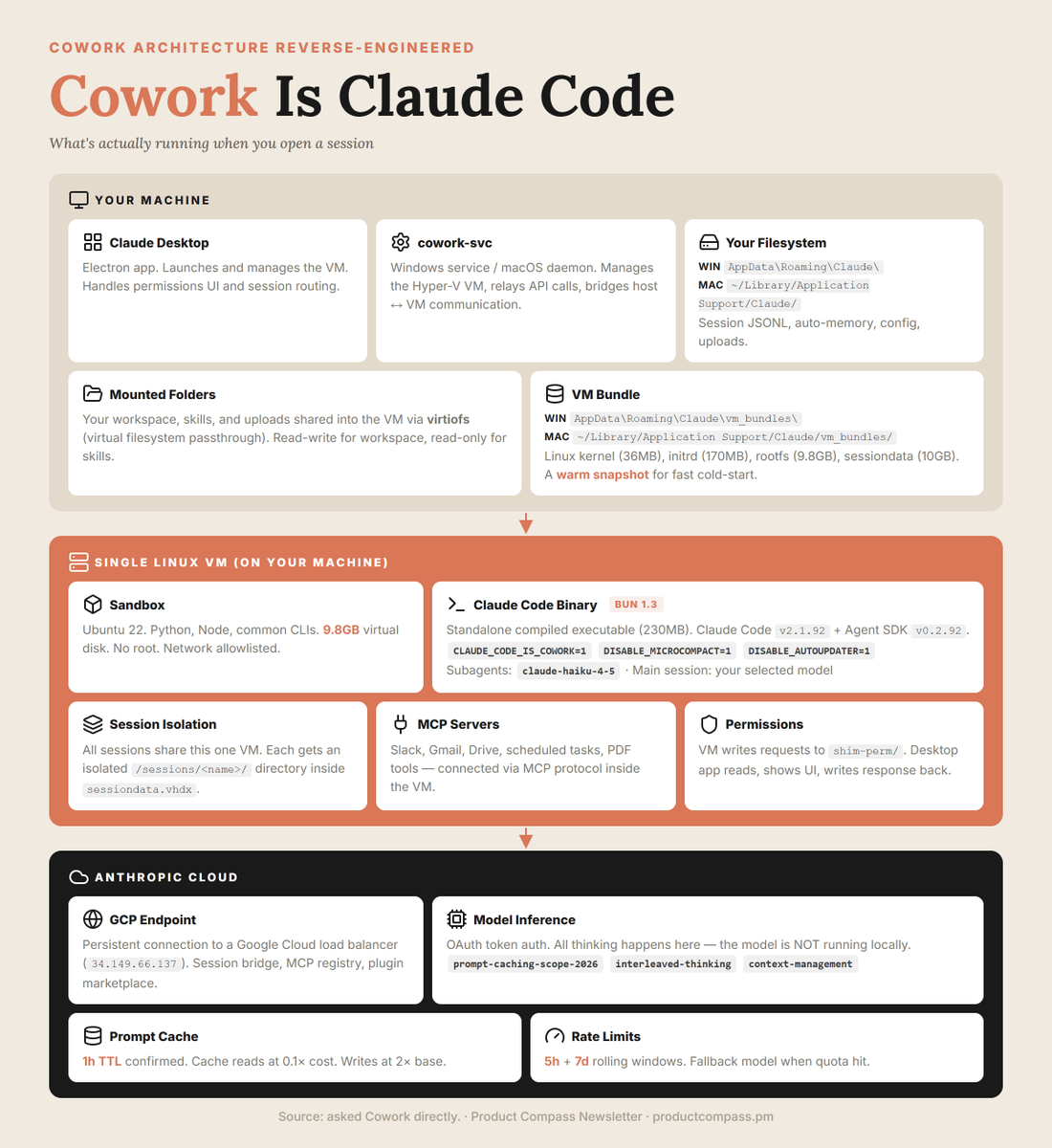
Cowork is Claude Code.
Same binary. Different environment flags. A 230MB Bun-compiled executable running inside a Hyper-V VM on your laptop.
Claude Code v2.1.92 + Agent SDK v0.2.92. One flag flips the mode: CLAUDE_CODE_IS_COWORK=1.
Your files aren't uploaded anywhere. They're shared into the VM via virtiofs — virtual filesystem passthrough. Read-write for your workspace, read-only for skills.
All sessions share one VM. Each gets an isolated /sessions/<name>/ directory inside a 10GB virtual disk.
Permission prompts are a file-based handshake. The VM writes a request to shim-perm/. The desktop app reads it, shows the UI, writes the response back.
Subagent calls default to claude-haiku-4-5. Your main session runs whatever model you selected.
Prompt cache: 1h TTL (not 5m). Cache reads at 0.1x cost. Rate limits: 5h + 7d rolling windows.
API calls route through GCP. Everything else runs on your laptop.
Our new model Claude 2.1 offers an industry-leading 200K token context window, a 2x decrease in hallucination rates, system prompts, tool use, and updated pricing.
Claude 2.1 is available over API in our Console, and is powering our https://t.co/uLbS2JNczH chat experience.
A gap I see is that AI solves a lot of real problems that people in organizations face every day, but many non-technical folks don’t realize they can build their own tools
And many tech folks are not familiar with approaching problem-solving in the non-generalized way LLMs work
Confused about why people overreact or think OpenAI killed many AI startups with their recent announcements.
Most of the announcements/features have been possible already. It's just easier to build things like AI assistants now but it's not necessarily a breakthrough.
This is not a jab at OpenAI or anything, they have been crushing it lately and continue building useful products/services for developers. They also have some of the smartest and most hard-working people in the industry.
But my main question is why is there this assumption that the recently announced OpenAI capabilities/features kill any startups that have been actually deeply innovating in this space? It's like we are just assuming that advanced AI will automatically build products people love. That sh*t is hard and there is a lot of innovation that still needs to happen there not to mention how insanely difficult it is to build and maintain properly-functioning LLM applications!
Some people are asking the wrong questions and making the wrong assumptions. The right question to ask is how do we build unique and rich experiences for users on top of this amazing technology. The more you focus on that the more you realize that AI is simply another tool to enable that and not a "thing that will replace products and humans". AI, as they call it today, won't build products and companies automatically.
I am also not sold on the fact that so-called "thin wrapper" companies will just disappear when AGI arrives (if it ever does). We are serving users here not machines. If startups/builders have a good vision, good user experience, good customer support, healthy product usage, and the million things necessary to run a company and maintain a good product, I don't see how they will just all of a sudden disappear overnight.
OpenAI is building incredible technology and we should be exploring and thinking deeply about how to use it to build new and unique experiences. Don't listen to all the fear-mongering. It's unproductive and it's all part of the usual AI hype cycle which doesn't do anyone any good.
Some people just assume that AI updates will automatically build awesome products, replace humans, and kill companies. We have to stop that nonsense and focus on leveraging the technology to build innovative experiences for our users and communities instead.