Advocate of the High Court of Kenya|Eclectic being|Random and quirky|Politics junkie|Music connoisseur| Gourmet cook|God fearing|Avid dreamer| A pluviophile
🚨 BREAKING: The Court Has a Message for Brothers Who Want Sisters Left Out of Inheritance.
One of the most enduring beliefs in many Kenyan homes is that once a daughter gets married, her father's land ceases to be her concern. In the Estate of Kimani Gaturu, that belief exploded into a bitter family war that lasted nearly two decades. The deceased left behind sons and daughters, but the sons insisted that their father had verbally allocated land to them before his death and that the daughters, having married and left home, should receive little or nothing from the estate. The daughters pushed back, arguing that the land remained in their father's name and that the law did not distinguish between a son who stayed and a daughter who got married.
The High Court was confronted with a question that cuts across countless Kenyan families: Can sons inherit more simply because they remained on the ancestral land while daughters got married? The answer was an emphatic NO. The Court held that alleged oral gifts, family understandings, and informal allocations could not defeat the law where no valid transfers had been completed during the deceased's lifetime. More significantly, the Court reaffirmed that under Section 38 of the Law of Succession Act, read together with the Constitution, daughters and sons stand on equal footing. Marriage is not a legal disqualification from inheritance, and cultural practices that substantially disadvantage daughters cannot override constitutional guarantees of equality.
The implications are profound and uncomfortable. Many estates across Kenya are being occupied, developed, and controlled based on assumptions that daughters have "already benefited elsewhere" through marriage. This decision signals that such arrangements can be challenged years later, potentially reopening distributions families considered settled. It is a wake-up call to parents, administrators, and beneficiaries alike: if you intend to distribute your property differently, do it lawfully and transparently while alive. Otherwise, the law will intervene, and when it does, it will ask a simple question that many families have avoided for generations: Who said a daughter stopped being a child of the family the day she became someone's wife?
Kindly REPOST widely🙏🙏
🚨🔴 BREAKING: Can a Bank Still Auction Your Property After You Have Cleared the Default?
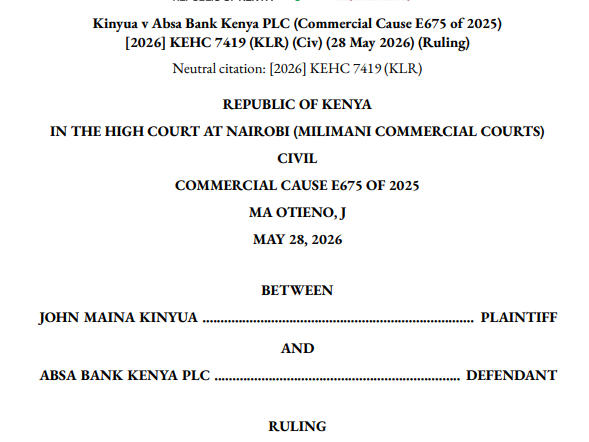
The High Court has confronted a question that keeps many developers, landlords, and investors awake at night. In Kinyua v Absa Bank Kenya PLC, a property owner had secured an KShs 80 million facility using two commercial properties in Sigona. When repayment difficulties emerged, the bank issued statutory notices and proceeded to recall the entire outstanding loan balance, nearly KShs 80 million, despite the facility having been structured to run for approximately fifteen years. The borrower rushed to court arguing that although there had been a default, he had subsequently brought the account up to date and cleared the arrears before the recovery process was completed. The dispute therefore shifted from whether there had been a default to a more complex question: once a lender accelerates an entire facility, can later payment of the arrears stop the auction process?
The Court found that this was not a straightforward debt recovery case. What persuaded the judge was the bank's own records showing that the arrears had been reduced to zero and the account regularized. Justice Moses Ado questioned whether a lender could lawfully proceed with a forced sale of valuable commercial assets when the very default relied upon to trigger the process had already been cured. The Court emphasized that statutory power of sale must be exercised strictly within the law and in accordance with equitable principles, warning against premature foreclosure where the underlying breach no longer exists. An injunction was consequently issued stopping the intended auction pending determination of the suit.
The decision is likely to attract significant attention within Kenya's real estate and banking sectors. It suggests that courts may increasingly scrutinize accelerated loan recalls, particularly where borrowers have demonstrated willingness and ability to regularize their accounts. For investors whose projects depend on long-term financing, the judgment raises an important commercial principle: the statutory power of sale is not merely a contractual remedy but a legal process subject to fairness, proportionality, and judicial oversight. The ruling may therefore become a valuable precedent in disputes involving distressed developments, income-generating properties, and large-scale commercial lending facilities.
Kindly retweet. 🙏🏽
Ready to file the first case on "marex tort" in Kenya. "Marex tort" is a brand new claim developed by English courts that allows a decree holder to go after a third party who helps the judgment debtor frustate the enforcement of the decree. The English courts have ruled that no defence can be raised againt a "marex tort". @omwanza@NelsonHavi
#employmentlaw👋
Muga v Prof Ojienda SC, T/A Prof Ojienda & Associates:
1. A Show cause letter serves the purpose equal to that of a charge Sheet In criminal law:✅️
'In matters employment, a show cause letter serves the purpose of a charge sheet, as it sets out the accusation and/or a catalogue of accusations levelled against an employee, and gives him an opportunity to respond to those accusations in writing within a reasonable time frame that must be set out in the show cause letter. Such reasonable time, in my view, should never be less than seven working days.'
2. Proper service of a show cause letter before termination:✅️
'33.A show cause letter must always be served on the accused employee, who must acknowledge receipt thereon, and indicate the date and time received. If the employee refuses to either acknowledge receipt or to indicate time, the person serving the show cause letter must make a record of the employee’s decline, and the date and time of the same; and must keep the record for purposes of future disciplinary proceedings and/or litigation.'
3.Proceedings of a
disciplinary hearing must have clear indication of what the respondent & claimant submitted, clearly captured & signed by both. Further, those present should testify as to the correctness of those records & employers have no free hand to write what they deem fit. ✅️
'41. In the present case, the minutes exhibited by the Respondent are shown to have been signed by the Respondent only, and do not, in my view, contain any representations made by the Claimant at the disciplinary hearing.'
'42. In view of all the foregoing, the Respondent is not shown to have adhered to the mandatory procedure set out in Section 41 of the Employment Act regarding employees accused of misconduct and poor performance. I make a finding that termination of the Claimant’s employment was procedurally unfair.'
4. In a disputed situation of what amount of salary was being paid to a claimant in the absence of a contract, and the claimant cannot provide evidence of actual salary, the Respondent's testimony shall be taken as the credible version on the correct amount. ✅️
Read the Full decision as attached:
https://t.co/lSGaKp9xnJ
Bahati Mwamuye J in Francis Awino Vs State Law Office and Hon. Aisha Jumwa Katana and 2 others, Petition E043 of 2025,
"The appointment of Hon. Aishwa Jumwa as member of the Kenya Roads Board is unconstitutional and unlawful ab initio as it did not comply with Section 7 of the Kenya Roads Boards Act and articles 10,47 and 232 the Constitution of Kenya 2010.
A fresh appointment must follow the KRB Act and the Constitution."
🚨🚨BREAKING: COURT BACKS EMPLOYER, SAYS YOU DON’T NEED A CRIMINAL CONVICTION TO FIRE AN EMPLOYEE FOR MISCONDUCT
In a major decision likely to shake workplaces across Kenya, the Employment and Labour Relations Court in Mombasa in Ogola v Bamburi Cement PLC (Cause E056 of 2025) [2026] KEELRC 1294 (KLR) has upheld the dismissal of a long-serving employee of who was accused of attempting to leave the company premises with electrical spares hidden in his bag. The employee fought back hard, arguing that police investigations found no criminal case against him and that he was never charged in court. He claimed the dismissal traumatized him, caused anxiety and mental distress, and insisted the CCTV footage never showed him actually stealing anything. But the court still sided with the employer. Justice ruled that an employer is legally allowed to dismiss an employee once internal investigations create a genuine and reasonable belief that gross misconduct occurred, even if no criminal charges are ever filed.
The judgment now sends a chilling warning to employees across the country: your job can still disappear even when the police do not charge you. The court emphasized that workplace disciplinary processes are completely separate from criminal proceedings. According to the court, an employer only needs to show that it genuinely believed misconduct happened after following proper disciplinary procedure. In this case, the company proved that the employee was issued with a show-cause letter, invited to disciplinary hearings, allowed representation, and given a right of appeal. The court also noted that the recovered items matched company stock and that the employee already had previous warning letters on record. Once trust and confidence break down in employment, the court said, the employer is entitled to terminate the relationship.
For employers, the ruling comes as a powerful message of confidence and authority. The court has effectively reaffirmed that companies are not helpless when handling internal misconduct, theft allegations, or breaches of trust. As long as due process under the Employment Act is followed, employers do not have to wait for the police, the DPP, or criminal courts before taking action against an employee. The former employee walked into court seeking millions in compensation and damages. Instead, his entire case was dismissed with costs. The message from Mombasa is loud, sharp and unforgiving: if an employer can demonstrate a fair process and reasonable grounds for suspicion, Kenyan courts will stand behind workplace discipline - even where no criminal conviction exists.
Kindly retweet 🙏
The art of cross-examination is knowing when to press, when to pause and when to stop.
A few rules every trial advocate learns sometimes the hard way:
• Never ask a question you do not already know the answer to.
• Never argue with the witness. Control the witness.
• Ask short, precise questions. Long questions create escape routes.
• One fact per question. One objective per line of attack.
• Do not chase every inconsistency. Chase the material ones.
• Listen carefully. Some witnesses destroy themselves if you simply let them speak.
• Do not ask “why” unless you are prepared for a speech.
• Never ask the final question if you already made the point. Many cases collapse because counsel became greedy for “one more answer.”
A good cross-examination weakens testimony.
A great one changes the entire case
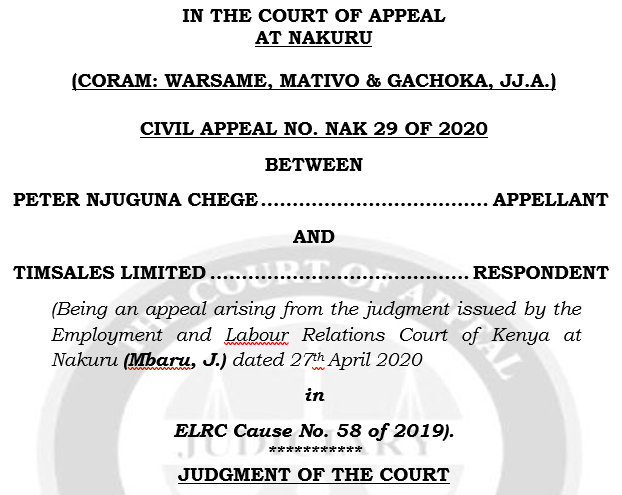
🚨🚨BREAKING FROM COA: YOU CANNOT “RETIRE” OVERNIGHT TO ESCAPE DISMISSAL - EMPLOYEES MUST FACE DISCIPLINE FIRST
In a major decision shaking Kenyan employment law, the Court of Appeal at Nakuru has ruled that an employee cannot suddenly retire or resign “with immediate effect” simply to dodge disciplinary action. In Peter Njuguna Chege v Timsales Limited, Civil Appeal No. NAK 29 of 2020, the employee attempted to retire overnight after being accused of participating in an unlawful strike and damaging company property. He claimed that once he submitted his retirement letter, the employer lost all power to discipline or dismiss him. But the Court of Appeal firmly disagreed and upheld his dismissal.
The judges found that the employee issued his retirement letter only after the court had already allowed disciplinary proceedings to continue and after notices to show cause had been issued. Worse still, the retirement was intended to take effect immediately, without notice. The Court, composed of Justices Warsame, Mativo, and Gachoka, was blunt and held that employment law does not recognize “instant retirement” used as an escape route from accountability. According to the Court, allowing employees to vanish through sudden retirement while facing misconduct allegations would “sanitize gross misconduct” and destroy workplace discipline. The judges emphasized that even where a Collective Bargaining Agreement allows early retirement, an employee must still issue proper notice under the Employment Act unless the employer waives it.
For ordinary Kenyans, this judgment carries a powerful message. Many workers believe that once they submit a resignation or retirement letter, the employer’s hands are tied. Not anymore. This ruling confirms that if disciplinary proceedings have already begun, especially over serious misconduct, an employee cannot simply disappear behind a retirement letter and expect full benefits. The Court has now drawn a hard line: retirement is not a legal hiding place. If you are facing disciplinary action at work, timing matters, procedure matters, and attempting to outsmart the process may leave you jobless, dismissed, and without the benefits you thought were guaranteed.
Kindly retweet🙏🙏
The court has held that hospitals cannot detain patients over unpaid medical bills.
In a notable decision, the High Court in Nairobi intervened in the case of Stephen Ndwaru Gicheru, who was being held at The Nairobi Hospital after undergoing open-heart surgery.
Although medically discharged on 27 March 2026, he was not released due to an outstanding insurance balance. Even after his family paid Ksh 1 million and offered to settle the remainder, the hospital continued the detention, allowing further charges to accumulate and denying him home recovery.
The court ruled the detention unconstitutional, stating that hospitals cannot use “self-help” to recover civil debts. It emphasized that such detention violates human dignity and personal liberty under Article 29 of the Constitution.
An order was issued for his immediate release and handover of his medical records to his family.
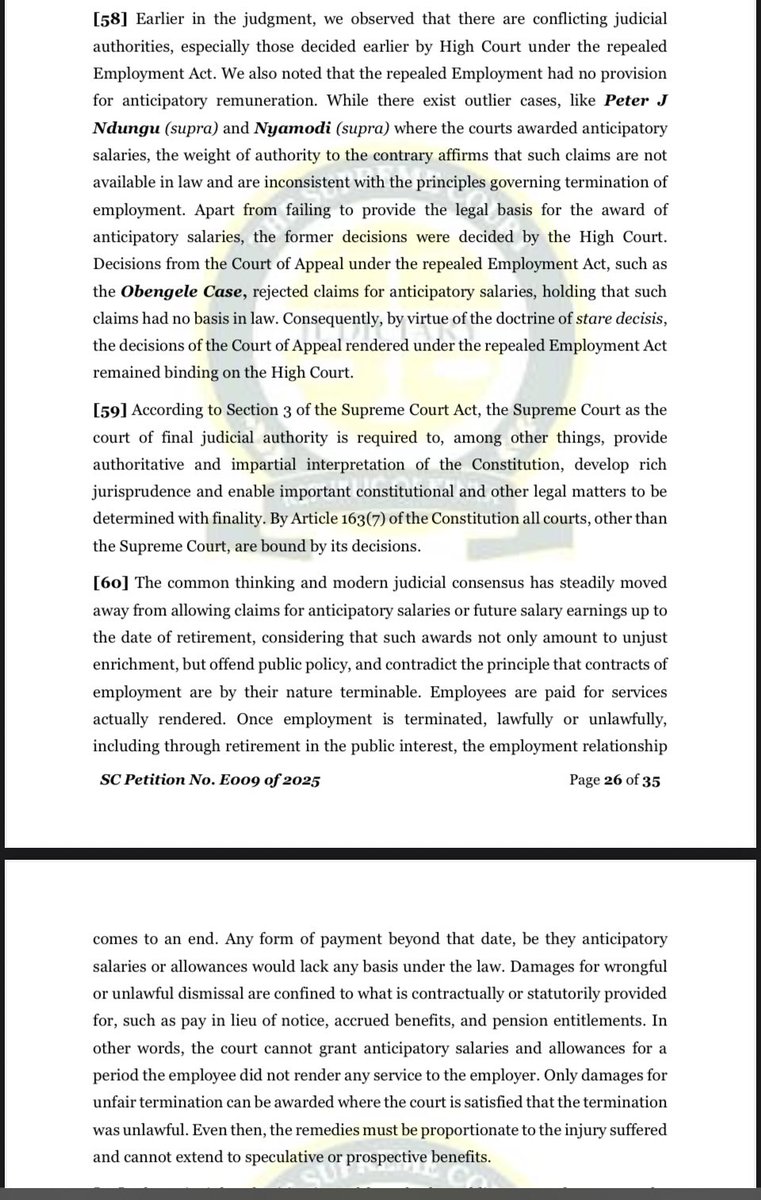
Remedies sought by H.E Gachagua would be an up hill task to be granted. The Supreme Court has previously held that “anticipated or future salaries and benefits” go against public policy & border on unjust enrichment. Damages to be awarded, if any, cannot extend to speculative/prospective benefits #gachagua #impeachment 🤔
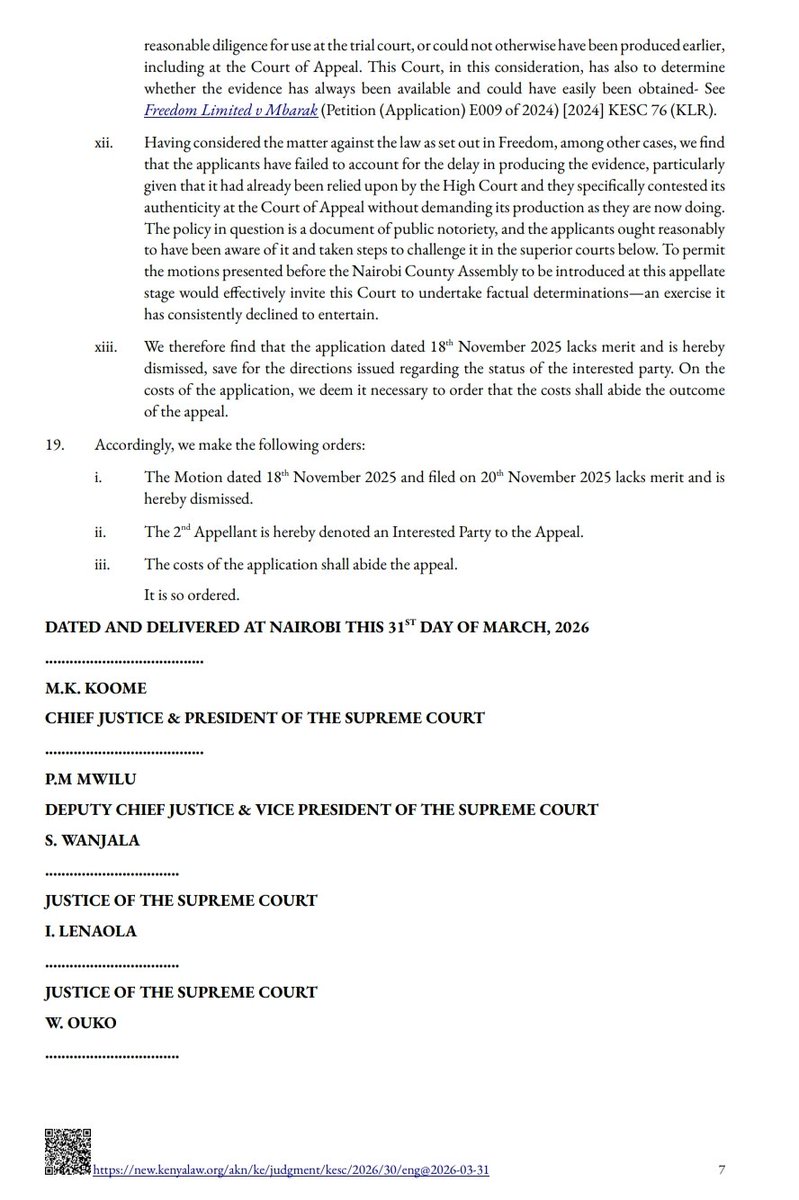
The Supreme Court of Kenya has held that an interested party cannot appeal where none of the principal parties has done so, emphasizing that such parties cannot suddenly transform themselves into substantive litigants on appeal.
The case involved a dispute over a proposed 16-storey residential development on Mbaazi Avenue in Lavington, Nairobi. The Mbaazi Avenue Residents' Association and Millennium Gardens Management Limited challenged the project, arguing it violated their constitutional right to a clean environment and ignored zoning restrictions for the low-density area. They sought to stop the construction, claiming the Court of Appeal incorrectly relied on an unapproved development policy to justify the high-rise buildings.
The Supreme Court dismissed the application for conservatory orders, ruling that any potential environmental harm could be remedied through damages or future restoration orders rather than halting construction. The Court also rejected the request to introduce new evidence regarding the development policy, noting the applicants failed to provide it during earlier proceedings despite its public nature. While the Court affirmed its jurisdiction to hear the main appeal, it ordered that the Residents' Association be demoted from "appellant" back to "interested party".
The National Land Commission has developed the National Land Commission (Investigation of Historical Land Injustices) Regulations 2026 to provide a clear, structured legal framework for the NLC to investigate, hear, and resolve claims arising from historical land injustices.
These Regulations will apply specifically to historical land injustices that occurred between 15 June 1895 and 27 August 2010. Injustices after 27 August 2010 are treated as “present land injustices” and fall outside these Regulations.
Warsame sat on the Court of Appeal bench that affirmed spousal consent is not required for property that does not qualify as matrimonial property, even where the couple has occupied or used it for a long period. The Court was clear that the mere fact a house is a matrimonial home does not, in itself, confer a beneficial interest on a spouse absent proof of contribution.
Looking forward to his jurisprudence at the Supreme Court of Kenya.
Court Declares Purchasers Trespassers and Sale Agreements Invalid Where Widow Sold Estate Land Without Co-Administrator’s Consent
In Kiarie v Sang & 5 others (Environment and Land Case 44 of 2015) [2026] KEELC 2047 (KLR), a judgment delivered virtually at Eldoret on 16 April 2026 by C.K. Yano J, the suit concerned LR No. 9360, which belonged to the late John Geoffrey Kiarie Mwangi. After his death, a grant of letters of administration over his estate was issued to Jane Wangui Kiarie, his widow, and Peter Mwangi Kiarie, his son and the plaintiff. The plaintiff claimed that the defendants had trespassed on the land, while the defendants argued that they had purchased their respective portions from Jane. The plaintiff contended that Jane was not the registered owner, had no authority to sell the land alone, and did not obtain his consent as co-administrator or leave of court before disposing of estate property.
The court noted that land belonging to a deceased person can only be dealt with by a duly authorised personal representative. It further emphasised that where an estate has multiple administrators, one administrator cannot act or deal with estate assets to the exclusion of the others. A co-administrator therefore needs the consent, cooperation, or involvement of the other co-administrator to sell land belonging to an estate. In that sense, unless an administrator acts in accordance with the instrument appointing them, and in this case jointly, that administrator may be treated as intermeddling with the estate because the powers and authority must be exercised jointly.
Since the grant appointed both Jane Wangui Kiarie, the deceased’s widow, and Peter Mwangi Kiarie, the deceased’s son, as administrators, the court found that Jane could not validly sell the suit property without the plaintiff’s consent, cooperation, or involvement. The sale agreements were therefore invalid because they were executed by Jane alone, without proof of the plaintiff’s written consent or participation. Although the defendants claimed to be bona fide purchasers for value without notice, the court rejected that argument because the grant shown to them indicated that there was a co-administrator, and they ought to have confirmed whether he had consented to the sale.
On trespass, the court held that the defendants initially entered the land on the basis of the sale agreements with Jane, but those agreements had been made by a person without capacity to transact alone. Once the plaintiff, as administrator and beneficiary, withdrew any permission to remain on the land, the defendants had no lawful justification to continue occupying it. The court therefore found them to be trespassers and held that the prayers for vacant possession, eviction in default, and a permanent injunction were merited.
The court finally ordered the defendants to vacate LR No. 9360 within six months, failing which the plaintiff would be at liberty to evict them. It also issued a permanent injunction restraining the defendants from interfering with, ploughing, using, or erecting structures on the land after the six-month period. However, the plaintiff was ordered to refund each defendant the purchase price proved to have been paid to Jane Wangui Kiarie, and each party was directed to bear its own costs.
When you begin dealing with commercial Contracts you slowly learn how:
1. An entire Litigation can sprout out of a coma;✅️
2. Arbitration is most of the time a clause to serve the interests of the 'stronger party in the transaction'✅️
3. Attention to detail should leave the CV to Word to Word scrutiny of any work before you.✅️
4. The owners of capital sometimes do not value the Legal Risks Assessment. ✅️
5. Informality & business interests Trump upon all legalese.✅️
6. Owners of capital care more about the Results(End) than the process. ✅️
👏👏
Unpaid internships are a form of unfair labour practices. Education is too expensive for one to work for free.Nepal has abolished it,Kenya should follow suit.Nobody pays super metro or rent using experience.
To Kenyan Advocates and Litigants:
The use of AI in litigation and academic undertakings are generally banned and frowned upon globally because AI is unreliable, prone to abuse, manipulation and often misrepresents facts, issues, principles of law and case law.
A legitimate judicial process cannot rely on AI generated pleadings because AI isn’t just unreliable and prone to manipulation, the CREDIBILITY of an AI-generated statement cannot be assessed. Yet, CREDIBILITY—the determination of truthfulness and reliability of a party or witness—is the basis for judicial findings.
AI generated witness statements and affidavits have zero credibility because one cannot assess the credibility of an AI—a thing—with no emotion, no human experience, and zero capacity to appreciate truth from falsity.
Fundamentally, using AI to generate pleadings and submissions is akin to using a ghost writer in an academic setting. Both constitute dishonesty, cheating and/or plagiarism. The use of AI cannot be compared to the role of an advocate in litigation.
Advocates are trained, regulated and required to adhere to the Rules of Professional Ethics and the Rules of Court when advising clients, preparing documents, attesting to the truth of contents of documents they have prepared, taking instructions and making representations to the court or tribunal. AI softwares have no similar requirements and their developers and users are NOT ACCOUNTABLE to the court or the society at large.
Paying advocates who use AI is like paying a Nigerian voodoo artist to multiply your hard-earned money at River Road!
Research, Drafting and Advocacy are—at their core—ORGANIC human exercises. Not artificial engagements. They require creativity, innovation and resourcefulness as well as HUMAN EMOTIONAL and EMPATHY.
Moreover, when allowed, AI would tend to perpetuate inequality, inequity and unfair practices in the legal, judicial and intellectual systems because the wealthy would ultimately access more sophisticated, costly and better AI software than the poor. In other words, IF AI were to be allowed for use in academic and judicial settings, AI companies will unveil (in fact they have done so already) different categories and qualities of softwares, with the most expensive and reliable tools (and therefore inaccessible to poor people) being used by major corporations and wealthy individuals while the most unreliable and therefore risky softwares being used by the poor. It will create a FIRST WORLD of AI users and a THIRD WORLD of users.
And we know where the Kenyan users currently hailing AI will fall—to the Third World of unreliable, risky and therefore useless AI Third world—of course, with zero credibility in academia and judicial systems.
Conveyancing Still:
Court of Appeal (Civil Appeal E682, E686 & E705 of 2024) dismissed claims by Williams & Kennedy Ltd (WKL) and others:
1. Demonstrates the Actual analysis into Due Diligence, how far cannot it go & what does It entail?✅️
2. Contracts of Land entered into before the enactment of the requirement for Writing cannot be faulted for lack of Sale Agreement ✅️
3. A title cannot be invalidated for the reason that it is imperceptible how one got the huge amount of money to acquire the Land. ✅️
Happy Reading!


![MiracleMudeyi's tweet photo. Justice Joel Ngugi’s Proposed CCTV Evidence Guidelines in Republic v Njoroge & 2 Others [2024] KEHC 3710 https://t.co/088KRqoLYW](https://pbs.twimg.com/media/HJucrm0XwAU8tH7.jpg)




![pmpaulmukiibi's tweet photo. Court Declares Purchasers Trespassers and Sale Agreements Invalid Where Widow Sold Estate Land Without Co-Administrator’s Consent
In Kiarie v Sang & 5 others (Environment and Land Case 44 of 2015) [2026] KEELC 2047 (KLR), a judgment delivered virtually at Eldoret on 16 April 2026 by C.K. Yano J, the suit concerned LR No. 9360, which belonged to the late John Geoffrey Kiarie Mwangi. After his death, a grant of letters of administration over his estate was issued to Jane Wangui Kiarie, his widow, and Peter Mwangi Kiarie, his son and the plaintiff. The plaintiff claimed that the defendants had trespassed on the land, while the defendants argued that they had purchased their respective portions from Jane. The plaintiff contended that Jane was not the registered owner, had no authority to sell the land alone, and did not obtain his consent as co-administrator or leave of court before disposing of estate property.
The court noted that land belonging to a deceased person can only be dealt with by a duly authorised personal representative. It further emphasised that where an estate has multiple administrators, one administrator cannot act or deal with estate assets to the exclusion of the others. A co-administrator therefore needs the consent, cooperation, or involvement of the other co-administrator to sell land belonging to an estate. In that sense, unless an administrator acts in accordance with the instrument appointing them, and in this case jointly, that administrator may be treated as intermeddling with the estate because the powers and authority must be exercised jointly.
Since the grant appointed both Jane Wangui Kiarie, the deceased’s widow, and Peter Mwangi Kiarie, the deceased’s son, as administrators, the court found that Jane could not validly sell the suit property without the plaintiff’s consent, cooperation, or involvement. The sale agreements were therefore invalid because they were executed by Jane alone, without proof of the plaintiff’s written consent or participation. Although the defendants claimed to be bona fide purchasers for value without notice, the court rejected that argument because the grant shown to them indicated that there was a co-administrator, and they ought to have confirmed whether he had consented to the sale.
On trespass, the court held that the defendants initially entered the land on the basis of the sale agreements with Jane, but those agreements had been made by a person without capacity to transact alone. Once the plaintiff, as administrator and beneficiary, withdrew any permission to remain on the land, the defendants had no lawful justification to continue occupying it. The court therefore found them to be trespassers and held that the prayers for vacant possession, eviction in default, and a permanent injunction were merited.
The court finally ordered the defendants to vacate LR No. 9360 within six months, failing which the plaintiff would be at liberty to evict them. It also issued a permanent injunction restraining the defendants from interfering with, ploughing, using, or erecting structures on the land after the six-month period. However, the plaintiff was ordered to refund each defendant the purchase price proved to have been paid to Jane Wangui Kiarie, and each party was directed to bear its own costs.](https://pbs.twimg.com/media/HGw2NO4bQAAhPyY.jpg)






![MiracleMudeyi's tweet photo. Justice Joel Ngugi’s Proposed CCTV Evidence Guidelines in Republic v Njoroge & 2 Others [2024] KEHC 3710 https://t.co/088KRqoLYW](https://pbs.twimg.com/media/HJucrm1XAAEsBX6.jpg)
![AssociatesRoba's tweet photo. 🚨🚨BREAKING: COURT BACKS EMPLOYER, SAYS YOU DON’T NEED A CRIMINAL CONVICTION TO FIRE AN EMPLOYEE FOR MISCONDUCT
In a major decision likely to shake workplaces across Kenya, the Employment and Labour Relations Court in Mombasa in Ogola v Bamburi Cement PLC (Cause E056 of 2025) [2026] KEELRC 1294 (KLR) has upheld the dismissal of a long-serving employee of who was accused of attempting to leave the company premises with electrical spares hidden in his bag. The employee fought back hard, arguing that police investigations found no criminal case against him and that he was never charged in court. He claimed the dismissal traumatized him, caused anxiety and mental distress, and insisted the CCTV footage never showed him actually stealing anything. But the court still sided with the employer. Justice ruled that an employer is legally allowed to dismiss an employee once internal investigations create a genuine and reasonable belief that gross misconduct occurred, even if no criminal charges are ever filed.
The judgment now sends a chilling warning to employees across the country: your job can still disappear even when the police do not charge you. The court emphasized that workplace disciplinary processes are completely separate from criminal proceedings. According to the court, an employer only needs to show that it genuinely believed misconduct happened after following proper disciplinary procedure. In this case, the company proved that the employee was issued with a show-cause letter, invited to disciplinary hearings, allowed representation, and given a right of appeal. The court also noted that the recovered items matched company stock and that the employee already had previous warning letters on record. Once trust and confidence break down in employment, the court said, the employer is entitled to terminate the relationship.
For employers, the ruling comes as a powerful message of confidence and authority. The court has effectively reaffirmed that companies are not helpless when handling internal misconduct, theft allegations, or breaches of trust. As long as due process under the Employment Act is followed, employers do not have to wait for the police, the DPP, or criminal courts before taking action against an employee. The former employee walked into court seeking millions in compensation and damages. Instead, his entire case was dismissed with costs. The message from Mombasa is loud, sharp and unforgiving: if an employer can demonstrate a fair process and reasonable grounds for suspicion, Kenyan courts will stand behind workplace discipline - even where no criminal conviction exists.
Kindly retweet 🙏](https://pbs.twimg.com/media/HIv_fMyWcAAjUm_.png)



![pmpaulmukiibi's tweet photo. Court Declares Purchasers Trespassers and Sale Agreements Invalid Where Widow Sold Estate Land Without Co-Administrator’s Consent
In Kiarie v Sang & 5 others (Environment and Land Case 44 of 2015) [2026] KEELC 2047 (KLR), a judgment delivered virtually at Eldoret on 16 April 2026 by C.K. Yano J, the suit concerned LR No. 9360, which belonged to the late John Geoffrey Kiarie Mwangi. After his death, a grant of letters of administration over his estate was issued to Jane Wangui Kiarie, his widow, and Peter Mwangi Kiarie, his son and the plaintiff. The plaintiff claimed that the defendants had trespassed on the land, while the defendants argued that they had purchased their respective portions from Jane. The plaintiff contended that Jane was not the registered owner, had no authority to sell the land alone, and did not obtain his consent as co-administrator or leave of court before disposing of estate property.
The court noted that land belonging to a deceased person can only be dealt with by a duly authorised personal representative. It further emphasised that where an estate has multiple administrators, one administrator cannot act or deal with estate assets to the exclusion of the others. A co-administrator therefore needs the consent, cooperation, or involvement of the other co-administrator to sell land belonging to an estate. In that sense, unless an administrator acts in accordance with the instrument appointing them, and in this case jointly, that administrator may be treated as intermeddling with the estate because the powers and authority must be exercised jointly.
Since the grant appointed both Jane Wangui Kiarie, the deceased’s widow, and Peter Mwangi Kiarie, the deceased’s son, as administrators, the court found that Jane could not validly sell the suit property without the plaintiff’s consent, cooperation, or involvement. The sale agreements were therefore invalid because they were executed by Jane alone, without proof of the plaintiff’s written consent or participation. Although the defendants claimed to be bona fide purchasers for value without notice, the court rejected that argument because the grant shown to them indicated that there was a co-administrator, and they ought to have confirmed whether he had consented to the sale.
On trespass, the court held that the defendants initially entered the land on the basis of the sale agreements with Jane, but those agreements had been made by a person without capacity to transact alone. Once the plaintiff, as administrator and beneficiary, withdrew any permission to remain on the land, the defendants had no lawful justification to continue occupying it. The court therefore found them to be trespassers and held that the prayers for vacant possession, eviction in default, and a permanent injunction were merited.
The court finally ordered the defendants to vacate LR No. 9360 within six months, failing which the plaintiff would be at liberty to evict them. It also issued a permanent injunction restraining the defendants from interfering with, ploughing, using, or erecting structures on the land after the six-month period. However, the plaintiff was ordered to refund each defendant the purchase price proved to have been paid to Jane Wangui Kiarie, and each party was directed to bear its own costs.](https://pbs.twimg.com/media/HGw2TLvboAAg9ez.jpg)


