Excited to co-found Discovery Loop with my long-time collaborators @JeffDean@Sanjay_Ghemawat@OriolVinyalsML . Our mission is to automate machine learning, engineering and science. Learn more at: https://t.co/JFHy15o1uw ♾
Our general approach is to automate the experimental loop. We think this approach is broadly applicable across many different fields of science and engineering. We’ll initially focus on ML research and engineering, but believe the approach can help with important subproblems in nearly every one of the fourteen <at>NAE Grand Challenge problems. We think doing this well requires strong expertise in machine learning as well as large-scale systems.
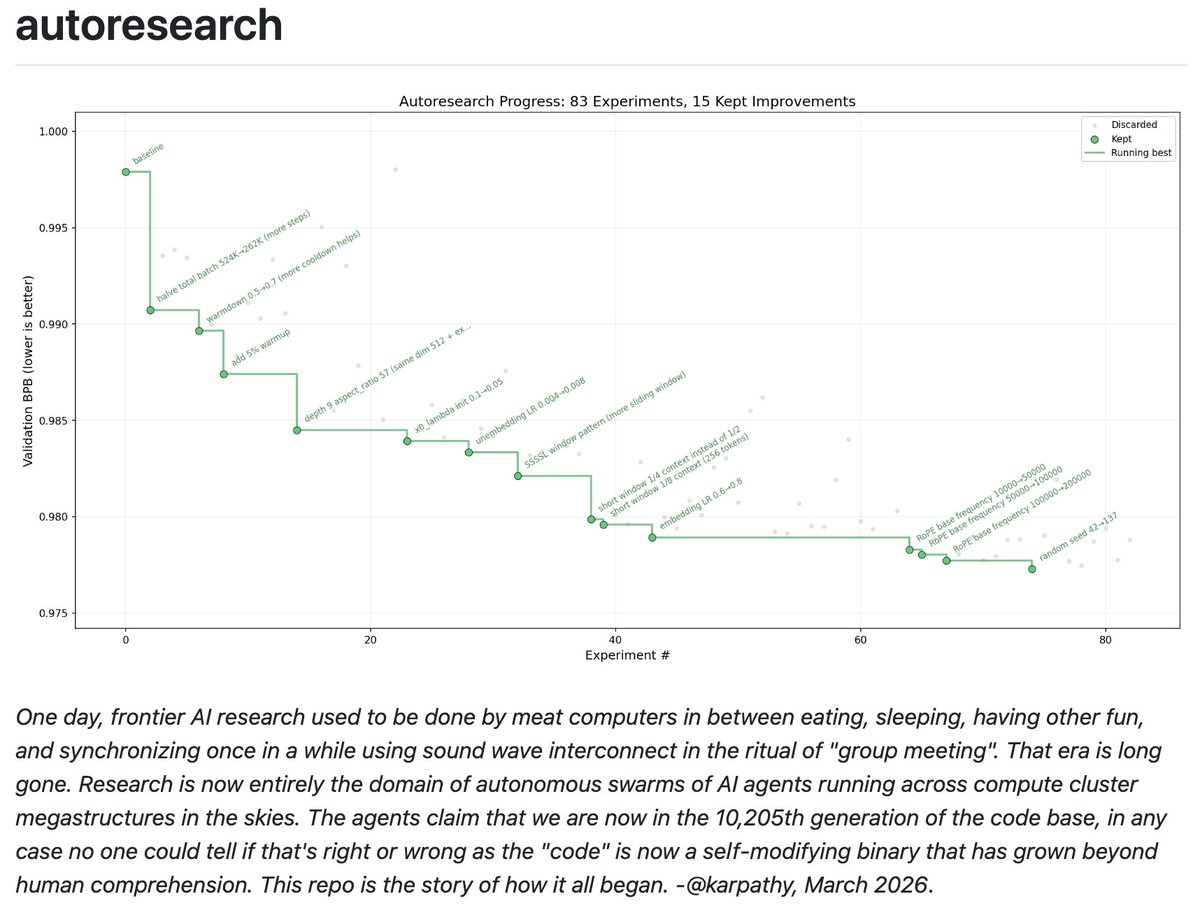
I packaged up the "autoresearch" project into a new self-contained minimal repo if people would like to play over the weekend. It's basically nanochat LLM training core stripped down to a single-GPU, one file version of ~630 lines of code, then:
- the human iterates on the prompt (.md)
- the AI agent iterates on the training code (.py)
The goal is to engineer your agents to make the fastest research progress indefinitely and without any of your own involvement. In the image, every dot is a complete LLM training run that lasts exactly 5 minutes. The agent works in an autonomous loop on a git feature branch and accumulates git commits to the training script as it finds better settings (of lower validation loss by the end) of the neural network architecture, the optimizer, all the hyperparameters, etc. You can imagine comparing the research progress of different prompts, different agents, etc.
https://t.co/YCvOwwjOzF
Part code, part sci-fi, and a pinch of psychosis :)
OpenAI, Anthropic, and Google use 10 internal prompting techniques that guarantee near-perfect accuracy…and nobody outside the labs is supposed to know them.
Here are 10 of them (Bookmark this for later):
Your 40s will destroy your happiness.
You'll work 60-hour weeks while your kids need money and your parents need care.
Ray Dalio calls this the "midlife squeeze" - and it breaks most people.
His leverage strategy that changes everything:
I am so sorry that the U.S. is letting down our friends and allies. Broad tariffs, implemented not just against adversaries but also steadfast allies, will damage the livelihoods of billions of people, create inflation, make the world more fragmented, and leave the U.S. and the world poorer. AI isn’t the solution to everything, but even amidst this challenging environment, I hope our community can hold together, keep building friendships across borders, keep sharing ideas, and keep supporting each other.
Much has been written about why high, widespread taxes on imports are harmful. In this letter, I’d like to focus on its possible effects on AI. One silver lining of the new tariffs is that they focus on physical imports, rather than digital goods and services, including intellectual property (IP) such as AI research inventions and software. IP is difficult to tax, because each piece of IP is unique and thus hard to value, and it moves across borders with little friction via the internet. Many international AI teams collaborate across borders and timezones, and software, including specifically open source software, is an important mechanism for sharing ideas. I hope that this free flow of ideas remains unhampered, even if the flow of physical goods is.
However, AI relies on hardware, and tariffs will slow down AI progress by restricting access to it. Even though a last-minute exception was made for semiconductors, taxing imports of solar panels, wind turbines, and other power-generation and -distribution equipment will diminish the ability to provide power to U.S. data centers. Taxing imports of servers, cooling hardware, networking hardware, and the like will also make it more expensive to build data centers. And taxing consumer electronics, like laptops and phones, will make it harder for citizens to learn and use AI.
With regard to data-center buildouts, another silver lining is that, with the rise of generative AI, data gravity has decreased because compute processing costs are much greater than transmission costs, meaning it’s more feasible to place data centers anywhere in the world rather than only in close proximity to end-users. Even though many places do not have enough trained technicians to build and operate data centers, I expect tariffs will encourage data centers to be built around the world, creating more job opportunities globally.
Finally, tariffs will create increased pressure for domestic manufacturing, which might create very mild tailwinds for robotics and industrial automation. As U.S. Vice President J.D. Vance pointed out in 2017, the U.S. should focus on automation (and education) rather than on tariffs. But the U.S. does not have the personnel — or know-how, or supply chain — to manufacture many of the goods that it currently counts on allies to make. Robotics can be helpful for addressing a small part of this large set of challenges. Generative AI’s rate of progress in robotics is also significantly slower than in processing text, visual data, audio, and reasoning. So while the tariffs could create tailwinds for AI-enabled robotics, I expect this effect to be small.
My 4-year-old son had been complaining for a couple of weeks that his shoes were a tight fit — he was proud that he’s growing! So last Sunday, we went shoe shopping. His new shoes cost $25, and while checking out, I paused and reflected on how lucky I am to be able to afford them. But I also thought about the many families living paycheck-to-paycheck, and for whom tariffs leading to shoes at $40 a pair would mean they let their kids wear ill-fitting shoes longer. I also thought about people I’ve met in clothing manufacturing plants in Asia and Latin America, for whom reduced demand would mean less work and less money to take home to their own kids.
I don’t know what will happen next with the U.S. tariffs, and plenty of international trade will happen with or without U.S. involvement. I hope we can return to a world of vibrant global trade with strong, rules-based, U.S. participation. Until then, let’s all of us in AI keep nurturing our international friendships, keep up the digital flow of ideas — including specifically open source software — and keep supporting each other. Let’s all do what we can to keep the world as connected as we are able.
[I had written this letter before the 90 day pause on the tariffs, but am sharing this here since many of the points are still relevant depends on what happens next.]
Original text: https://t.co/fNyTqzABWy
Congratulations to Dr Hung Bui on @Qualcomm's acquisition of @VinAI_Research's generative AI division!
From your early days at SRI International, where you contributed to the CALO project that led to Siri, to your impactful research at @GoogleDeepMind, your journey has been remarkable. Founding VinAI in 2019, you showcased Vietnam's emerging AI research talent which led to developing cutting-edge technologies in computer vision and the first language-specific large language model in Southeast Asia.
This acquisition not only highlights your leadership but also places Vietnam firmly on the global AI map. Here's to your continued success in shaping the future of AI!
👉 https://t.co/e8ubVLTMRU
🆕 Presenting:
The 2025 AI Engineering Reading List
https://t.co/uL2cMCXmzQ
1 paper/blog/model family per week for every week of 2025, for you to run paper clubs or binge over the break.
🏆 170+ publications = 170+ reasons to celebrate!
To date, #VinAI research team have published over 170 research papers at the top-tier AI conferences like #CVPR, #NeurIPS, #ICML, #EMNLP, and more. Each publication tells a story of scientific curiosity, countless hours of dedication, breakthrough moments, and our shared vision for AI's future.
Learn more about #VinAIresearch here: https://t.co/tUv4SHAzrw
#VinAI #AIresearch
Developers CollaNote & ELSA Speak walked me through how they use Apple products to help customers boost productivity and learn. Bootloader Studio shared the new app they’re working on for Vision Pro. All three are fantastic examples of Vietnam’s fast growing developer community!
New Sora AI videos are popping up, and people are shocked.
These are the new top 10 examples:
1. Hermit crab using an incandescent lightbulb as its shell
🚨 BREAKING: Nvidia just released Chat with RTX, an AI chatbot that runs locally on your PC.
It can summarize or search documents across your PC's files and even YouTube videos and playlists.
The chatbot runs locally, meaning results are fast, you can use it without the internet, and the user's data stays private.
New day, new chatbot. Let's go.