@SafaricomPLC@Safaricom_Care The One App has gotten really good and reliable. Looks like your work is starting to pay off. I like how it shows me my data bundle balance and M-PESA is no longer misbehaving as much. Your bet might just pay off 👍
@werucome@_celestino127 You’re absolutely right and I didn’t even think about it that way. We might even have a chance with manufacturing if we can crack this!!!
@werucome@_celestino127 Yes, you are right, I stand corrected. “Is hard to find” is the correct wording. And I pray that it happens soon. We can leapfrog entire civilizations with our youthful population.
@werucome@_celestino127 “Elon Musk contributed roughly $38 million (with some estimates reaching up to $45 million) to OpenAI between December 2015 and May 2017..” - Google.
Finding someone with his IQ who is a good capital allocator in our population is impossible. That’s a big challenge.
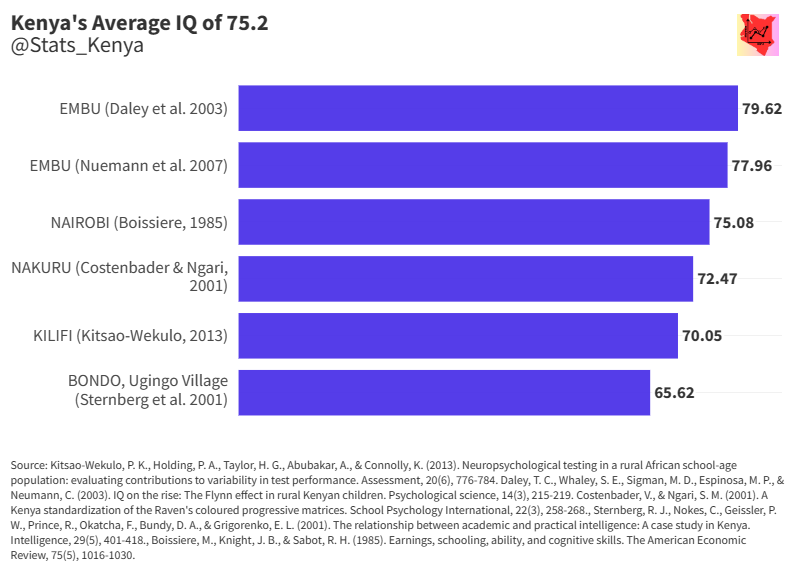
Due to Public Demand: What is Kenya's average IQ, and how was it measured? Kenya has an average IQ of 75.2.
1. EMBU 79.62
2. EMBU 77.96
3. NAIROBI 75.08
4. NAKURU 72.47
5. KILIFI 70.05
6. BONDO, Ugingo Village 65.62
For more details, this post summarizes everything you need to know about IQ testing in Kenya.
Kenya’s average IQ was determined from studies conducted on Kenyan children and adults from different regions. In 2001, a sample of 1370 children in Nakuru were given the Raven’s Colored Progressive Matrices (RCPM), a culturally unbiased IQ test. Most of the children in this study were between 6 years of age and 10 years. All the children were between class one and class five. The sample had a total of 583 boys and 637 girls. Half of the students were Kikuyu (605 students), Luo (252), Luhya (134), Kisii (82), Kalenjin (57), and 79 other children from other ethnicities. The study found the average IQ of the students in the study sample to be 72.47.
Another study was conducted in Nyanza province in 2001. It involved a sample of 85 children, 43 boys and 42 girls, living in Ugingo village in Bondo. The children's ages ranged between 12 and 15. The children took various tests to measure intelligence, including a Dholuo vocabulary test, an English vocabulary test, and an abstract reasoning test. The test results found that the average IQ of the children was 65.62.
In 2007, researchers conducted a study to find out the effect of meat supplementation on the cognitive abilities of Kenyan children living in Embu. Twelve primary schools were selected, each assigned one of four groups. The test group received meat in addition to the Githeri they ate at school, while the rest acted as control groups. The children's IQ was measured using the Raven’s Colored Progressive Matrices, which yielded an average IQ of 77.96 after analysis.
In 1984, another study was conducted in Embu to measure the Flynn effect (The observed rise of IQs over time) over a 14-year period. The initial study was conducted in 1984 with a sample of 118 children with a mean age of seven years. The final study was conducted in 1998 with a sample of 537 children. Different IQ tests were used, including Raven’s Progressive Matrices, a digit span test, and a verbal meaning test with culturally appropriate pictures. The initial study recorded an average IQ of 69.89, while the final study recorded an average IQ of 79.62. This last figure was used in the calculation of the mean.
In 1985, a study of 205 adults conducted in Nairobi also established the average IQ of Kenyans to be within the same range. The study sample comprised working individuals from different socioeconomic backgrounds, primary and secondary school graduates, and occupations. The study established that the average IQ of the individuals was 75.08.
Children from Kilifi also participated in a 2013 study to establish methods of testing the IQs of children from non-western countries, considering the cultural differences between western and African children. 308 children aged between 8 and 11 were included in the study. The study found ways of testing children using culturally appropriate techniques and successfully established test scores from the Raven Progressive Matrices. The tests administered revealed an average IQ of 70.05.
Note: Check the chart for references.
@werucome@_celestino127 “With a budget of around US$2–5 million (KSh 260–650 million), a consortium…”
I wonder when was the last time we spent 2-5 million USD on any tech related RnD. That kind of money is under someone’s mattress, unfortunately they are most likely low IQ politician not a University
@_celestino127 Hata hiyo si ngumu. Stima iko. Na si lazima tuanze from scratch. Shida naona ni inahitaji ujamaa. Capital allocation ni ngumu. Data yetu ni kama raw materials, labor yetu ni kama miners. Tutabaki nyuma tu kama industry zingine. Maybe @CassavaTech wataweza
@nduwaflorent Good idea. Developing for multimodal is the goal I guess. Especially since they want to create Humanoids at the end of all this. Tesla is the closest to crack vision, audio seems to be unsolved, speech to text sucks. Text through chat is close to being solved.
Great analogy comparing LLMs (AI) to compilers. I started my “coding” journey on Visual Basic. I still had to devolve down to working almost exclusively in VIM and the terminal later on. Coding isn’t just about the code. It’s magic.
I have a new found respect for Hon. Ichung'wah, Anthony Kimani. I might not agree with him but I respect those who speak their mind. Freedom of expression is a fundamental principle of democracy
As the old joke goes: ‘Linux is free… if your time has no value.’
Open-source AI feels the same right now. The weights are free, but turning them into reliable agents that just work? That costs hours of setup, debugging, fine-tuning, and custom skills.
Anyone who tried OpenClaw early on knows benchmarks mean little for real AI usefulness. Turning open-source models into truly capable agents still takes serious work. It feels like early Linux, when you had to compile your own kernel just to get a modem working.
I confess that on some mornings I hate waiting, so I've been known to run multiple agents on the same codebase if they're working on disjoint tasks. Hasn't burned me yet :-)
5 million humanoid robots working 24/7 can build Manhattan in ~6 months. now just imagine what the world looks like when we have 10 billion of them by 2045. now imagine the year 2100.
@NdindiNyoro Updating the website link on your bio takes 1 minute. Even if maybe you had ADHD it should at least take 2 weeks. Your lack of action, just like voting patterns, show that your are complicit. Update the link!