@BertAndDomes @LetsTalkHockey9 Hey Jeff, I'm a reporter for the Toronto Star, looking to hear from people stuck without power after the storm. Mind shooting me a DM or email if interested?
@LetsTalkHockey9 Hey there, I'm a reporter with the Toronto Star looking to chat with people swept up in the power outages. If interested, mind shooting me a DM or email when you have time?
@glott77 Hey Kevin, I'm a reporter with the Toronto Star looking to chat with people swept up in the power outages. If interested, mind shooting me a DM or email when you have time?
Have you been dropped or otherwise penalized by your family doctor after visiting a walk-in in Ontario? We'd love to hear from you for a story for @TorontoStar.
Please shoot me a DM or email at [email protected] if interested, thanks!
@_DanielleLeGrow@MikePMoffatt Hi @_DanielleLeGrow I'm sorry this happened to you -- I'm a reporter for the Toronto Star writing about this policy. Do you mind sending me a DM when you have the time?
@MikePMoffatt Hi @MikePMoffatt, I'm a reporter for the Toronto Star writing about this policy in Ontario. Do you mind sending me a DM when you have the time?
@tjfarncombe Hi Travis, I'm a reporter for the Toronto Star - mind DMing me when you have time? We'd love to hear from you about this incident, many thanks.
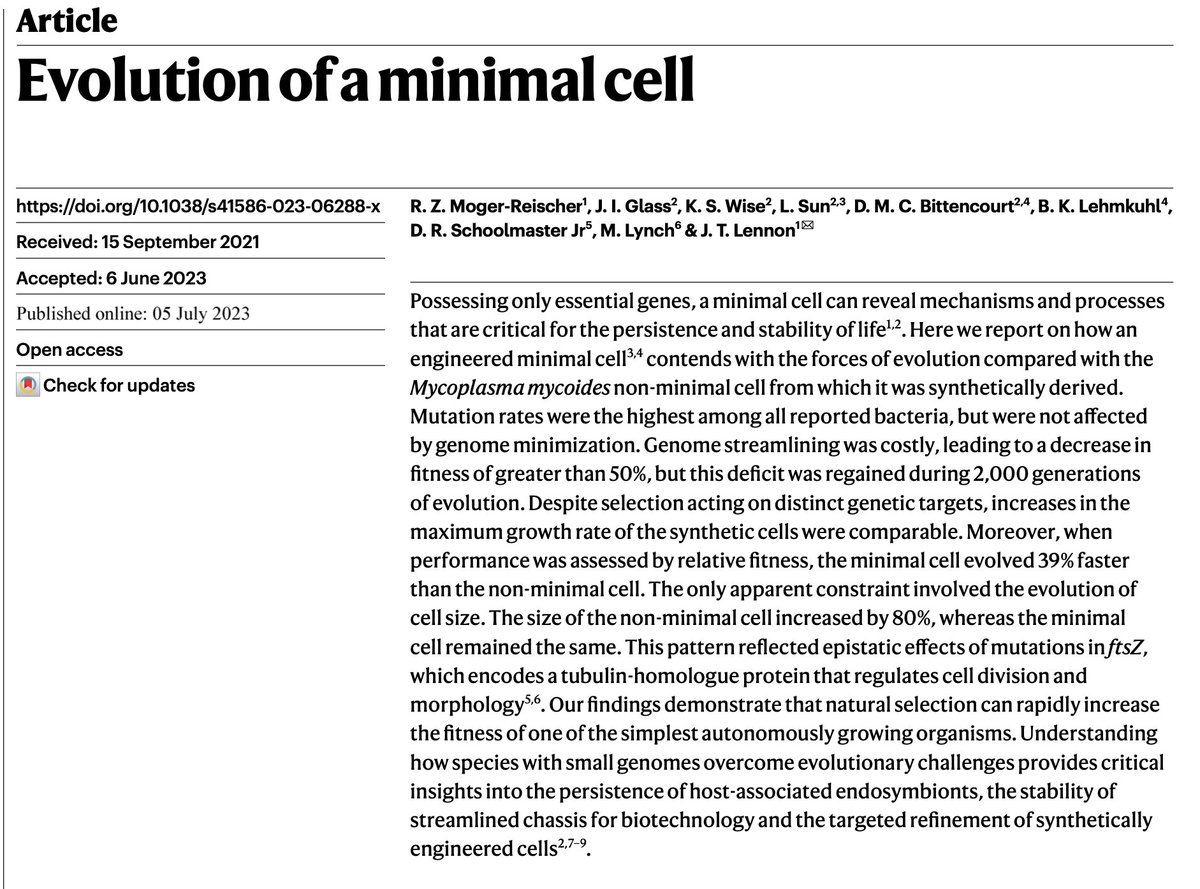
A mind-blowing paper has come out today in @Nature
In 2016, JC Venter Institute scientists trimmed a bacterial genome to its barest minimum required for life to synthesize what they called a "minimal genome" (https://t.co/Rk8oZJ0bUj).
Today, a group of scientists from Indiana University reports how that minimal genome evolved over 2000 generations in comparison to the non-minimal genome.
The authors found that even when you reduce a bacterial genome to its absolute minimum where every nucleotide matters, the genome undergoes mutational events generation after generation as much as the non-minimal genome. One simply cannot stop the evolution.
Just over 300 days of evolution (equivalent to 40,000 years in humans) the minimal cell has gained everything it lacked in fitness on day one in comparison to the non-minimal cell.
When comparing the evolved traits between the minimal and non-minimal cells, the scientists found something striking. The evolutionary process increased the cell size of non-minimal cells but not that of the minimal cell. But that is not the striking part.
The scientists were able to identify the key mutation that resulted in cell size evolution. And it turned out that the mutation that helped the non-minimal cells to grow bigger is the same that helped the minimal cells to stay smaller. Growing bigger had a survival advantage for non-minimal cells and not growing bigger had a survival advantage for minimal cells. So, the mutation had a context-dependent effect. This just demonstrates that the evolutionary effects on traits have no absolute direction. All that matter is what is beneficial for the organism's survival.
The conclusion of the paper is metaphorically a quote from the Jurassic Park movie:
“Listen, if there’s one thing the history of evolution has taught us is that life will not be contained. Life breaks free. It expands to new territories, and it crashes through barriers painfully, maybe even dangerously, but . . . life finds a way". (https://t.co/UlxRlb86CT)
https://t.co/zA9OAqSoAu