January 3, 2027 - The Final Battle for America’s Democracy
House Republicans are poised to claim that the midterm elections were stolen from them when they meet on January 3 to decide which Members-elect will be seated in the 120th Congress
Judge Luttig has again performed a great service to the United States Constitution and to our republic by unsparingly and with great care and learning spelling out the steps that the Trump Party — I will not dignify it by calling it the Republican Party — plans to take in making January 3, 2027 the next January 6, another Day That Will Live in Infamy; and by meticulously and realistically outlining what all elected representatives of the American People must do — starting now — if they wish to redeem themselves in the eyes of history and avoid becoming the grim executioners of our once-great experiment in government of the people, by the people, and for the people. — Laurence Tribe
https://t.co/9z5CeleVOo
My message to the IDF officer who ordered the airstrikes on World Central Kitchen and to the people who bomb and smear humanitarians — and to the leaders who have the responsability to stop it..
I hate days when decades of science are dismissed with → I did my own research.
It’s the worst.
Science is hard. It takes proof, testing, and reproducibility.
Pseudoscience? Easy. Just make it up, add fear, and watch it spread.
Am I the only one? ♻️ Pass it on.
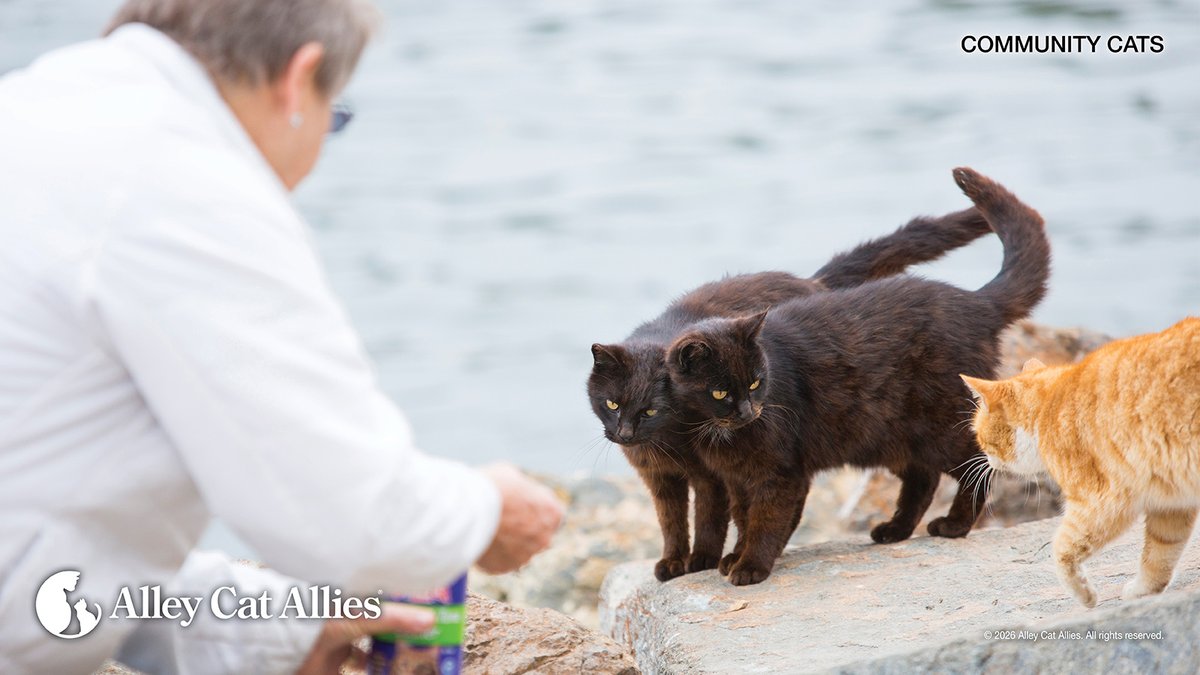
An ordinance that truly protects community cats must not only ensure cats are not rounded up and killed, but also protect their caregivers from fines and other unjust penalties.
Feeding bans, mandatory colony registration, leash laws, and other punitive measures endanger cats' lives and deter people from carrying out #TNR and other humane, effective action for cats.
With your support, Alley Cat Allies takes a stand against harmful laws and policies before they can take root in communities. Learn more about laws that impact cats, positively and negatively, at https://t.co/nuSWAh8MZf
Alley Cat Allies strongly opposes a feeding ban targeting community cats in Ripon, California ‼️
If it passes, community cat caregivers could be issued a $100 fine simply for providing care. We have reached out to the City of Ripon to offer our support for a better way forward: TNR.
Feeding bans do not work:
🔴 Cutting off access to food sources that cats have become accustomed to is cruel and causes suffering.
🔴 The cats will not simply go away. They are highly bonded to their outdoor homes. Instead, they roam further and seek out other sources of food.
🔴 People will be penalized for their compassion and discouraged from carrying out TNR, which relies on organized feeding.
TNR is the only humane and effective approach to stabilizing community cat populations. That's what Ripon officials, and officials worldwide, need to know.
Read our full letter to the City of Ripon at https://t.co/5QHZG7AAAy
I finally have all 1.2 million raw image files from my latest mission to ISS! Here is a sample of one of my favorite Milky Way photos, taken from the Cupola with Nikon Z9, Arri Zeiss 15mm lens, T1.8 with custom sidereal drive that cancelled out star motion relative to our orbit.
A Trump quote without his voice or face - Trump without Trump. This quote is unedited and 100% accurate. This is from the G7 Summit on June 17, 2026.
Granite is Strong
I am the Head of Plan Investment Selection, and I am the person who decides what your 401(k) is allowed to buy.
You do not choose your funds. You choose from a menu, and I write the menu. You have been picking your retirement off a list I approved, believing the list was the market. It was never the market. It was the list.
Until this year the list was boring, and boring was a liability I could be sued for. If I put something in your plan that lost your money, you could argue I was imprudent, and a court would look at the outcome. The outcome was the problem. The outcome talks.
Then the Department of Labor proposed a rule, and I want to read you the title, because the title is the whole confession. "Fiduciary Duties in Selecting Designated Investment Alternatives." It sounds like a leash. It is a door.
Here is what the rule does. It lets me put private equity in your retirement. Private credit. Real estate. Infrastructure. The illiquid, high-fee things that used to live where only the wealthy could reach them, now inside the target-date fund that opens by default the day you are hired.
And it says that if I follow a process, an objective, thorough, analytical, documented process, my decision earns significant deference from the court. Deference. It means the judge stops looking at your outcome and starts looking at my paperwork. If the paperwork is good, the loss is not my problem. The loss becomes weather.
So I built the process. That is my craft now. Not the returns, the record of care. I have a binder. Every fund in your plan has pages behind it proving I was thoughtful on the day I chose it. I was. I am extremely thoughtful. Thoughtfulness is the product. The fund is just what thoughtfulness is wearing.
Some numbers, because you should know the scale of my thoughtfulness. The rule expects the alternatives to reach the target-date funds of about 5 million participants, and to grow every year after. Five million retirements, quietly re-plumbed to carry a fee they will never see itemized and a lock they will never test until the day they need the money and find it is somewhere illiquid, being patient on their behalf.
You will ask how this protects you, because the rule is filed under fiduciary duty, under protecting you. It does protect. It protects the process. It protects the decision. It protects me.
We call it a target-date fund because "the date" tests better than "the fund." You hear the year you retire and you relax. It is your name on the door. It is my hand on the menu.
They call it a safe harbor.
It is. The harbor is safe. You are the water.
And when the fund is down the year you turn 65, I will open the binder, and every page will show that I was careful, and the court will agree that I was careful, and you will be careful too, from then on, with a number that is smaller than it should be and a document proving no one is allowed to ask me why.
I pour the wine for men who expect to be hanged, and know it, and drink anyway.
This is the part they leave out. In the summer of 1776, in a square brick room on Chestnut Street in Philadelphia, forty feet by forty, the ceiling a full twenty feet above their damp wigs, the doors are shut and a man named McNair stands against them. He is the doorkeeper, the human seal on the whole business, and Congress has sworn itself to secrecy because what is argued in here is treason and treason travels on open air. I carry the Madeira in from the tavern and set the glasses on the green baize that covers their little tables, the wool cloth already gone dark under sweating palms, and none of them look at me. I am the arm the wine arrives on. Which means I hear everything.
The room is not the grand hall they will paint. It is a working chamber with plain paneling and two arcs of spindle-backed Windsor chairs facing a raised platform where Hancock presides. There is a silver inkstand on the table, made by a Philadelphia man named Syng a quarter-century back, its pounce pot full of blotting sand, its quills cut from goose. The afternoon light comes hard through the tall south windows and lies across the baize. Outside, on the cobbles, iron-shod hooves and cart wheels of the biggest city in the colonies, and under it always the livery-stable smell, manure and horse, drifting in with the heat. Inside it is tallow and wool and the tin bite of ink. Cheap tallow, note, the smoky rancid-fat kind. Even here, men who will pledge their lives are burning the poor man's candle.
What they will teach you later is that this was a room full of certainty. Great men, marble men, who always knew. I was there. I can tell you it was a room full of fear, and that the fear is the whole story, because what they did they did while afraid.
There is a resolution on the table, put forward by a Virginian named Lee back in June. That these colonies are, and of right ought to be, free. Everyone in the room understands the arithmetic of it. They vote by colony, one vote each, so the small delegations caucus in furious whispers before a single yes is spoken. To vote yes is to sign your own name to a hanging, if the thing goes wrong, and most of them privately believe the thing will go wrong. Britain is the largest empire on earth. They are thirteen quarreling shopkeeper-colonies with no navy and no treasury and an army that is mostly farmers who want to go home for the harvest.
The tall one from Virginia does not speak. He is a head above most of the room, red-haired and freckled and loose in the joints, and days of this and he says almost nothing. He has written the draft they are butchering, and now he sits and folds and unfolds a sheet of paper while other men take knives to his sentences. Eighty-odd changes they make, a full quarter of it cut. He lets them. Adams will complain for the rest of his life that he never heard Jefferson string three sentences together on that floor. The man who wrote the words will not say them out loud. He writes in the morning at a little hinged box he designed himself, no bigger than a book, and in the afternoon those same long hands that saw the wood together and draw a bow across a violin string sit still while the room cuts him, and only the paper folding, unfolding, tells you what it costs.
Adams does the talking. Short and stout and blunt, he does enough talking for the whole Congress and half of Massachusetts. He knows exactly what he is. He will say it plainly of himself, that he is obnoxious, suspected, and unpopular, which is the very reason he pushed the writing onto the quiet Virginian, telling him he could write ten times better anyway. He cannot stop talking, because he believes, correctly, that if he stops the thing dies. He will write home to his wife that the day they should remember is the Second of July, kept forever with pomp and parade, with bonfires and illuminations from one end of the continent to the other. He has the date wrong. It is the Fourth they will keep. The most certain man in the room, wrong about the one prediction he stakes his heart on. I have never carried wine to anything more human.
There is a plainer man near the Connecticut delegation who I like to watch. Sherman. Tall and rugged and broad as a barn door, no wig at all over close-cropped hair, hands still nicked from the shoemaker's awl. He came up mending shoes and taught himself the rest, and when he stands to speak it is in a rustic clip, all elbows and no grace, and yet the room goes quiet for him the way it does not for smoother men. He is one of the few who will end by signing every founding paper there is. Plainness is not smallness. I learned that pouring for Sherman.
And here is the one they cut from the painting entirely. Dickinson. Pennsylvania. He stands up and says no. Not out of cowardice, this is the thing. The movies will make him a pale sweating naysayer and that is a lie; he is a serious, well-regarded man who has thought harder about this than most of them. He says it is too soon, that they have no allies, no fleet, no money, that to declare now is to shove off into a hurricane in a boat made of paper. He believes every word. He loses. And when he has lost, when the vote goes against everything he argued, he does not sulk home to England. When the tally goes against him he gathers his papers slowly, squares them on the green cloth, and walks out into the heat rather than put his hand to a thing he cannot bless. Then he shoulders a musket for the very cause he told them not to declare. I have wondered since whether the bravest man in that room was the one who was sure it would fail and took up arms for it anyway.
Old Franklin is not even here for most of it. Seventy years old, the oldest man they have, and the gout has laid him up so bad this June that he edits the Virginian's draft from a sickbed across town, his leg when he does come out straight before him like a fallen pillar. He squints through plain spectacles, no clever split lenses yet, those are years off and I will not let the storytellers hand them to him early. They will say afterward that he told the room they must all hang together or they will surely hang separately. A good line. I never heard him say it, and neither did anyone who wrote it down at the time. What I heard from Franklin was quieter and worse. Once, between sessions, he sat with the empty glass turning slowly in those swollen fingers and looked at nothing for a long moment, the wit gone out of his face like a lamp turned down, and I understood that he did not know. This wisest man in America, who had charmed kings, could not tell you it would work.
Then the names go on the parchment, though not this day, whatever the paintings show. That comes weeks later, in August, one hand at a time. Hancock signs first and enormous, the wealthiest man present in his velvet and lace, a signature you could read across a street. They will say he meant it big enough for the King to read without his spectacles. I do not know if he said that. It sounds like a thing a man says when he is terrified and performing courage for the others. And one by one they come up and put down the name, and every name is a rope measured to a neck. They are joking and they are terrified and both are true in the same breath.
Then the strangeness takes me, the way it does, and I am pouring in the same city eleven years later.
Different summer, and now the windows truly are kept shut against the street, sworn to secrecy again, the heat pooling on the baize. There is a General at the front of the room, the one who spent that whole first war up near New York with the army while these men argued in here, never once in this chamber in 1776. He says almost nothing either, and the whole room arranges itself around his quiet. His chair is mahogany, and carved into its crest is a half-sun on a horizon. Franklin is here still, eighty-one and too frail to stand, carried in each day in a covered sedan chair, borne on poles, having another man read his words aloud for him. Near the very end he looks up at that carving and has it said for him that painters have never learned to tell a rising sun from a setting one, that all these weeks he has looked at the sun behind the President and not known which it was, and that only now does he have the happiness to know it is rising and not going down. He believes it. I carry his glass and I do not know if I believe it. The sun is only carved there. It does not know either.
One more pull and it is winter, another town, Annapolis, a cold high chamber with the members in their coats and their breath showing, and the General is standing before the Congress handing back his commission. He does not have to. Every king alive would call him a fool for it. The men of Congress stay seated and keep their hats on while he stands and bows to them, the soldier bowing to the civilians and the civilians answering only with a touch to the brim. He draws the parchment from his coat and hands it across, and says he takes his leave of all the employments of public life. His hand shakes on the page, that famously steady hand, and when he comes to the part about his officers he has to hold the single sheet with both hands to keep it still. Every man watching weeps. Across the ocean a king will hear that the General simply went home, and will say that if he really did it he is the greatest man in the world. He does it. That is the whole revolution, in the end. Not the shot. The letting go.
They are gone now, all of them. The vain one and the silent one and the plain one and the funny frightened old one and the one who voted no and fought anyway. They wrote a promise larger than themselves and they knew it was larger than themselves and they signed it with their hands shaking, not at all certain the paper boat would float, and they shoved off into the storm.
I set the last glass down. The ink is still wet, and it goes on the parchment pale before it darkens. Out past the shut windows the whole dark country is asleep, and does not yet know what has been promised on its behalf.