Super excited about our adversarial models (not examples!) for uncertainty quantification. Model prediction is uncertain if other models with large posterior predict differently. Improved integral approximation by mixture importance sampling based on constraint optimization. Cool
Our CLAP 👏 model learns audio concepts from natural language supervision. CLAP achieves SoTA in Zero-Shot learning for different audio tasks. For example, in ESC50 CLAP achieves 82% acc, better than human classification with 81%. https://t.co/gLeaO9GujN
HEAR PMLR journal submissions are open until 2022-06-30. https://t.co/URhf1PPgrY
Besides that, people have asked if they can run HEAR benchmarks, get on the leaderboard, cite us in the future. Yes! HEAR is here to stay. See our updated website: https://t.co/VuSnPYF095
In case you missed it: I am one of the contributors to the first ICLR blog post track this year! I (tried to) write about Normalizer-Free networks (https://t.co/P6AbpDYlQA) and what they can and can not tell us about normalization:
https://t.co/DsJTo80K4v
Checkout the pre-print on arxiv https://t.co/nJRRkOuXJW
and the source code https://t.co/xXowr3qPjj
Joint work with Jan Schlüter, @heghbalz and Gerhard Widmer.
If you're attending @NeurIPSConf, don't miss today's Competition Track at 19:00 GMT. HEAR 2021 will be presented @neuralaudio.
I will give a lightning talk about our latest work "PaSST: Efficient Training of Audio Transformers with Patchout"
#NeurIPS2021
If you're attending @NeurIPSConf, don't miss today's Competition Track at 19:00 GMT. HEAR 2021 will be presented @neuralaudio.
I will give a lightning talk about our latest work "PaSST: Efficient Training of Audio Transformers with Patchout"
#NeurIPS2021
🔊Here's the video presentation of our WASPAA21 paper: "Self-Supervised Learning from Automatically Separated Sound Scenes". Work done during an internship at Google Research.
paper: https://t.co/NvEhyI8BzE
video: https://t.co/TD2x6Gs9b8
slides: https://t.co/U0LcbcgjfC
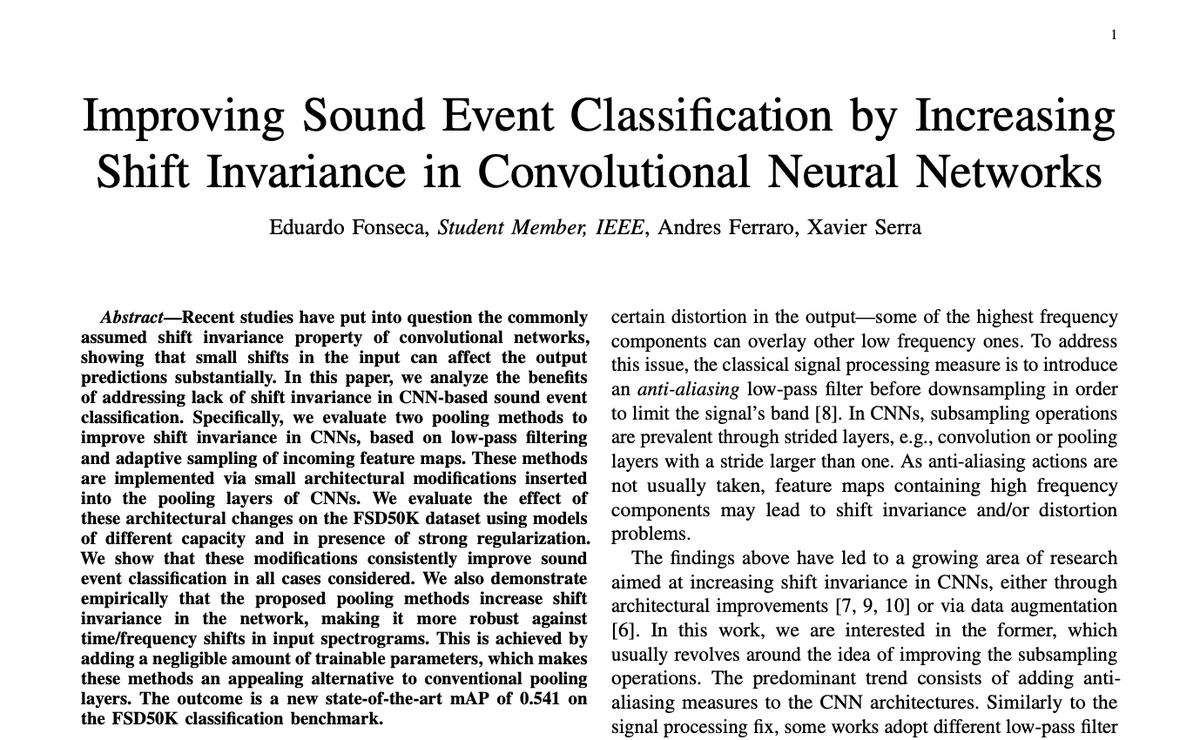
New paper! We evaluate two pooling methods to improve shift invariance in CNNs, obtaining SOTA on FSD50K. Methods are based on low-pass filtering & adaptive sampling of feature maps. They increase robustness to time/freq shifts in the input! w/ @andrebola_ https://t.co/j1C4SviomM
So many exciting papers accepted for @ismir2021! Can't wait for the conference!
Adding ours: "On Perceived Emotion in Expressive Piano Performance: Further Experimental Evidence for the Relevance of Mid-level Perceptual Features" w/Gerhard Widmer @cpjku
I am happy to announce that our latest work "On the Veracity of Local, Model-agnostic Explanations in Audio Classification: Targeted Investigations with Adversarial Examples" (together w/ @katxiip, Arthur Flexer and Gerhard Widmer from @cpjku) has been accepted to @ismir2021 🎉🥳
Very happy to announce a new #LIT project to start in fall @cpjku: Mitigating Gender Bias in Job Recommender Systems: A Machine Learning-Law Synergy (TIMELY). We are looking for PhD students in recommender systems, NLP, and non-discrimination. #HCAI#MMS#RecSys#NLP#RecSys2021
On Wednesday we are going to present our latest work "Tracing Back Music Emotion Predictions to Sound Sources and Intuitive Perceptual Qualities" at the Sound and Music Computing Conference in Session 8. See you there! @smcnetorg