...stay calm.
I found a treasure trove of coverage on the SPX whale's put spreads from last summer.
should I drop a master thread this weekend?
..need a ton of demand for this to justify the effort.
follow / like / retweet, and IF the interest is there
..it'll be epic.
🚨MAJOR ANNOUNCEMENT🚨
I’ve just released a big one-off Report on the US Stockmarket (historical perspectives, key lessons and principles for investors + the biggest risks vs opportunities in the coming years) https://t.co/v1VreAIk8k
Risk models increasingly drive the behavior of fundamental long short equity investors.
@__paleologo's 'Advanced Portfolio Management' is the most efficient primer to understand the internals of what is happening.
Chapter 1-4 bullets, with math & comments.
Let know if you'd like the excel.
*1) Risk, alpha, factors, & performance (Ch 1-3)*
"Any argument in favor of conflating beta and alpha is weaker than the simple argument in favor of decomposing them."
In the simple version, stocks contain components of both:
1) Systematic (factor) returns driven by common attributes across names, and
2) Idiosyncratic (residual) returns driven by specific attributes of each.
Most investors accept this distinction at a high level.
But the nuance is:
How sophisticated should your modeling of this "systematic" component be?
The first intellectual step beyond simple benchmarking is to look at historical beta: running a univariate regression between stock & market.
But simple betas are imprecise for several reasons, among them that they conflate one-time idio moves with recurring systematic relationships; and they also gloss over other often large systematic drivers (industry, growth, value, momentum).
Factor models in principle address those limitations:
If a simple benchmark "gives us a way to describe performance and variation of stock returns," the solution is "factor models[, which] capture these two intuitive facts, make it rigorous, and extend them in many directions."
*2) How to build a factor model (Ch 4)*
There are many flavors of plausible factor models, and Gappy outlines 3 (fundamental/characteristic, statistical, time-series).
As Gappy points out: "Each of these approaches has its merits and drawbacks" and he covers several of the core tradeoffs at the outset of the chapter. But "the characteristic model has the benefit of being interpretable by the managers" and "can be extended with new characteristics and perform quite well in practical applications."
The result is that "because of these two decisive advantages, the fundamental (or characteristic) method is by far the most used model by fundamental managers."
To build a fundamental factor model, the starting point are company attributes which are transformed into "loadings" (betas) of a stock to that attribute's returns.
For example:
The "size" loading is the simplest factor, and starts with the log of the stock's market cap compared to other market caps in the universe you care about.
The size loading is then its z-score (# of standard deviations away from avg) in that universe.
(In the weeds, data is winzorized, may use EWMAs, and more).
But armed with those loadings, the model then pulls factor returns by running cross-sectional regressions of stock returns against their loadings.
Restated in math:
The Y vector is each stock in the universe's return over the period,
The X matrix is all of their loadings.
The time series of those extracted factor returns then drives factor covariances (the FCM), residual returns, mimicking portfolios, idiovar%s, breadth, vol, and more.
There is much more worth spending time on here, but particularly to arm the fundamental investor with the basic mathematical intuitions, I've attached a very simplified fundamental factor model.
Will cover many other topics Gappy touches on another time: attribution, sizing skill, factor detail, PCAs & non-linearity, Sharpes & ICs, optimization, vol, & leverage.
But stepping back, the reason this all matters is simple: "empirically, most PMs have no skill in style factors whatsoever, and a few have very moderate skills in having exposures to industries or sectors."
The book's meta theme is intellectual honesty:
"The simplest and deepest challenge is to understand the limits of your knowledge."
Factor models rigorously separate what analysts can predict about single stocks, from what they cannot.
As Gappy points out, "you are entering an industry in transition."
Let know if you'd like the excel.
May Employment Report was described as "strong" by many.
NFP well above expectations.
UR higher but still some see it as "low".
AHE slightly above expectations.
However, there are worrying signs in the labor mkt that are usually overlooked and point to a #recession.
An employment thread.
1/11
Latest Unemployment data - SAHM Rules
State data says one thing (#recession), national averages say another (no recession). State data runs to March only, 1-month behind latest #unemployment print.
👉SAHM (3MA smoothing) is original rule that uses 3-month rolling average of nation wide unemployment data
👉SAHM (raw) is modified rule with no smoothing
👉% STATES SAHM TRIPPED = % of 52 U.S states where the SAHM rule, using no smoothing, have triggered.
⚡️To read about best use of SAHM rules at the national, state and metro levels, see our seminal research "The SAHM-rule Redux" at https://t.co/7768BJ3Zln
“Why should we listen to a fighter about trading?”
Never said you should. I share my thoughts and bet real money. Thats it!
Here to discuss, learn, connect with fellow traders. I love the game, work hard behind the scenes, but have never claimed to be more than a retail guy 🤷♂️
A new centrally cleared era in repo markets is looming, which will cause an exodus from its shadowy yet most systemic regions. This may increase resiliency but also inhibit key trades gluing U.S. Treasury markets together. The Repo Leverage Squeeze™ is here... 1/
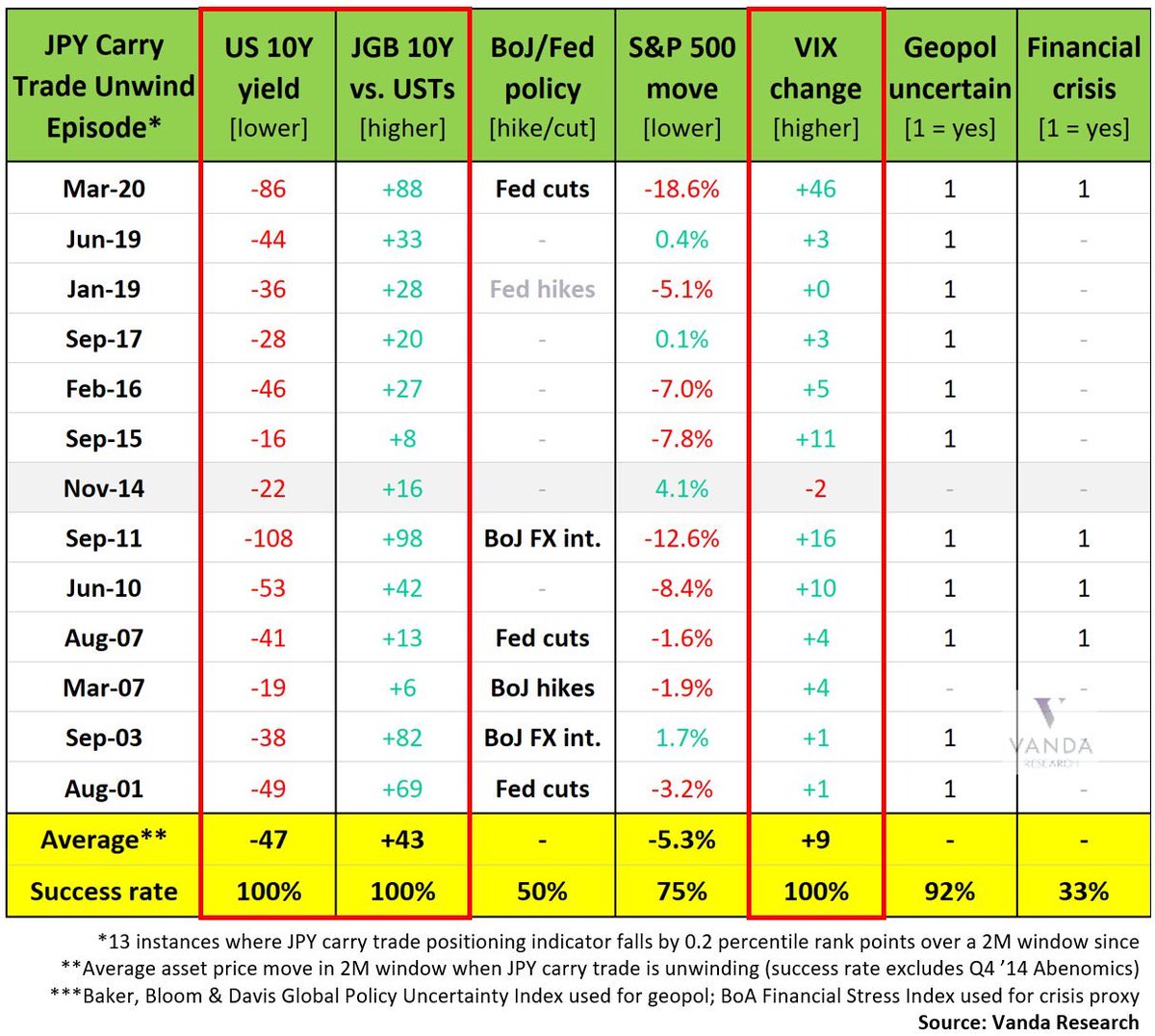
On $JPY - the problem with intervention is that once the genie is out of the bottle… it’s hard to put it back in. We’re at a stage where MoF/BoJ have no choice but to intervene. The best way would be for BoJ to hike 25bps this week. It’s not about the macro anymore (BoJ should’ve normalized policy faster last year).
It’s now a game between speculators and officials. Specs are short yen for good fundamental reasons (carry). At this stage, a “surprise” hike to send a signal to markets that they are concerned about ongoing FX weakness (and don’t test us) would be less costly to the economy vs. a further devaluation in the yen. It also adds an additional level of uncertainty to the BoJ/MoF reaction function - which speculators (long carry trades) don’t like.
FX intervention - which unfortunately looks to be the MoF/BoJ’s preferred route based on recent history - is not even a short-term fix anymore. USD/JPY dips would be quickly bought into based on recent market chatter. A hike goes a bit further towards solving the root cause of yen weakness - even it’s only a marginally better option.
P.S. The only true circuit-breaker for yen weakness is lower US yields/weak US macro. One added complexity for MoF/BoJ is that their two options for tackling yen weakness indirectly adds upward pressure to global rates/yields. They’re caught between a rock and a hard place… and speculators know (enjoy) this


![richfalkwallace's tweet photo. Risk models increasingly drive the behavior of fundamental long short equity investors.
@__paleologo's 'Advanced Portfolio Management' is the most efficient primer to understand the internals of what is happening.
Chapter 1-4 bullets, with math & comments.
Let know if you'd like the excel.
*1) Risk, alpha, factors, & performance (Ch 1-3)*
"Any argument in favor of conflating beta and alpha is weaker than the simple argument in favor of decomposing them."
In the simple version, stocks contain components of both:
1) Systematic (factor) returns driven by common attributes across names, and
2) Idiosyncratic (residual) returns driven by specific attributes of each.
Most investors accept this distinction at a high level.
But the nuance is:
How sophisticated should your modeling of this "systematic" component be?
The first intellectual step beyond simple benchmarking is to look at historical beta: running a univariate regression between stock & market.
But simple betas are imprecise for several reasons, among them that they conflate one-time idio moves with recurring systematic relationships; and they also gloss over other often large systematic drivers (industry, growth, value, momentum).
Factor models in principle address those limitations:
If a simple benchmark "gives us a way to describe performance and variation of stock returns," the solution is "factor models[, which] capture these two intuitive facts, make it rigorous, and extend them in many directions."
*2) How to build a factor model (Ch 4)*
There are many flavors of plausible factor models, and Gappy outlines 3 (fundamental/characteristic, statistical, time-series).
As Gappy points out: "Each of these approaches has its merits and drawbacks" and he covers several of the core tradeoffs at the outset of the chapter. But "the characteristic model has the benefit of being interpretable by the managers" and "can be extended with new characteristics and perform quite well in practical applications."
The result is that "because of these two decisive advantages, the fundamental (or characteristic) method is by far the most used model by fundamental managers."
To build a fundamental factor model, the starting point are company attributes which are transformed into "loadings" (betas) of a stock to that attribute's returns.
For example:
The "size" loading is the simplest factor, and starts with the log of the stock's market cap compared to other market caps in the universe you care about.
The size loading is then its z-score (# of standard deviations away from avg) in that universe.
(In the weeds, data is winzorized, may use EWMAs, and more).
But armed with those loadings, the model then pulls factor returns by running cross-sectional regressions of stock returns against their loadings.
Restated in math:
The Y vector is each stock in the universe's return over the period,
The X matrix is all of their loadings.
The time series of those extracted factor returns then drives factor covariances (the FCM), residual returns, mimicking portfolios, idiovar%s, breadth, vol, and more.
There is much more worth spending time on here, but particularly to arm the fundamental investor with the basic mathematical intuitions, I've attached a very simplified fundamental factor model.
Will cover many other topics Gappy touches on another time: attribution, sizing skill, factor detail, PCAs & non-linearity, Sharpes & ICs, optimization, vol, & leverage.
But stepping back, the reason this all matters is simple: "empirically, most PMs have no skill in style factors whatsoever, and a few have very moderate skills in having exposures to industries or sectors."
The book's meta theme is intellectual honesty:
"The simplest and deepest challenge is to understand the limits of your knowledge."
Factor models rigorously separate what analysts can predict about single stocks, from what they cannot.
As Gappy points out, "you are entering an industry in transition."
Let know if you'd like the excel.](https://pbs.twimg.com/media/GPjJ6FwXgAAVm33.png)