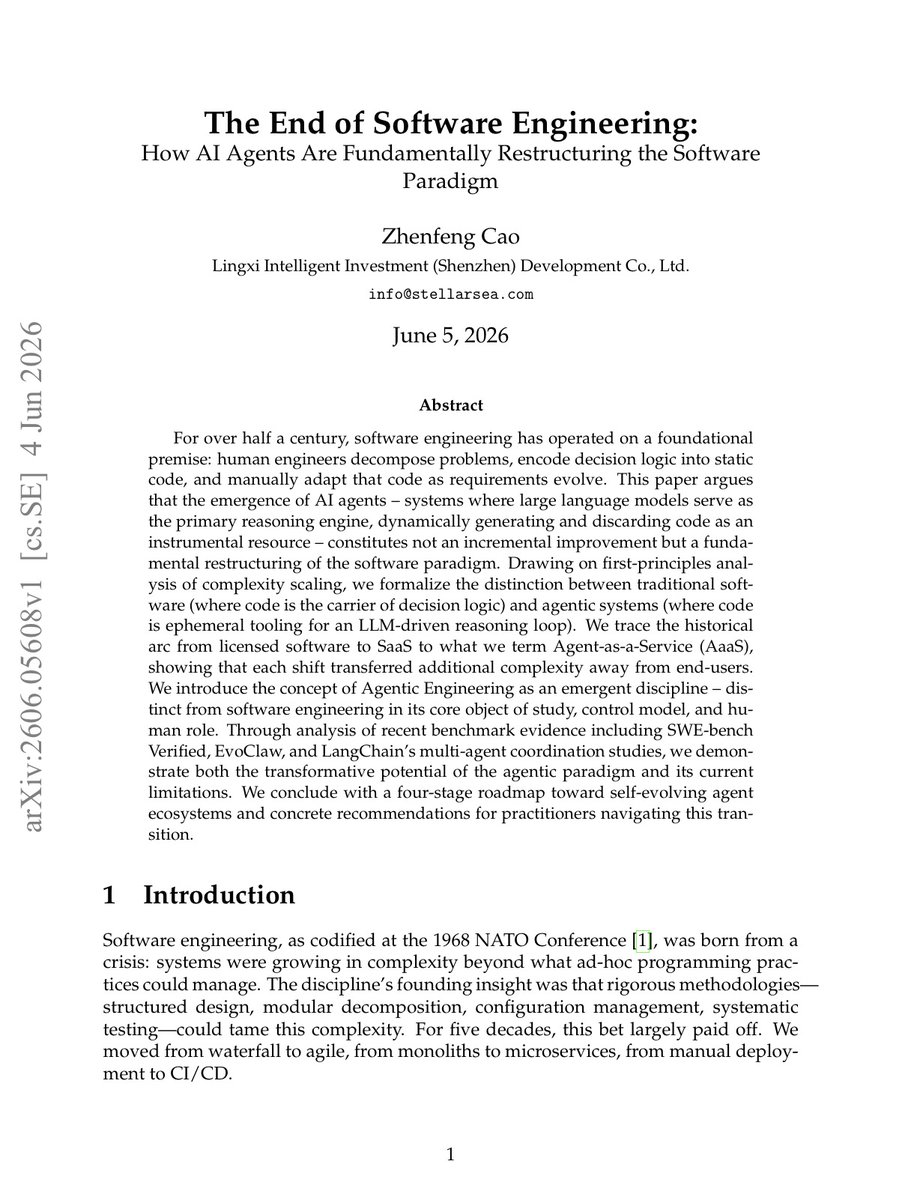
Chinese researchers just published a paper with a brutal title: "The End of Software Engineering."
The core point is that writing code is completely finished as a skill.
Your brain can only hold so much state and so many dependencies before it hits a wall.
An agent doesn't have that ceiling, and its capacity only grows with compute.
So the human stops being the one who writes the code.
You become the intent architect, the one who directs the agents and audits the result.
Code becomes the throwaway, and judgment becomes the job.
That's exactly why i wrote the guide below on how to build your own agent system from scratch.
You can also find the full paper this is based on below.
We didn’t just add a built-in browser.
OpenDesign gives agents an entire creative workspace.
Browsing, sketching, and document editing are all built in, so agents can research, think visually, and turn ideas into real deliverables without leaving the task.
See it in action↘️
إذا كنت تستخدم Claude Code أو Cursor لبناء واجهات، هذه المهارة قد تختصر عليك كثير من قرارات التصميم.
UI UX Pro Max تحلل نوع المشروع وتولّد Design System مناسب من الألوان والخطوط والأنماط إلى قواعد UX، مع دعم عدة أطر وتقنيات.
https://t.co/ypMaZCpmk7
I while back, I created a deterministic CLI to migrate entire Dart codebases to the new primary constructors syntax.
Now that this feature is stable in Dart 3.13, I decided to open-source this tool.
Check it out here:
https://t.co/itHoMHfUeX
Codex Design is real now.
Open Design is now live in the official Codex Plugin Directory, bringing a live design canvas directly into Codex.
A detailed demo is coming soon.
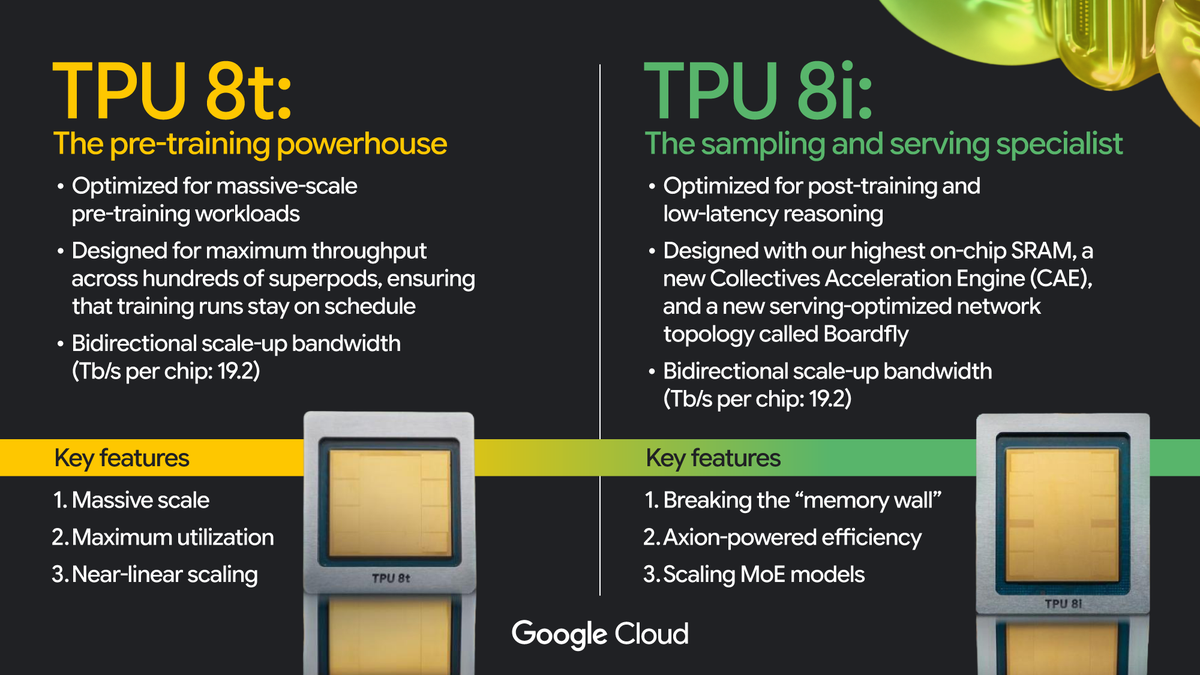
Get to know our 8th generation TPUs.
TPU 8t & TPU 8i are custom-engineered to power the next generation of supercomputing. Both chips can run various workloads, but they are individually specialized to the needs of training and serving → https://t.co/RtKlw5h390
🎨 Meet Qwen-Image-3.0 — the third generation of our foundational image generation model.
If 1.0 was about "Precision," and 2.0 added "Variety, Completeness, Beauty & Authenticity," then 3.0 comes down to a single word: Real (实).
Three dimensions of "Real":
📰 Rich Content — prompts up to 4.5k tokens. One-pass generation of complex layouts: newspapers, storyboards, exam papers — even a 3×3 infographic grid or picture-in-picture-in-picture UIs.
🔬 Authentic Details — text legible down to 10px, full LaTeX paper pages, pores, hair strands & near-photographic skin texture.
🌏 Deep Knowledge — native rendering in 12 languages, 100+ art styles, realistic UIs (web / games / livestreams), plus world knowledge & live web retrieval.
Not just "good-looking" — genuinely useful. Image generation as a real productivity tool for design, content, education & e-commerce.
Go create 🏃🎨
💬Qwen Chat: https://t.co/941HmITJ2W
📝Blog: https://t.co/5mnS4uI9Ar
BBC literally built the greatest sound library on the internet.
It is called BBC Sound Effects, and it gives you access to more than 30,000 recordings from around the world.
Just search any word, and it instantly finds matching sounds.
You can filter them by category, duration, and even the continent where the sound was recorded.
Every sound can be previewed inside your browser, downloaded, or added to the built-in mixer so you can layer multiple recordings together.
And the archive gets insanely specific.
You can find creaking ships, old typewriters, jungle ambience, distant church congregations, and even someone vigorously washing their hands.
There is a good chance a BBC engineer recorded the exact sound you need decades before you were born.
https://t.co/vdOBewxyg3
Train your own LLM from scratch!
A step-by-step repo that walks you through building and training a transformer model from scratch using PyTorch,
From downloading training data all the way to generating text.
The architecture is built from the ground up following the original Attention is All You Need paper.
MLP, single head attention, multi-head attention, transformer blocks, and the full transformer model -
all coded and explained with detailed diagrams at each step.
Training data comes from The Pile - a diverse 825GB open-source dataset covering books, articles, code, websites, and more.
The repo includes scripts to download it, preprocess and tokenize it using tiktoken, store it in HDF5 format, and feed it into training batches.
You can train a 13M parameter model on a single Colab T4 GPU.
At 13M parameters the model starts generating proper grammar and coherent short sentences.
For billion-parameter training you need at least an A100 or RTX 4090.
The repo includes a full GPU compatibility table so you know exactly what's possible on your hardware, Includes a complete SFT and RLHF guide as a separate notebook for taking your trained model further.
capabilities
- End-to-end pipeline: data download to preprocessing to training to text generation
- Full transformer implementation from scratch with PyTorch
- Trains models from 13M to 2B+ parameters on a single GPU
- Training data from The Pile (825GB, 22 diverse datasets)
- Tokenization via tiktoken (r50k_base)
- SFT and RLHF guide included
- https://t.co/mndieEoibk
You can now run an AI-driven security review on local code changes with the new experimental /security-review command in Copilot CLI.
https://t.co/Vp2gxSmJRd