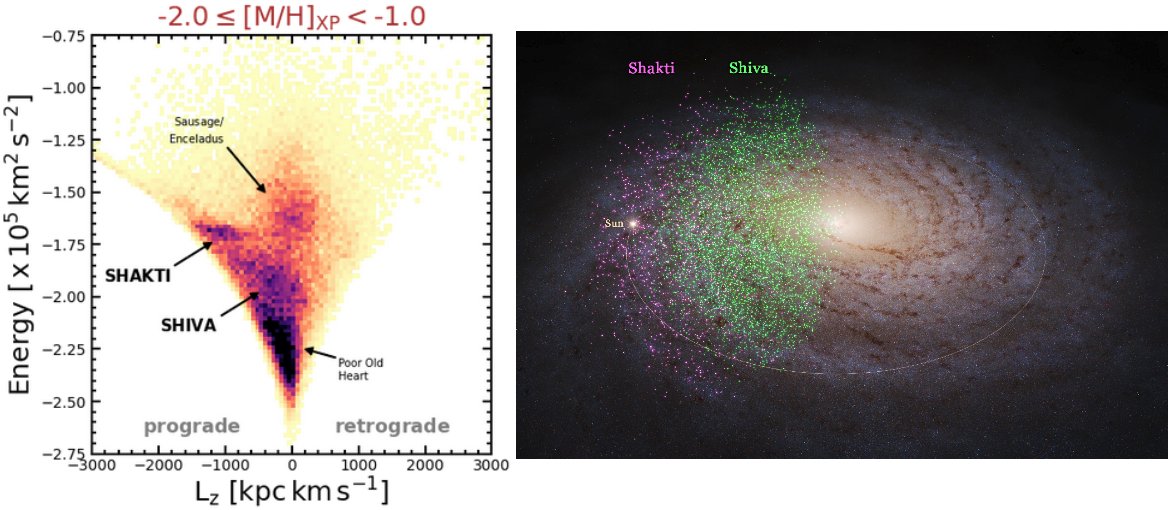
Discovery of two stellar structures in the orbit-metallicity space of our Galaxy. Shiva & Shakti appear to be two of those early, massive fragments that coalesced ~12 Gyr ago, forming the proto-Milky Way. Published in ApJ. https://t.co/53oHNQNVbE @ESAGaia@APOGEEsurvey@mpi_astro
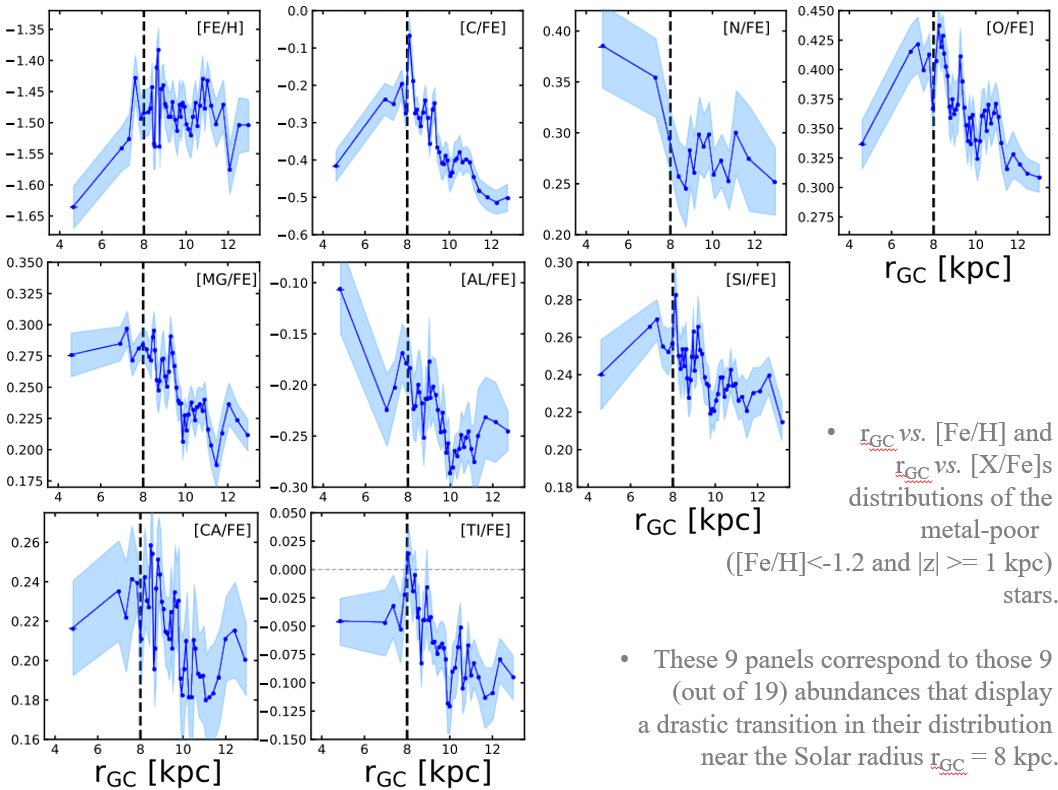
Milky Way’s Metal-Poor Stars display Chemical Transition near the Solar Radius. Accepted in ApJL. https://t.co/yHG1oUfhLq
Results obtained using the data from @ESAGaia and @APOGEEsurvey .
Today marks Gaia's end of observations: https://t.co/RcogUOq1o3. Gaia now performs a set of technology tests to help future missions: https://t.co/Q5HqOHa14X. The most up to date view of our Milky Way was created thanks to Gaia, with much more to come with #GaiaDR4 + #GaiaDR5.
Selections from 2024: Possible Proto-Galactic Fragments in the Milky Way
Two stellar structures discovered in the Milky Way this year may be fragments of proto-galaxies that formed before our galaxy was assembled. https://t.co/f4qxFI39jx
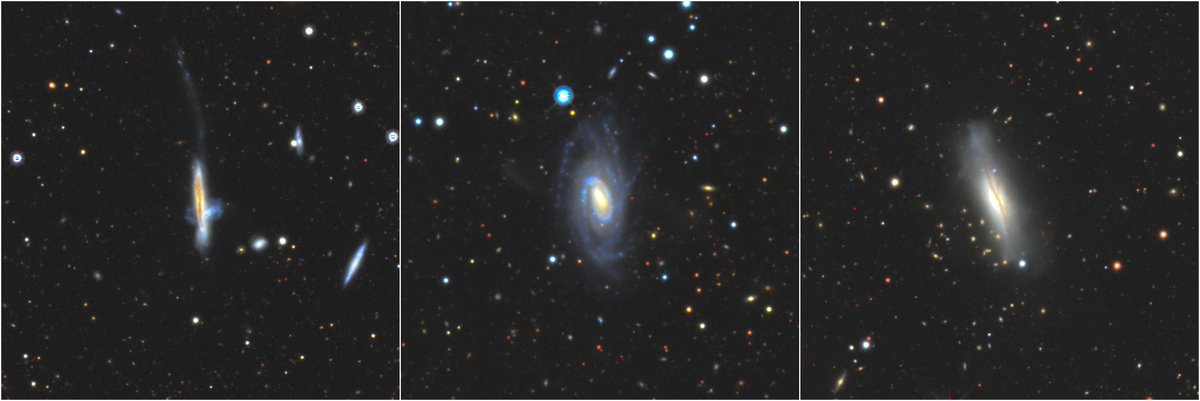
In our new paper today (https://t.co/Z03j6orTCT), we report the catalog and photometry of the extragalactic tidal streams found in @theDESurvey as part of the Stellar Stream Legacy Survey. A comparison of the stream frequency with cosmological models is coming very soon!
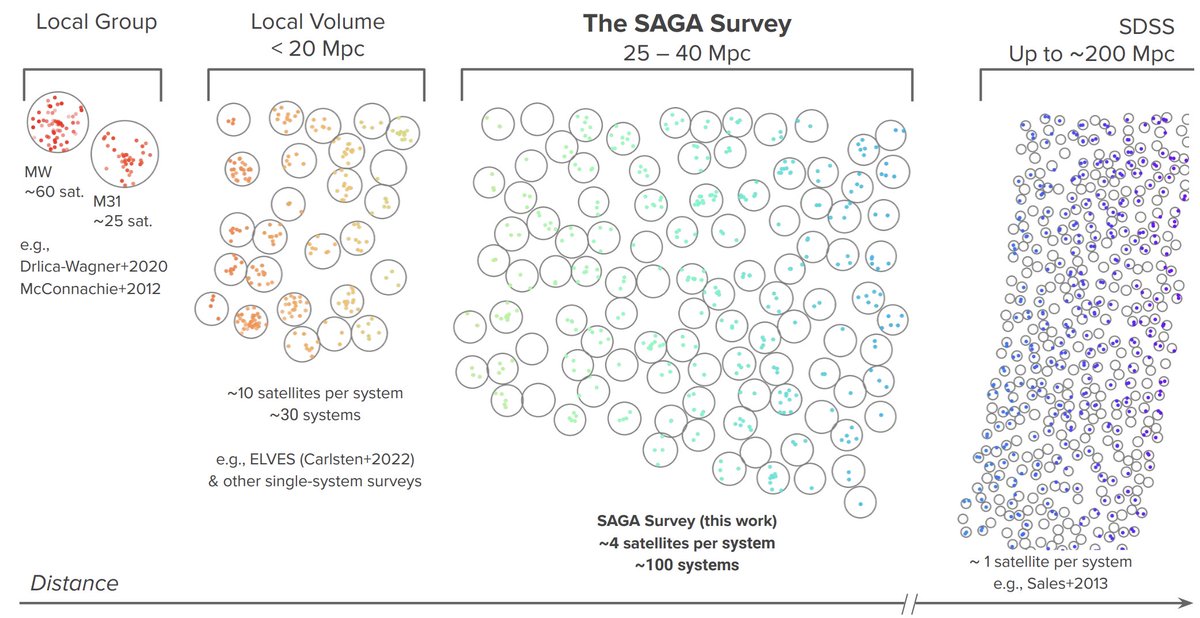
@jsbagla The decreasing number of satellites per host is becuase with increasing distance it becomes more and more challenging to find fainter systems. :)
A schematic overview of MW-mass satellite systems in Local group and beyond (taken from https://t.co/2ADXs9pbVu)
#dwarfgalaxies2024 conference in #Durham
The Gaia-Sausage/Enceladus stars, which were previously hypothesized to have originated from an ancient (8-11 Gyrs ago) merger event, likely came from a more recent (< 3 Gyrs ago) event, now dubbed as the Virgo Radial Merger (VRM).
📢 @ESAGaia reveals that the Milky Way’s last major collision was surprisingly recent!
Gaia unravels our history by studying the wrinkles created by collisions, but there's a catch. Like Benjamin Button, our galaxy is getting less wrinkly over time 👉 https://t.co/iD9FRU41SD
Paper day! A central result from our survey of the Milky Way's outskirts:
"All-Sky Kinematics of the Distant Halo: The Reflex Response to the LMC"
https://t.co/tr3bmmeWHM
Paper thread!! This was up on arXiv a bit over a week ago: https://t.co/ClbngS2m9k
We show here the dynamical analysis of the first spectroscopic follow-up of extremely metal-poor stars using photometric metallicities based on Gaia XP CaHK magnitudes run on Pristine survey model
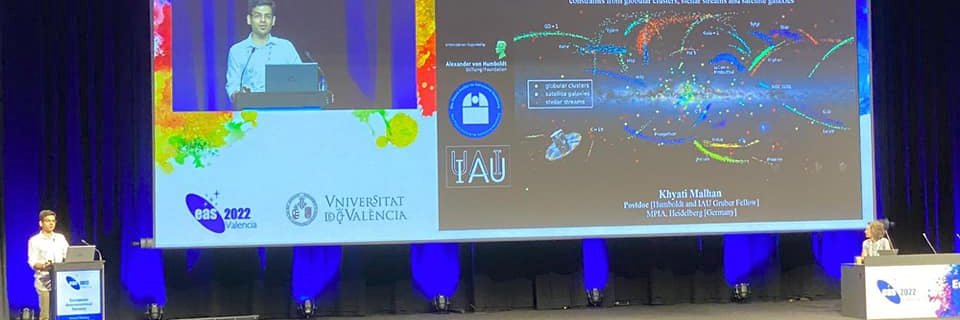
What stellar substructures does Gaia map? This visualisation of the Milky Way by @StefanPWinc / @kmalhan07 highlights globular clusters, dwarf galaxies and stellar streams. Notice also Shakti & Shiva, subjects of a recent story:
https://t.co/wrlPdLfqAQ
https://t.co/cZwikDIQPp
The paper I have been working on for a while is out! In this one I predicted the detectability of Globular Clusters in the full 6-year Euclid survey! And then tested detection models and size measurement using the first ERO data on the Fornax Cluster!
https://t.co/yjsnKpHlpX
Paper day: https://t.co/kocW5xLaYU
We show that Gaia BH3 is part of the ED-2 star cluster. The update astrometry puts GaiaBH3 in excellent agreement with the orbit of ED-2. Using some @ESO data we got last period we also show that ED-2 is very likely a disrupted globular cluster
Paper day! With @ViktorHJonsson looking at velocities of stars in the Milky Way's warp. We find that they just don't match the picture of a steadily precessing warp where we see it today. https://t.co/bCYnLKY3Pd
A webinar I gave @Swinburne, hosted by Prof. Duncan A. Forbes, on "The LMS1 stellar stream: A very metal-poor fossil remnant of our Galaxy's formation".
https://t.co/iAAvovAFWQ
A talk I gave for the "@IAU_org Commission H1 - The Local Universe" seminar, on the topic "Atlas of Milky Way mergers created using the @ESAGaia dataset".
https://t.co/IoKMfP2z7H
Our paper on the discovery of five dwarf galaxies around the galaxy NGC 253, found by @GJDonatiello in the @desisurvey deep imaging, is available today in: https://t.co/BMZBjS5fZV. This result gives new insights on the presence of a satellite plane in this Sculptor group spiral.
Galactic map of #StellarStreams detected in the @ESAGaia dataset. Each star in the stream represents an actual Gaia source, color-coded by heliocentric distance (as computed by the STREAMFINDER algorithm): blue for nearer (~1 kpc) and red for distant (>~30 kpc).