1/ Most genes and variants matter somewhere but look silent in any one cell model. Can we build conditions that reveal phenotypes? With @kanishkadey, we engineer cell states to expose hidden disease biology and trace how genetic risk reaches disease genes. https://t.co/pUHPPjxTkX
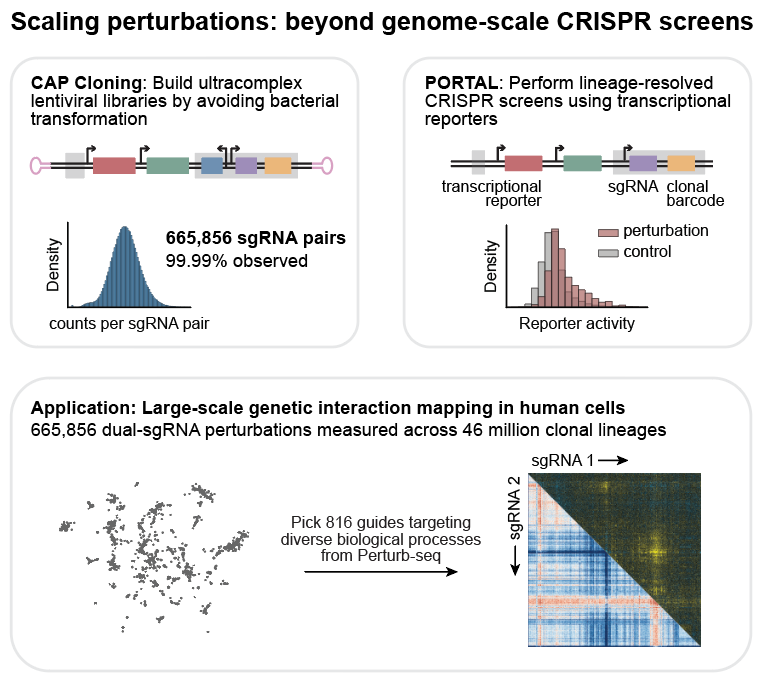
New preprint on technologies to scale up CRISPR screens.
We use them to map 665,856 pairwise genetic perturbations and outline a path to comprehensive interaction mapping in human cells.
We also introduce an approach for cloning lentiviral libraries with billions of elements.
Our paper is now out in final form at Nature Genetics! For those who missed the preprint, we used large-scale Perturb-seq targeting transcription factors to push primary fibroblasts into diverse transcriptional states, including those observed in cell atlas studies.
check out our vectors published with our Mutliome Perturb-seq paper (https://t.co/s0SfOAxWNG). Not only for Multiome experiments! A drop in replacement for any CROP-seq style experiment and the +SIRLION vector is especially useful for single-nuclei RNA-seq.
Our vectors are available on Addgene. All you need is this and 10x Multiome reagents to get started with Multiome Perturb-seq experiments! https://t.co/SM86nWUrC4
Our Multiome Perturb-seq paper is now out in @CellSystemsCP! As discussed in my thread on the preprint, this is an approach for linking CRISPR-mediated genetic perturbations to their effects on cellular chromatin state and gene expression. https://t.co/SeqTCGM6vH
Hi all,
I am currently on the academic job market. I am a postdoctoral researcher in Dr. Christina Leslie's lab at the Computational and Systems Biology Program at Memorial Sloan Kettering Cancer Center.
My research focuses on deciphering causal and dynamic gene regulation mechanisms by integrating observational data—genomics, epigenomics, transcriptomics, and 3D chromatin conformation like Hi-C—with perturbational data from CRISPRi/a screens and Perturb-seq in single-cell multiomics. I employ techniques from statistical machine learning, causal inference, dynamical modeling, and artificial intelligence (AI) to achieve this goal. The models that I have developed include GraphReg, ENCODE-rE2G, and DynaVelo (to be submitted soon).
Why is this important? Designing any effective and off-target-free therapeutic intervention for diseases, including cancer, first requires a complete understanding of the underlying wildtype system and then identifying the components that malfunction in disease states. With the ever-growing role of AI in synthetic biology and drug design, it is crucial to ensure that the models are causal and comprehend the basic biology of all cells. This is a challenging problem, but I am very hopeful that with the increasing scale of perturbational and multiomic data across cell types, we will achieve significant outcomes.
If you believe I could be a good fit for your department, please reach out to me.
Sincerely,
Alireza
So excited to share this work! It has been incredible to work with Tom @thenormanlab and the Norman Lab members to put this together. We made several key advances, did truly massive experiments, and learned about fibroblast biology. Big shout out co-author @ricocardy!
Can we recreate the transcriptional states seen in single-cell atlas projects? In our new preprint we try to do this using large-scale Perturb-seq experiments. Along the way we discuss off-target effects of CRISPR epigenetic editors and identify drivers of key fibroblast states.
Excited to share our preprint "Multiome Perturb-seq unlocks scalable discovery of integrated perturbation effects on the transcriptome & epigenome". This work extends single-cell CRISPR screens to simultaneously profile gene expression & chromatin accessibility.
NHGRI, NIEHS, and NCI are co-collaborating on a new initiative – Multi-Omics for Health and Disease. The goal is to advance the application of multi-omic technologies to study health and disease in ancestrally diverse populations. https://t.co/y6kezIj4d7