i don’t like the attempt from some insiders to paint the zcash bug disclosure as “heroic”
it’s not heroic. it’s a systemic problem
yes they paid a smart researcher to find bugs and he did. that’s great
but the issue isn’t that the bug existed
the issue is that zcash, unlike almost any other cryptocurrency, enables a unique class of bugs, where if they’re exploited no one would know
this unique class still exists. the fact that they fixed this specific bug is immaterial. mythos could find 8 others. and then mythos 2
bugs can exist in all cryptocurrencies. they can exist in btc or eth or sol. but if someone exploits them we will IMMEDIATELY KNOW and limit the damage
with zcash, when someone secretly finds a bug and exploits it, WE WILL NOT KNOW
imagine if the kelpdao hack was exploited but it somehow magically wasn’t visible onchain. the attacker stole 300m but no one would know. and aave and other apps would assume everything is fine not knowing that they secretly have a hole in the balance sheet. how much wider would the damage have spread by the time we found out?
this is the real issue. not a specific bug. the systemic vulnerability: if a hack happens, we won’t know until much later
and a lot of zcashers have been trying to downplay the severity of this fundamental issue for years (including yesterday when this was first disclosed but played down)
regardless of this specific bug, i don’t think zcash is a safe place to store meaningful wealth long-term, until the design fundamentally changes
i wish zcashers were more open about that. that would’ve been heroic
Great news!
Shielded Labs has just received a donation from @VitalikButerin to support the continued development of Crosslink, a security-focused upgrade to Zcash’s consensus architecture.
Let me get this straight.
So @VitalikButerin@tyler@cameron have now donated $1M+ over the past few months to support unstoppable private money?
The co-founder of Ethereum and some of the earliest Bitcoin supporters?
Probably nothing.
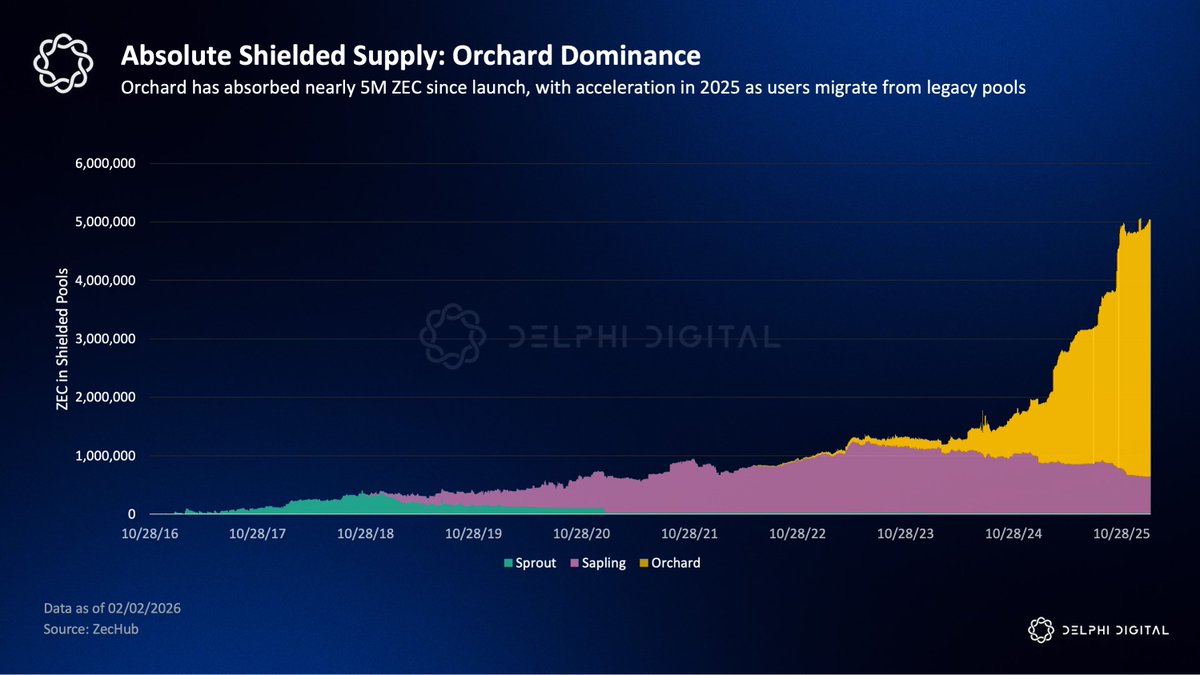
Zcash's shielded pool went from 11% to 30% of total supply in a single year.
This is more growth than the previous eight years combined.
Users are actively moving coins into the shielded pool and keeping them there. Shielded ZEC tends to be stickier, acting as a supply sink that removes coins from circulation.
Three things changed in the last two years: the cryptography no longer requires any trust assumptions, mobile wallets actually work, and Near Intents gave users a non-custodial way to rotate into ZEC from any chain.
In the last 30 days alone, ZEC has done $285M in volume on Near Intents versus $348M for BTC.
That adoption is built on real cryptographic guarantees.
The privacy is information-theoretically hidden. Sender, receiver, and amount are all encrypted in a way that makes transactions mathematically indistinguishable from one another.
Every shielded transaction cryptographically proves no coins were counterfeited without revealing any transaction details. There's no information for a quantum computer to extract.
The next phase is scaling. Orchard eliminated the trusted setup entirely and became the default shielded pool.
Tachyon comes next, reworking how transactions are validated and batched to push throughput toward the levels needed for real economic activity.
Now the privacy needs to work at scale.
Thank you to @VitalikButerin for supporting Shielded Labs and Crosslink! A portion of the funding will be used to spin up a persistent incentivized testnet, where users running finalizers or staking can earn small amounts of ZEC. We’re looking forward to broader community participation once the testnet is live. We’ll announce more soon.