How did Gruns actually scale the way they did, financially speaking?
I dont have any inside info, but I can tell you how. Balancing inventory, CACs, opex, etc during hypergrowth is an extremely difficult task; however on a spreadsheet it can in fact all be reduced down to a very simple mathematical model that is highly dependent on two variables and one ratio:
Lifetime profit per customer divided by the cost to acquire said customer
or for the initiated; LTV:CAC
Put simply, there is approximately a zero percent chance that Gruns had an LTV:CAC less than 3.0x. Further, if they did manage to somehow scale without 3.0x, Unilever wouldn't have acquired them.
My best performing substack post ever (will link in the comments) is titled "Why 3.0 LTV:CAC"
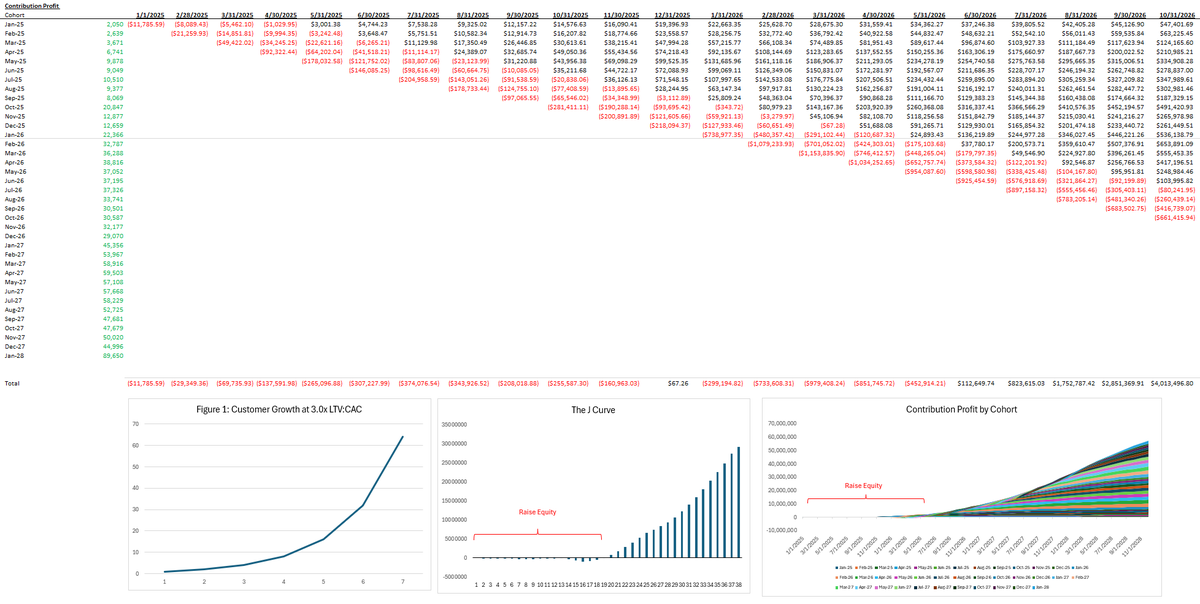
Summarized into a sentence; the answer is: because when 1 customer gives you enough profit to pay back the first customer and acquire 2 more customers, you can grow exponentially. 1 customer turns into 2, 2 customers turns into 4, 4 turns into 8 and voila - you have your hockey stick (figure 1).
Over time, the wide majority of revenue becomes repeat customers. Terminally, a healthy ratio for new:repeat is about 30% new to continue compounding at an exponential rate.
However, you are acquiring these customers at a loss on the first purchase. In the early days, this creates a cash burn. I theorize that this is why Gruns raised fairly significant capital early on, becuase they recognized the nature of the 'J-curve'
The J-curve is when you are burning cash on customer acquisition, and you don't yet have enough cohorts returning to actually cover the cost of the marketing investment you're deploying to acquire new customers. It creates a period of negative contribution prior to a period of compounded profits, in the shape of a J.
When you have the proper LTV:CAC, the business case for financing the negative portion of J curve with equity is very very strong, hence the early capital raising.
So the calculus is essentially:
establish unit economics -> raise capital ->scale
The most critical part of executing on this model is ensuring that as you scale customer acquisition, each cohort is CREATING enterprise value, not DESTROYING it. This is where 99% of founders fail.
EV is only created then those cohorts pay back and start generating profit. As you scale, often CAC goes up so much that cohorts never pay back, and you are actually losing money and destroying enterprise value, even if revenue is going up.
This is where the phrase 'not all growth is good growth' comes from.
And that ladies and gentleman, is your financial modeling primer. Someone told me not to put the term 'financial modeling' at the front of this post because they will fall asleep, but ha ha i've tricked you into learning it!
This is the kind of work we do every day with brands at iris. We deploy agents to clean your data & build your models. if that sounds like something you could benefit from, shoot me a DM
In August we spent $3.4M on ads across my two DTC brands.
Below is the breakdown of our creative output for the month
I’ll also share:
- some lessons we learned
- breakdown how we track output across Creative Strategists, Editors, Designers and Agencies
Hope it’s helpful ✌️
For the month of April, we spent 4.3x more than last April with a -17% of CAC
This is one of the many things we have done differently to last year:
More different & better ads.
Last Dec we have 70-ish ads active in the ad library. As of today, we have 400. At this rate, we will probably hit 6-800 by the end of the year.
My strong opinion is that there are three path-dependent variables for ad production for scrappy brands.
Quantity first, then diversity, and finally quality.
When I say quantity, I don't mean 500 variations on the headline. Just 5 concepts per person, 3-4 variations each, uploaded each week. I have 2 PH team members that I train closely to do this.
A lot of the discourse on X starts with the presumption that you have resources to do shit.
The reality is that you don't. You can't hire anyone good.
You have to do it yourself and hire someone average who's hungry and train them.
You have to compromise on something.
Don't compromise on volume. Start shit then become good. Quantity precedes quality. This is how we all learn
ANYTHING. Also, AI lifts the bottom, so use this to your advantage. Keep on studying.
I wish I were born great at making ads or had work experience at CTC but no I am fucking shit at making ads AND content because I was trained as a doctor.
So you have to put the reps in. This is the same for your overseas team members.
This might not seem like a lot of ads to the people on X but we are lapping the fuck out of the competitions by like 4x their number. It's enough ads. I check the ad library for a lot of brands in the founder's group I'm in, 80-90% have less than 100 active ads and they spend eons asking about cost cap or bid caps.
The key thing is the discipline. Every week, this must be done with no exceptions.
When you have this basic volume, you then focus on diversity. Just browse X + creative research SAAS and try everything new. It's way easier to try new things now that you have a SYSTEM.
The difficult thing is to step outside of your comfort zone. There's no such thing as "brand". The goal is DIFFERENT.
Ads looks a bit shit but it's different? Send it.
Once the production is steady, you MUST cap the quantity.
Capping the quantity is a prerequisite to quality. You can't have both.
As builders, you HAVE TO prioritize. Just accept shitty ads for a few weeks, and trust that they will get better.
Uploading shit ads is way better than not uploading at all.
Our ads are WAY better than before vs 12 months ago. 12 months ago, I did not have the TASTE to know how shit our ads really were.
Big s/o to a lot of the people on X who share their ads.
The argument between quality vs quantity IMO is not relevant for founders. You have to actually do all of it, just not all at once.
Hope this helps. This is just 1 of the many things we have done and by no means the most important.
20% of our SKUs were out-of-stock in April so we probably have a lot more gas in the tank.
We also seed 100 packages a month and use those videos for ads. It helps a ton with volume + diversity. Quality is a random but when these videos do well, they do really well. Pretty self-explanatory.
Crocs has entered the top 40 TikTok Shop seller rankings with $3.2m in the last 3 weeks.
It's a masterclass in affiliate strategy
Here's how they did it:
If you’re producing a high volume of net new ad creative concepts for less than 5% of your monthly ad spend AND you’re scaling revenue (even better your MRR) by more than 20% month-over-month…
You are a rare breed in DTC and you’re fucking killing it.
If you’re not in this situation you are likely:
- not spending enough on developing new creative concepts
- not adjusting your offer/pricing to optimize profit per visitor
- not ruthlessly cutting opex or trying to optimize for lower cogs
You should have a forecasted P&L (annual plan) and a demand plan running at all times.
They can (should) use the same underlying data - the drivers of the revenue build.
But they are separate organisms.
The annual plan is for finance and leadership. It’s used to manage cash flow and balance sheet ebbs and flows. And to understand if costs are in line with expectations. Also, obviously, to manage company performance against the plan.
Making changes to it (i.e., re-forecasting) should happen much less frequently. If at all.
Just because you miss a month or two doesn’t mean you re-forecast the entire plan.
The demand plan is for the supply chain team. It’s used to manage and optimize production schedules, purchasing of raw materials, freight/shipping, and inventory.
It’s should change/update at least monthly - with every new set of data about what is actually happening as it relates to the revenue drivers.
Don’t confuse the two and don’t let demand planning meetings turn into financial performance meetings.
There is overlap, like with everything.
And you can take learnings from one into the other.
But they should stand on their own as models and be used differently.
What would happen if we began treating ads like products?
On an assembly line, with a margin profile and delivery date...
The workflow:
1) Build (the ads)
2) Improve the quality
3) Lower the cost
Turn the inventory, quickly, and build again.
This episode will cover exactly how to build and STAFF your ad assembly line. So that you know,
1) the precise number of ads you're shipping, &
2) exactly when they'll arrive off the conveyor
Sharpen Your Skills Season 2, Episode 1:
The Specialist Team That Solves DTC's Ad Formula
Special thank you to our partners at @mercury and @fermatcommerce for their support.
Enjoy! Also available on CTC's YouTube in 4K.
Wild, UK-based personal care brand, sells to Unilever for $286m:
- known for its refillable deodorants
- founded in 2019, raised $7m of equity
- did $58m in rev last year, up 77%, achieved profitability
Native was sold to P&G in 2017 for $100m on ~$30m revenue.
Are we back?!
Your financial model should answer the following questions every single month:
- How many customers do i need to acquire? (New Customer count)
- How much do I need to spend to acquire that many customers (Ad spend / CAC)
- How much are those customers going to spend with me when I acquire them? (nAOV)
- How many of those customers are going to come back and spend again? (cohort model)
- How much are they going to spend when they come back? (rAOV)
- What are the cost of the goods they will buy? (COGS)
- How much will it cost me to ship it to them? (COGS)
- How many people do I need on staff to satisfy this demand? (Opex/headcount)
- What software tools will I pay for to satisfy this demand? (opex)
- What happens to my cash balance when I satisfy this demand? (balance sheet)
The financial model gives you the roadmap for your business.
If you are paying someone for FP&A services, and they can not answer every one of these questions AT THE DROP OF A HAT then you are being RUGGED
Ben Horowitz on why Al Davis's "nobody cares" advice to Bill Parcells might be "the best CEO advice ever":
"When things go wrong in your company, nobody cares. The press doesn’t care, your investors don’t care, your board doesn’t care, your employees don’t care, even your mama doesn’t care. Nobody cares.
And they are right not to care. A great reason for failing won’t preserve one dollar for your investors, won’t save one employee’s job, or get you one new customer. It especially won’t make you feel one bit better when you shut down your company and declare bankruptcy.
All the mental energy that you use to elaborate your misery would be far better used trying to find the one, seemingly impossible way out of your current mess. It’s best to spend zero time on what you could have done and all of your time on what you might do. Because in the end, nobody cares, just run your company."
I paid Alex & Leila Hormozi $5,000 to attend their 2-day workshop.
...and then another $35,000 at the end to join their smaller-group workshop group to keep learning.
So, here's what I've learned so far:
Takeaway #1: Take out as much cash as you need from your business to feel “secure” personally… so that you can take more risk inside your business.
This is something I ROYALLY fucked up building my first company—my ghostwriting agency back in 2017.
I grew that agency from $0/mo to $180,000/mo in revenue in about 18 months. The mistake I made though was never taking any money OUT of the business to make my personal life feel more secure. In fact, the entire time we scaled that business, I had $5,000 - $10,000 in my savings account and that was it. (Meanwhile, our monthly payroll of 20+ employees was north of $100,000.)
As your business grows, you will inherently need to reinvest profits back into the business to keep it growing (we’re at this stage again right now). But that’s high risk. Which means, before you take that risk, make sure you’ve had a few months (or years) taking money out of the business so that you feel more comfortable/financially secure in your personal life… SO THAT you feel good taking that risk inside your business.
Takeaway #2: Above $5M/year in revenue, you don’t bootstrap departments. You hire subject matter experts who build the department.
This might have been my biggest “golden nugget” from the event, and thinking about the ROI of this simple concept relative to the fact I paid $5,000 to “learn this” is hilarious. $5k to learn something, at the moment I needed to learn it, that will make us millions more dollars in the future. (Not a bad ROI!)
This was also one of those “what-got-you-here-won’t-get-you-there” lightbulb moments.
I am a bootstrapper. Always have been. Whenever I have an idea, the first thing I do is go tinker and figure out how to duct-tape together something myself. And before you hit $1M or $2M or even $3M in revenue, that makes sense. That’s usually what’s required.
But this past year, our business grew a lot. And so did our team. We went from 13 employees to 28.
And the mistake I have been making (for months) is thinking, “Geez… I barely have any available time to bootstrap our next department!”
And it wasn’t until we attended this workshop that I realized (aka: someone said to me) that’s not how it works from here. Above $5M/year in revenue, you don’t bootstrap departments anymore. You take your cash, you go find someone who has already built the department you want to build, and you go buy their subject matter expertise and empower them to build it.
Completely different way of thinking about & solving the problem.
Takeaway #3: Before you change anything in your business, test it.
Piggy-backing on the above…
Another “bootstrapper” habit is to move fast and break things.
And when you’re small, this is correct. Perfection is the enemy of progress, so just do something and get moving.
The problem is, as you grow, the riskiest thing you can do is change something inside your business. Even if you’re convinced it’ll improve it. Even if you think, “There’s no way this won’t be ROI-positive.” When you have something that’s working, ANY change = some percentage of risk.
So a big piece of advice they hammered home to us was: don’t make company-wide changes.
If you have an idea, or are trying to solve a problem, don’t roll out a solution to the entire business, or the entire product, or the entire sales funnel, etc.
Instead, find a way to test your theory inside a contained environment:
• Have 1 closer try a different pitch, first.
• Have 1 coach try a different method with a student, first.
• Send a different offer to 10% of your email list (instead of 100%).
• Etc.
Takeaway #4: When you change something, expect a 20% decline in the short term.
Piggy-backing on the above again… when you change something, there will always be a period (in the short term) where metrics go down.
This is usually because, especially in a more mature business, when you change one thing that one change ends up affecting 5 or 10 other things, which inherently “change” as a result of the original change you made.
…which causes short-term inefficiencies.
…or causes short-term declining profitability.
…or causes some other metric to go down.
This isn’t a problem. It’s just something to expect (so you don’t see a metric go down in the short term and freak out).
Takeaway #5: There’s a difference between “continuity” and “back-end upsell.”
This was a really interesting clarification for us, and just goes to show how there’s always more to learn. (We’ve been in the digital education space for 4+ years now, and I had never heard anyone articulate this to me, this way, before.)
Continuity means a customer keeps paying for access to the thing you already sold them.
Back-End Upsell means a customer pays you (one-time or on a recurring basis) for access to “more” of what they already bought from you.
So let me give you an example.
Our core business is our Premium Ghostwriting Academy. And our core offer is we help turn burned-out freelance writers into Premium Ghostwriters by putting them through a 12-week curriculum, with 1:1 coaching, as well as group calls with me. And it’s a one-time payment.
• A Continuity Offer would mean at the end of the 12 weeks, we say, “Great, you went through the program. Now, if you’d like continued access to the curriculum, that continued access costs $99/mo.” (Or whatever price point you decide.) It’s payment to keep access to the thing you already bought.
• A Back-End Upsell would mean selling more coaching, more accountability, and maybe even a new roadmap or curriculum to help them accomplish their next goal.
Hearing this delineation was extremely helpful as we think about the best ways to scale our Back-End Upsell Offer after people complete the PGA program.
Takeaway #6: "Strategy is how you choose to allocate your limited resources against unlimited options.”
This is something I’ve heard Alex Hormozi say probably 50 times at this point. But for some reason, hearing him say it in-person made it click for me in a different way.
The entire game of entrepreneurship is a game of who can make the best decisions. Because we all have the same 24 hours in the day.
And how you identify “the best decisions” is by thinking deeply about how to allocate the few resources you have (time, energy, attention, money) against the unlimited options in front of you.
And in the context of growing your business, the way to make this decision (according to Alex) is to ask:
• “How does this get me more customers?”
• “And/or how does this make our current customers worth more?”
Anything on your list that doesn’t accomplish one of the above is probably the wrong thing to focus on (right now).
Takeaway #7: More/Better/New
This is one of my favorite Hormozi frameworks.
The path to improving anything goes like this:
• More: Until volume is the constraint, do more.
• Better: Once volume is the constraint, focus on increasing the quality of your volume by doing better.
• New: Once quality volume is the constraint, and you can’t do any more, and you can’t do what you’re doing any better, consider doing something new or different.
I love the simplicity of this.
But here’s a different way of interpreting the above framework (which Alex also articulated in a nice and sticky way):
Doing “More” is the least risky thing you can do. If something is already working, there’s almost no risk to doing more of that thing.
Doing “Better” has some risk, but also has some incremental reward. “Better” fundamentally means “change,” and as I already noted above, change inherently injects risk. But, some risk, some reward. Which is why “Better” leads to improvement.
Doing “New” has the most risk. You’re choosing to do something you haven’t done before with the hypothesis this thing will in some way be more powerful than whatever you were doing before. High risk, high reward.
So when trying to figure out what to do, I encourage you to not just use the More/Better/New framework, but also consider the different risk levels associated with each decision.
Takeaway #8: CEOs think more like investors and less like managers.
This was a brain-breaking moment for me.
(And it wasn’t even Alex or Leila who said it. It was their Head of Strategy during her presentation, which was badass.)
I’ve been a Founder/CEO-type for 8 years now. I started my first company in 2017, and we just started 2025. And for the past 8 years, I always felt like my responsibility was “manage” people. And while that’s true, I see now how that frame causes your thinking to get sent in the wrong direction.
The way great CEOs build companies is they don’t think of themselves as managers. And their job isn’t actually to manage people. Their job is to find subject matter experts, who can run departments, who they can trust, who can successfully manage people.
A great CEO is an orchestrator (or in this metaphor, an investor).
Something for me to work on.
Takeaway #9: How you achieve the goal is irrelevant.
Something we’ve been banging our heads against the wall trying to figure out these past few months has been paid ads to grow our business.
From September 2024 to January 2025 we probably spent north of $250,000 on paid ads for our business.
And we lit most of it on fire (didn’t do much).
Another sadface.
Then, at the workshop, we talked to Alex a bit after the end of the first day during cocktail hour, and we told him our metrics and how we have been trying to get more customers using this new method (paid ads), and he basically said, “Why? You’re already crushing it on organic. Do more of what’s working.”
Quarter-million-dollar mistake we made.
Whoopsie.
The takeaway here is… how you achieve the goal is irrelevant. We kept thinking we needed paid ads because “that’s what everyone does.” But if you can achieve the same goal (more new customers) doing whatever you’re already doing, more, and then better, just do that. How you get there doesn’t matter. All that matters is that you do.
Takeaway #10: Don’t underestimate the value of a “better” team member.
Another thing Alex said to us that really hit was:
“A $500,000 team member is VERY different than a $50,000 team member. Get comfortable spending more.”
And meeting his and Leila’s team, I could see it. I have no idea how much they pay their portfolio team/subject matter experts, but they’re all rockstars. And it completely reset the bar for me of the sort of talent you can bring into your business.
This is absolutely a faulty belief/skill deficiency I’ll need to let go of to grow to the next level.
I need to get comfortable with the idea that the next department head we hire might be 2x or 3x more than any person I’ve ever hired in the past.
Takeaway #11: “The theoretical max of a business is the sum of the knowledge on the team.”
Building on the above… I thought this was brilliant.
If you’re the founder, and you’re the “smartest” person on the team (aka: you tell other people what to do and how to do it), then the theoretical max of the business is literally your own knowledge.
The business will grow to the extent of your own experience/pattern recognition.
And the business will stay stuck at the level where your experience/pattern recognition runs out.
I thought that was a fascinating way of looking at a business.
The takeaway here is: if you want to expand the theoretical max of your business, buy more knowledge.
For example: when you hire someone, you aren’t just filling a role. In an idea world, what you’re really buying is that person’s entire life experience. All the problems they’ve already figured out how to solve that you don’t. All the shortcuts they’ve learned about that aren’t even on your radar.
You expand the capacity of the business by adding more people who know more than you do.
Takeaway #12: Show team members “the gap.”
This was a gem from Leila.
When a team member in one role wants to move up to a different role, and they aren’t ready or qualified, don’t just say “No.”
Instead, show them the gap.
How she does this is by taking the job responsibilities list of the different or elevated role and highlighting all the things in red this team member currently isn’t doing or doesn’t have experience doing—so they can “see” the gap.
• Here’s where you are right now.
• Here’s what you aren’t doing.
• Here’s what I would need you to do (or be able to do) in order to consider you for this role.
I really liked this exercise because it shows people, if you want more growth potential, here are the exact skills you need to build and demonstrate proficiency in.
Takeaway #13: Checklists are more valuable than SOPs.
All roads lead back to making-things-actionable.
Takeaway #14: “What do you see that I believe about the world that isn’t true?”
This is a question Alex asks other smart people, specifically his mentors.
Takeaway #15: Anything can be a $100M business.
There’s no such thing as too niche.
People just give up too early.
5 Creative Formats That Will Convert in 2025
Our ads spent $25m+ on Meta last year.
After analysing thousands of ads across 26 ad accounts in 2024
Here are 5 lesser-used ad formats that I’m bullish on this year:
🚨HERE IT IS🚨
Database of over 300 consumer transactions in the past two years, PLUS a FREE VALUATION CALCULATOR for your business based on revenue & EBITDA multiples + DCF
Like this post, Reshare, and Comment "comps" and I will DM you the link!
I talked to a $40M D2C brand spending <10% of budget on Meta and >75% on YouTube ads - growing 100%+ a year.
All VSLs. Big focus for me next year.
If you’re big on YouTube ads:
Please DM. I’d love to exchange learnings.
Happy to share what we do on YouTube influencers to make that work at scale.