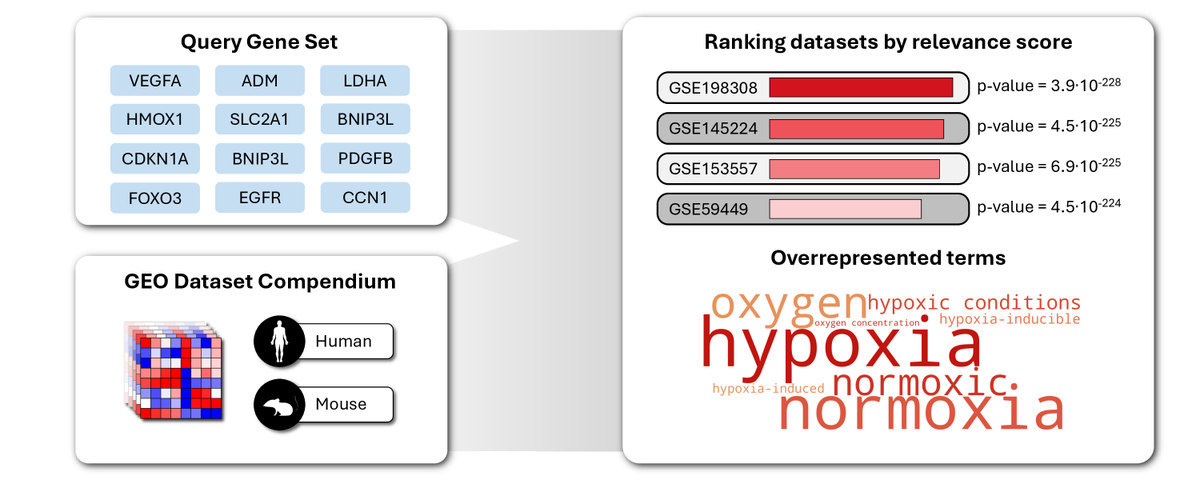
I'm happy to present our new web-tool CORESH https://t.co/r1bswFuZXo for searching public gene expression datasets using gene signature as a query, developed by @vd_sukhov, which was just published in @NAR_open https://t.co/PdDMgQz56a 1/n
@lisyarus prolly has more to do with your emotion/rewards around problem solving
in the childhood problem solving was more rewarding to me than stressful/forced, so I still feel positively rewarded when I solve puzzles now
@lisyarus I would say that the wording "has anything to do" is probably correct, but implication "math olympiads -> disliking puzzles" is probably no so much
Coming from the similar background, I still love a good puzzle game (witness, humanity, golden idol games).
I'm happy to share that out paper on Phantasus, a web-application for visual and interactive gene expression analysis, got out in @eLife https://t.co/fd99RQ2nIv Here, I'm using it to analyze a random GEO dataset, including basic QC to filter outliers, in under 100 seconds! 1/n
Also kinda cool to see that Sinkhorn transformation is such an easy procedure, and yet, Sinkhorn distances find more and more applications in optimal transport and machine learning
Happy to highlight recent preprint by @denis_kleverov, @AladyevaE, Alexey Serdyukov, and @maxim_artyomov
Sinkhorn transformation seems to be the key to much better solve general NMF and fits data into simplexes in both spaces
Read it and have feedback? - share with us!
Happy to report major analytical advance in NMF/deconvolution - we topologically reformulated it as 𝐃𝐮𝐚𝐥 𝐒𝐢𝐦𝐩𝐥𝐞𝐱 problem, reducing it to just K(K-1) variables, K=# clusters/components.
works in scRNAseq/bulk deconvolution, image analysis etc
https://t.co/88jTQothGT