🤔In 1986, the federal government built a system called SAVE. It stood for Systematic Alien Verification for Entitlements. Its job was simple: when a noncitizen applied for public benefits, the government could check whether they were legally in the country.
It worked. It was quiet. Nobody talked about it. For 39 years.
In March 2025, the President signed an executive order expanding it. The order told DHS to use the same system the one that's been running since 1986 to verify the citizenship of registered voters and people registering to vote. It told the Social Security Administration to share its records with DHS for that purpose.
Two months later, DHS launched the modified version. Two changes. First, it now checks Social Security numbers against SSA databases. Second, it allows state and local authorities to run bulk searches not one person at a time, but entire voter rolls at once.
Today September 25, 2026 the Supreme Court of the United States issued a ruling on whether that expansion can continue.
The case is DHS v. League of Women Voters. Per curiam. No. 26A308.
Now step back and look at the pattern.
The system was built in 1986. It ran for 39 years doing one thing. Then an executive order expanded what it could do using the same infrastructure, the same databases, the same legal framework to do something much bigger.
No new law was needed. No new agency was created. No new database was built. The system was already there. The records were already there. The connections between DHS, DOJ, the State Department, and SSA were already there.
All they did was turn the dial.
This is the same pattern that shows up everywhere in the enforcement architecture.
The Alien Terrorist Removal Court was created in 1996 and never used. Last week it was activated for the first time.
Section 338 tariff authority existed for decades and had never been tested. This year it was activated.
IEEPA had never been used for tariffs at this scale. It was activated for tariffs.
IEEPA had never been used for the power grid. It was activated for the grid.
The OFAC sanctions architecture was built after September 11, 2001. Twenty-five years later it's running the largest simultaneous enforcement operation in modern history.
The tools were already on the shelf. The databases were already connected. The legal authorities were already written. The infrastructure was already built.
Every time someone asks "how did they do this so fast?" the answer is the same. They didn't do it fast. They built it decades ago. They just turned it on.
SAVE was built in 1986 for benefit verification. In 2025, one executive order turned it into a voter roll auditing system with bulk search capability across every state in the country.
The building was already there. They just opened a new door.
That's what the Supreme Court is deciding today. Not whether the building exists it's existed for 40 years. Whether the new door stays open.
I am the guy on the couch, and you have been debriefed.
@goodside I told Grok “These look like Markov Chains” and got:
“The undirected weight is the probability that a random walk would traverse the edge in at least one direction. The finished object is therefore a sparse, reversible Markov kernel defined on the data”
The 55 million long term visa holders are not included the 343 million census number.
The Census excludes :
The large majority of the 55 million people worldwide who hold a valid U.S. visa but do not live in the US.
Short-term visitors and tourists (most B-1/B-2 visa holders)
Most U.S. citizens living abroad
The Coxon psyop was a decade and more than a billion dollars in the making.
Here's the story.
Coefficient Giving (formerly Open Philanthropy) is the grant-providing vehicle of Dustin Moskowitz.
CG is the overwhelmingly foremost funder of AI alarmism, with more than $1B in grants and $1B committed for 2026.
Moskowitz, who founded and runs Open Philanthropy/Coefficient Giving, led Anthropic's Series A in 2021.
Holden Karnofsky co-founded Open Philanthropy/Coefficient Giving and took a board seat at OpenAI when Open Philanthropy/Coefficient Giving gave it $30M in 2017.
Karnofsky is married to Anthropic's president Daniela Amodei.
He then joined Anthropic in January 2025.
Coxon, who started the viral thread, received a scholarship from Good Ventures, which is the foundation that funds Open Philanthropy/Coefficient Giving.
He coordinated his message ahead of time with the Wall Street Journal, which published its exclusive on him before he posted on X.
Coxon spent three years pretraining at OpenAI, the company that took $30M from Open Philanthropy/Coefficient Giving.
The funder of the AI alarmist ecosystem Open Philanthropy/Coefficient Giving, in other words, is also an owner of Anthropic, and his organization is deeply entangled with both OpenAI and Anthropic. Anthropic's researchers in turn amplified Coxon.
The same people who own the organizations that advocate for regulation, in other words, are those who own the companies that would dominate the market under that regulatory regime, which would prevent competitors from entering the market.
And this work all started ten years ago, right when these companies were founded, paving the way.
It's diabolically brilliant.
Win at the competition, then deploy activists to help you regulate the market and ensure your monopoly.
You have to respect the planning, manipulation, and foresight this took.
Posts should be fact-checked by Grok first and then rewritten to at least be able to survive a first-pass critique. Not doing so is lazy and results in reputational hits.
• The photographer was Richard Drew of the Associated Press using a digital Nikon DCS-620 and a 200 mm lens, not analog film; he captured an 8–12 frame burst while panning with the falling figure, then selected the single most vertical frame.
• A long telephoto from street level at West and Vesey Streets compresses perspective, so near-parallel building lines and modest tilt are expected; they do not require a helicopter or tilt-shift lens.
• Both the façade and the figure were hundreds of feet away in bright light, so adequate depth of field and a fast shutter plus panning readily explain the lack of motion blur; other frames in the same sequence show tumbling and billowing clothes.
@mathandcobb Trust and reputation is everything. Because of this local models are going to become far more popular and Apple is going to sell a f-ton of Mac Studios.
@Johnny153331@mattjay Not if you turned off wifi on the TV.
“No. If you turn Wi-Fi off on your TV, it cannot connect to a neighbor’s xfinitywifi (or any other wireless network).”
@SawyerMerritt Pull out a $3300 luxury item on the street in any large city and start counting down the seconds until it is snatched out of your hand. #makeyourselfatarget
I think the plan is to get researchers to start using their AI with a limited compute budget, then once they have all the academic data, they’ll basically steal all their ideas from underneath them and run the research internally with their unlimited compute budget!
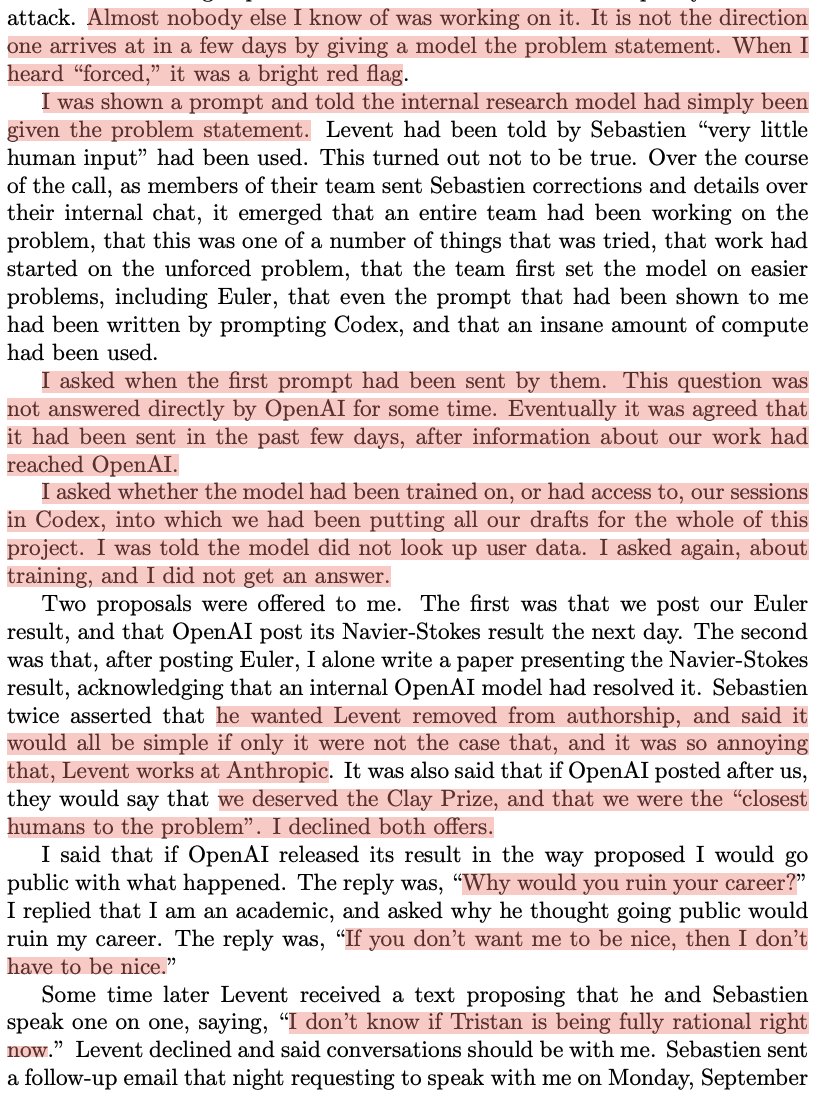
You're missing the core drama of the story: Tristan is softly accusing OpenAI of having stolen their result from Codex chat logs.
Tristan then claims OpenAI tried to threaten him to not publicly disclose this, and that they'd give him the Clay Prize ($1M) as the "closest humans to the problem" if he'd agree to disavow his co-author, @__alpoge__ , who is at Anthropic.
This is HBO-level drama, but with math proofs.
tristan buckmaster just published a statement that is, if accurate, one of the ugliest things i’ve read out of a frontier lab.
not because of the math. because of what happened after openai found out two people were about to beat them to the punch.
buckmaster and levent alpöge spent a year pushing the córdoba / martínez-zoroa program to smooth forcing. august 15 they got blowup for boussinesq and 3d euler. lean-verified august 22.
they were paying openai out of pocket and dumping every draft into private codex sessions.
the program is obscure. almost nobody else was on it. this was not “paste the clay problem into a chatbot.”
then this:
> thursday sept 3, buckmaster emails openai privately. rumors are flying. he is trying to stop a mess, not start one.
> they reply the same day: give us details so we can “avoid competing.” also, want free compute?
> sunday they suddenly need a call “at any point today.” sebastien bubeck gets on. levent is not invited.
> openai says an internal model has a ~100-page proof of forced navier–stokes blowup. fefferman options c and d. the exact route buckmaster and alpöge had quietly chosen.
> they show him a prompt and claim the model was “simply given the problem statement.” levent is told “very little human input.”
> that falls apart on the same call. a whole team had been on it. they started on the unforced problem, warmed the model up on easier equations including euler, and even the prompt they showed him was written by prompting codex.
> he asks when the first prompt went out. they stall. then agree: the past few days. after information about his work reached openai.
> he asks whether the model was trained on, or had access to, the private codex sessions where they put every draft of this project.
> answer: the model does not look up user data.
> he asks again. about training.
> no answer.
then it stops being a science story and becomes an hr story.
> offer 1: you post euler. we post navier–stokes the next day.
> offer 2: after you post euler, you alone write the navier–stokes paper, credit our model, and we cut levent.
> bubeck says twice he wants levent removed from authorship because he works at anthropic.
he declines both.
he says if they release it that way, he goes public.
the reply is not a scientific objection.
> “why would you ruin your career?”
> “if you don’t want me to be nice, then i don’t have to be nice.”
later, a text to levent proposing a one-on-one:
> “i don’t know if tristan is being fully rational right now.”
that is not how you treat a collaborator. that is how you split one.
openai got word two researchers were closing a path almost nobody else was on. they spun up a team on that exact path. they would not answer whether the researchers’ unpublished drafts in openai’s product were used. they tried to dictate the announcement order. they tried to remove a coauthor because he works at a competitor.
when that failed, someone reached for a career threat.
this is a lab finding out academics were about to publish, sprinting the same narrow program, refusing the data question, and trying to manage credit around a rival affiliation.
really slimy if even half of this holds.
what the fuck is happening.
Nope.
The plane that overran the runway on September 6, 2026 therefore left the pavement and crossed a road rather than being stopped by a crushable arrestor bed. FAA data and airport diagrams for Runway 12/30 list no EMAS https://t.co/0T9lf9okLW. Runway 30 at Miami International Airport does not have an EMAS.
Lots of problems here, mostly too much energy / unstabilized approach. They landed long because they floated, ended up touching down on the nosewheel and one main so spoilers didn't auto-deploy immediately. Finally no EMAS (collapsable metal stop zone) at the end of a runway pointed at a huge Amazon warehouse.