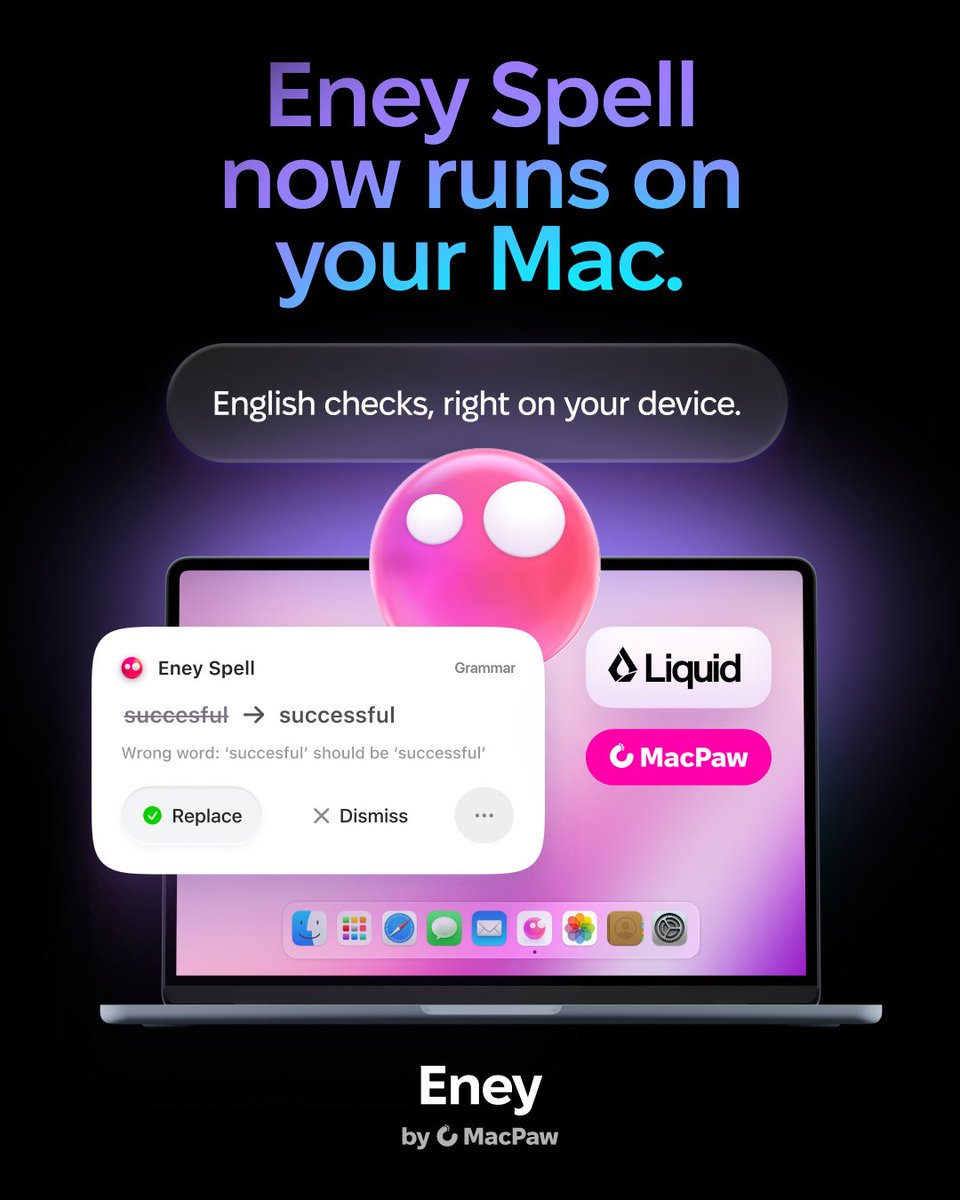
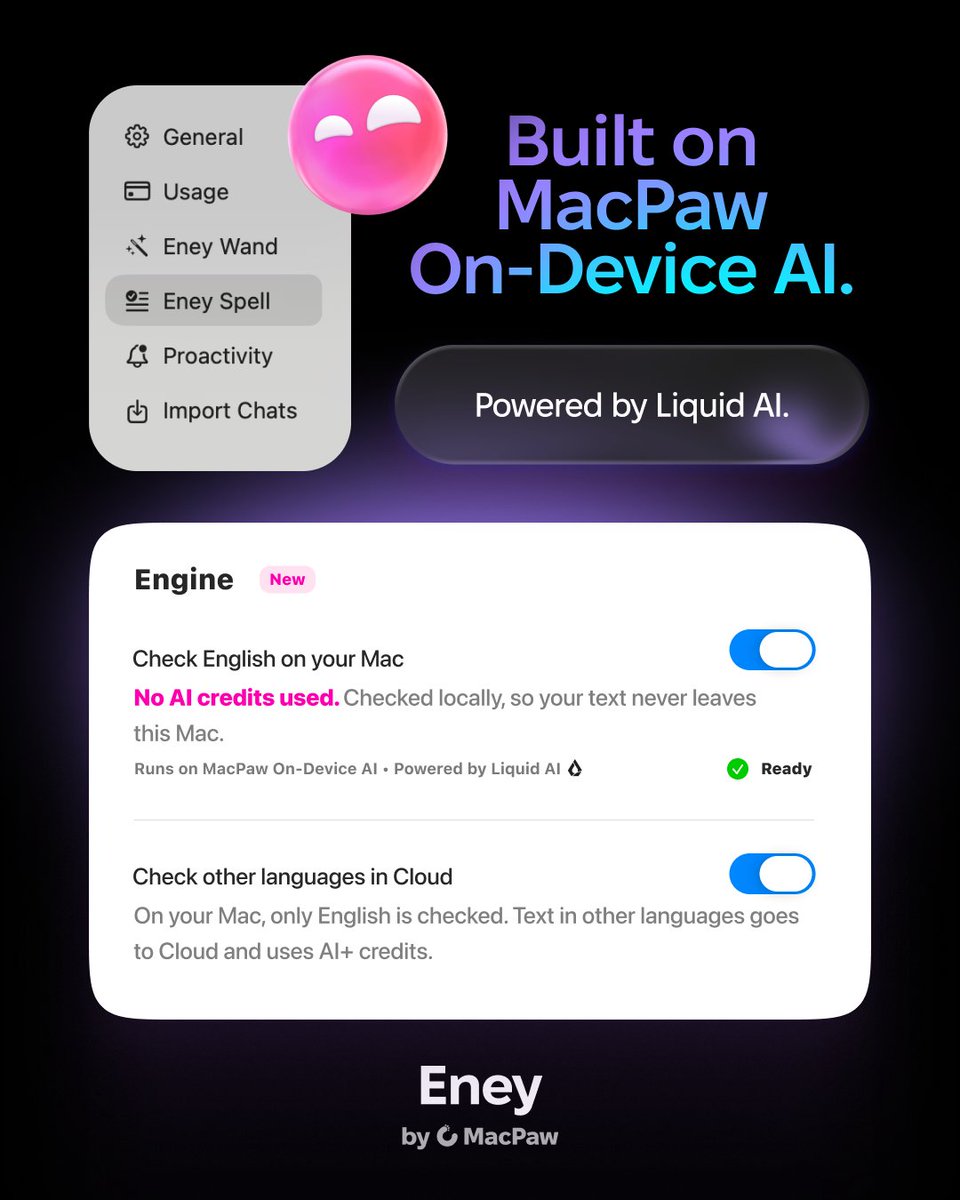
Our partners at @LiquidAI built a 350M model just for spellchecking, and it now runs locally in Eney Spell. The interesting part is that it only needs memory for the few seconds it is checking. Therefore I think small task-specific models are how local AI becomes the default.
A writing check runs on every sentence you type. That’s a lot to ask of a credit balance. So we built Eney Spell’s English checks to run on your Mac, not on a server.
Liquid AI’s grammar and spelling model catches typos, punctuation slips and capitalization errors instantly, through Elix, MacPaw’s own on-device AI runtime. Your credits stay put.
Turn it on: Eney settings → Eney Spell → select local engine → download MacPaw AI Runtime.
🔗 https://t.co/N6tYAcFXqE
With the latest update, MacPaw's Elix is 100% the fastest LLM inference engine on Apple silicon.
The team did amazing job to make it done.
7 LFMs by @liquidai at 4-bit, 5 Macs, 33 chip×model runs vs mlx-lm, mlx-vlm, mlx-serve, vLLM-Metal, llama.cpp, uzu:
• end-to-end fastest in 33/33
• decode +37% vs the field, +43% at 32K
https://t.co/4hgiZlAq0d
Many of us keep too many tabs open and then wonder why the Mac slows down. Browser Care, new in CleanMyMac for Chrome, shows which five tabs cost the most and lets you pause the rest in one click. It all stays on your Mac. Free with an active CleanMyMac subscription.
Some people keep their tab count low by instinct. Others thrive in creative chaos.
If you’re on team chaos, with dozens of tabs open and a Mac that’s starting to sweat, meet Browser Care: a new CleanMyMac feature for Google Chrome.
Some people keep their tab count low by instinct. Others thrive in creative chaos.
If you’re on team chaos, with dozens of tabs open and a Mac that’s starting to sweat, meet Browser Care: a new CleanMyMac feature for Google Chrome.
In general, an agent that takes actions needs two things a chat assistant does not: a way to show what it is about to do, and a way to be stopped before it does it. In Eney the confirmation sits next to the action, not in a settings page. Any other thoughts?
@ollama For agents the number we watch is time to first token, not peak throughput. Tool calls are short and frequent, so MLX-class speedups show up directly in how responsive an agent feels on a Mac. Do you see agent workloads shaping the runtime roadmap?
Local runtimes are moving to Apple’s MLX on the Mac (Ollama among them). For agents the number that matters is time to first token, not peak throughput: tool calls are short and frequent. Therefore I think agents will be what makes local inference the default on Mac.
In general, an agent on your Mac needs three things: a small model that runs locally, a memory that stays on the device, and a way to act in other apps. Therefore I think the model is the easy part now. Any other thoughts?
Our partners at @LiquidAI released LFM3 on Tuesday. We tested the 1.7B text model on macOS inside Eney agent tasks, and it completed them with fewer tokens than a larger model. The interesting part is that for agents, a model that fits in about 1 GB changes where the work can happen. 🔥
@karpathy In general, the bottleneck for agents on a personal machine is not reasoning. It is deciding which actions need a human signature. In Eney-to-Eney the user confirms every step, and a declined request never notifies the sender. That one decision shaped most of the rest.
@maximelabonne The interesting part of ~1 GB at 4-bit is where it lets an agent run. On a Mac it can sit next to the apps you use instead of behind an API. That changes what you can ask it to do without thinking about cost.
@jun1228909 Thank you to our partners at @LiquidAI. What we noticed running the 1.7B text model in Eney agent tasks on macOS: it finished multi-step tasks with fewer tokens than a larger model. For agents, tokens per completed task matters more than tokens per second.
iOS 27.2 reportedly gives Siri a memory of past conversations.
The interesting part is where memory lives. Mnemos runs on the Mac and scored 89.0% on LongMemEval-S in our public benchmarks.
Therefore I think memory is what assistants get compared on next.
@9to5mac@iryantldr The platform is moving toward assistants that remember. The open design question is where that memory lives and who can inspect it. On-device feels like the natural default.
@ollama@liquidai From shipping local inference on Apple silicon: once agents carry memory, prompt processing at long context matters more than raw decode speed. Do you see the same in the Ollama usage you get to observe?