Market's been choppy & trade feedback hasn't been great last few days so time to go back to the learning phase.
Everything below is free. Bookmark, & Study it properly.
SWING TRADING & MOMENTUM
-TraderLion - structured learning, model books, trader interviews
-Pradeep Bonde - Stockbee blog + YouTube. Momentum bursts & breakouts
-Qullamaggie streams - the goldmine
-Notes by Kyna Kosling on greats like Zanger etc.I recently found that . It's really good.
https://t.co/B4b3d6KHwy
-Jack Corsellis - example based teaching on YouTube
BOOKS
-How to Make Money in Stocks - William O'Neil.
-Trade Like a Stock Market Wizard - Mark Minervini
-Think & Trade Like a Champion - Mark Minervini
-Trading in the Zone - Mark Douglas
-How I Made $2M in the Stock Market - Nicolas Darvas
These 7 concepts can drastically improve your Swing trading win rate.
1-Stage Cycle : Scan only Stage 2 names. Price must be above the 51 DEMA.
2-Setup Quality : Focus only on clean A+ patterns like VCP or Flag tight ranges, with strong EMA support
3-Sector Strength : Stocks in strong sectors have far better odds than isolated movers.
4-Pocket Pivot Volume : Learn to spot institutional volume footprints. This is a game changer.
5-Relative Strength : Trade leaders only. Laggards will drain your capital.
6-Momentum+No Noise – Focus on stocks with clean momentum but less discussed or shared.
7-Extreme Tight Entry & Contraction – Master tight candles, quiet pullbacks. This is where low-risk, high-quality entries come from.
Bookmark this, Print this. Stick it above your trading screen.
Thank me later.
Some of the best investing books I’ve read over the years:
📚 The Intelligent Investor
📚 Poor Charlie’s Almanack
📚 The Joys of Compounding
📚 The Almanack of Naval Ravikant
📚 One Up On Wall Street
📚 Capital Returns
📚The compound effect
📚The Making of Value Investor
📚Diamonds in the Dust
📚 The Psychology of Money
Every one of them changed the way I think about investing by teaching patience, capital allocation, business quality, and temperament.
If you could recommend just ONE investing book, what would it be?
@DenizTheTrader 1st Scenario: Not Cut losses Early, Not Allocate more to Winners.
2nd Scenario: Cut Losses Early,
Allocated more to winners. Ultimately Risk:Reward matters about a trader irrespective of his reputation/ designation/status.....!
Ever Wonder
Why are the stupid traders always the most confident?
Or…
Ever seen someone watch 4 YouTube videos and suddenly start preaching about fitness, diet, or trading?
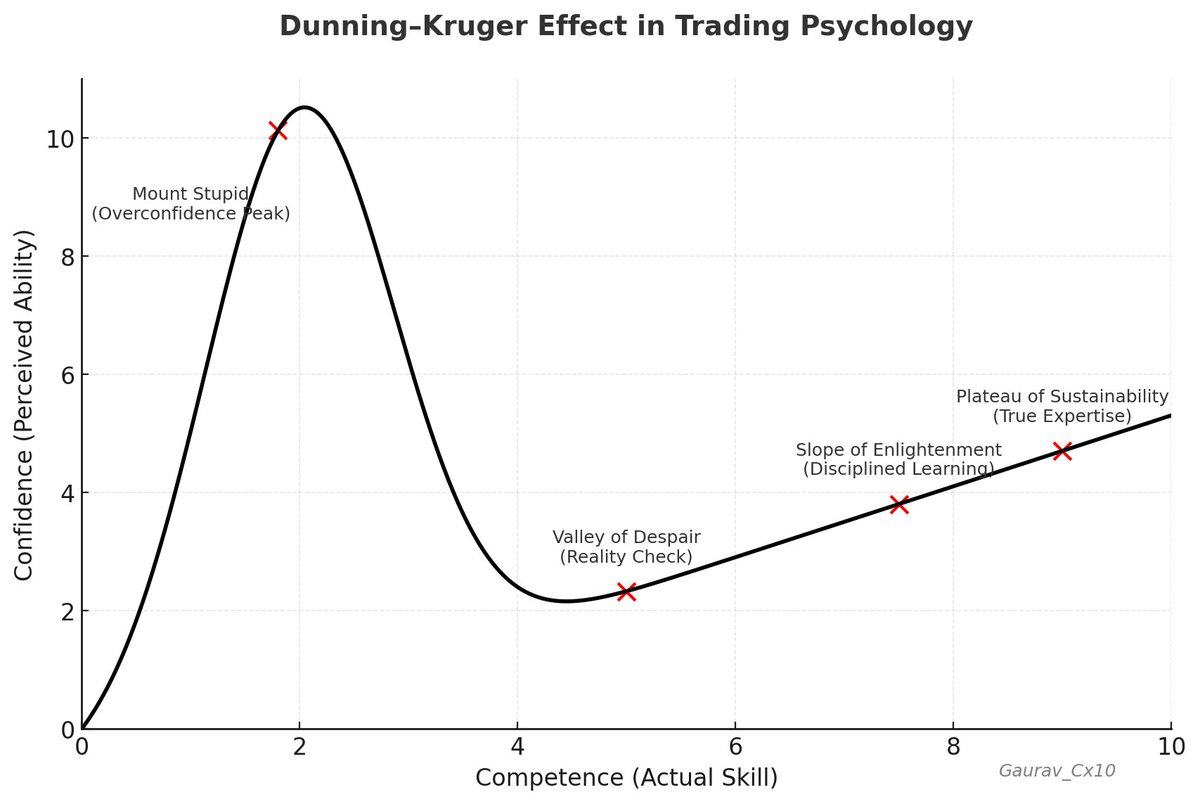
That’s the Dunning–Kruger Effect in action.
X-axis: Actual competence (low → high)
Y-axis: Confidence in ability (low → high)
1. Mount Stupid (Overconfidence Peak)
Competence: Very low
Confidence: Very high
Mindset: “This is easy. I’m a natural.”
Behaviors:
-Refuse to accept the law of probability.
-Dismiss stop-loss rules — too ego-driven.
-Obsess over “perfect” entries and “perfect” stocks.
-Copy-paste Twitter/Telegram setups, assuming they’re universal.
Outcome:
-Quick profits sometimes, but always followed by heavy drawdowns.
-Zero consistency.
2. Valley of Despair (Reality Check)
Competence: Increasing
Confidence: Collapses
Mindset:
-Losses reveal the complexity of markets.
-Trader feels: “Maybe I’m not cut out for this.”
Behaviors:
-Hop from one strategy/indicator to another.
-Take revenge trades to recover losses.
-Consume endless materials instead of practicing.
Outcome:
-Many traders quit here… or go broke.
-Few survive to grow further.
3. Slope of Enlightenment (Disciplined Learning)
Competence: Moderate → high
Confidence: Rising but grounded in reality
Mindset:
-Trading is about probabilities, not predictions.
Process > outcome. Risk > reward.
Behaviors:
-Journal and review every trade.
-Stick to fixed risk per trade (e.g., 1%).
-Focus only on high-quality setups, ignore the noise.
Outcome:
-Accounts stabilize.
-Equity curves smooth out.
-Confidence rebuilds.
4. Plateau of Sustainability (True Zone)
Competence: High
Confidence: Balanced
Mindset:
“I can’t control the market, but I can control myself.”
Trading becomes calm, almost boring — a true sign of mastery.
Behaviors:
-Take only A+ setups, with strict entry/exit discipline.
-Stay emotionally neutral — wins and losses treated alike.
-Focus on compounding over years, not jackpot hunting.
Outcome:
-Consistent profitability.
-Long-term wealth compounding.
Beyond books, I often turn to YouTube videos to further shorten the learning curve and gain knowledge. I've created and continually update a playlist that compiles few useful videos.
You can check out the playlist here: https://t.co/uuUczIgBxL
Feel free to bookmark it if you find it useful!
From this playlist, here are my top ten favorites.
1- Vijaya Kedia talking about his Journey & Style
https://t.co/Zs4Zr2T89b
2- Detailed Podcast by Samit Vartak
https://t.co/VXtT3nhdOC
3-Sumeet Nagar on Making it Big with Small & Midcap Stocks
https://t.co/xqAQwAmR1q
4-Maxims for Thinking Analytically | Prof. Sanjay Bakshi
https://t.co/PsGbPPlcWC
5-The Art Of Investing | Rajashekhar Iyer
https://t.co/i2vRYvUUat
6- Mukul Agarwal, sharing his trading journey
https://t.co/svmZwnp8FD
7-Small Cap investing by Ayush Mittal
https://t.co/CrHCeJmiEJ
8- Improving your profitability by Prabhakar Kudva
https://t.co/PH1xb15bBZ
9- Dan Zanger Videos all 3 parts
https://t.co/awdtMpz9SL
10-Ray Dalio on approaching problems, questioning, thinking, creating the best choices and making the best possible decision
https://t.co/wP7Yc01kxy
🎯
Have you ever wondered how successful investors find great opportunities in the stock market?
They use something called Mental Models. Think of them as smart tools that help make investing easier.
Let's explore one of the most useful mental models in investing
A thread….
A concept I can't stop thinking about: Shoshin.
Shoshin is a Zen Buddhist idea that means "the beginner's mind."
Here's how I think about it:
(you may want to bookmark this for later)
Over the course of your life to date, you have filled your mind with an endless array of beliefs, assumptions, and understandings about the world around you.
These form the basis of how we experience, process, and make sense of life.
Every new thing we encounter is placed onto this map of reality.
It insulates us from the embarrassment of feeling like a beginner—of feeling adrift in an ocean of uncertainty.
The problem: When we are too entrenched in our map, we may fail to see the beauty of something new.
New information that doesn't fit how we see the world is rejected and cast aside.
Shoshin is the idea that we should approach everything with a beginner's mind.
Be willing to scrape away those old assumptions, to embrace new beliefs, to feel new ideas, and to lean into being wrong about things.
We all need to embrace the embarrassment of being a beginner.
Every expert started out as a beginner.
The only way to accomplish something meaningful is to endure days, weeks, months, or even years of embarrassing failure.
Those who lean into the embarrassment of feeling child-like again will eventually win.
Lesson: Embrace your Shoshin—embrace your beginner's mind.
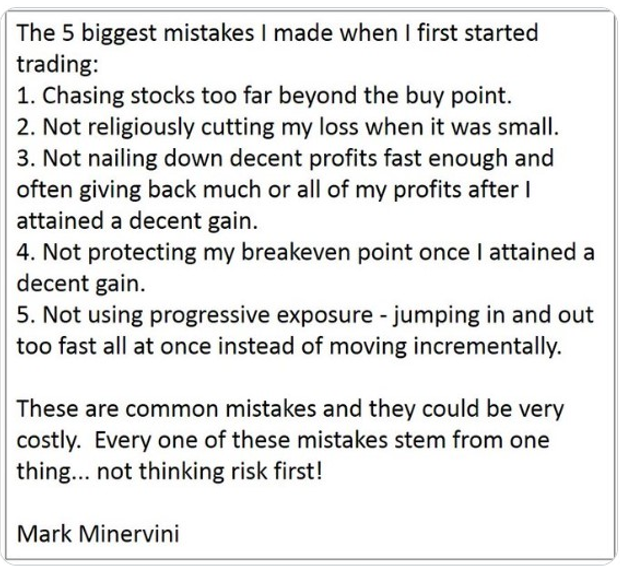
Here are some of the biggest mistakes I made when I was new to trading and very likely the same mistakes you will make a well. They all stem from one thing!
Wondering how much money you need to RETIRE?
A Simple Guide to a Happy Retirement! 🚀💰"
Break Free from Work🏃♂️
Ever dreamt of ditching the work routine? Let's kickstart the journey to financial freedom...
And understand math behind it...
(1/n)
Sad to know that one of the greatest investing legend has passed away....
He was 99...
As a tribute to this legend I have compiled thread of 99 powerful lessons...
These lessons will help us become best version of ourselves...
here we go...
1. BE A LEARNING MACHINE
(1/n)