My working paper "Marginal Propensity to Consume of Consumption and Savings Targeters" is now available at SSRN https://t.co/2BVlEhY5DO
🧵
1/ Evidence suggests that, while making financial plans, people tend to choose optimal spending for today OR optimal savings for tomorrow
How does run risk shape banks’ demand for long bonds?
@UMN_Econ JMC Angelo Mendes @angeloahmendes and coauthor Lucas Belmudes study model in which banks choose portfolio of short and long bonds and uninsured depositors can run.
https://t.co/Ddyx7K5hXU
🚨 Job Market Paper
🔍 Many workers start their career mismatched, not knowing which tasks they are best at. I estimate a dynamic structural model to study how this shapes careers and who gains and loses from task-biased technological change
📄 https://t.co/yxBJ0ga6XL
🧵👇
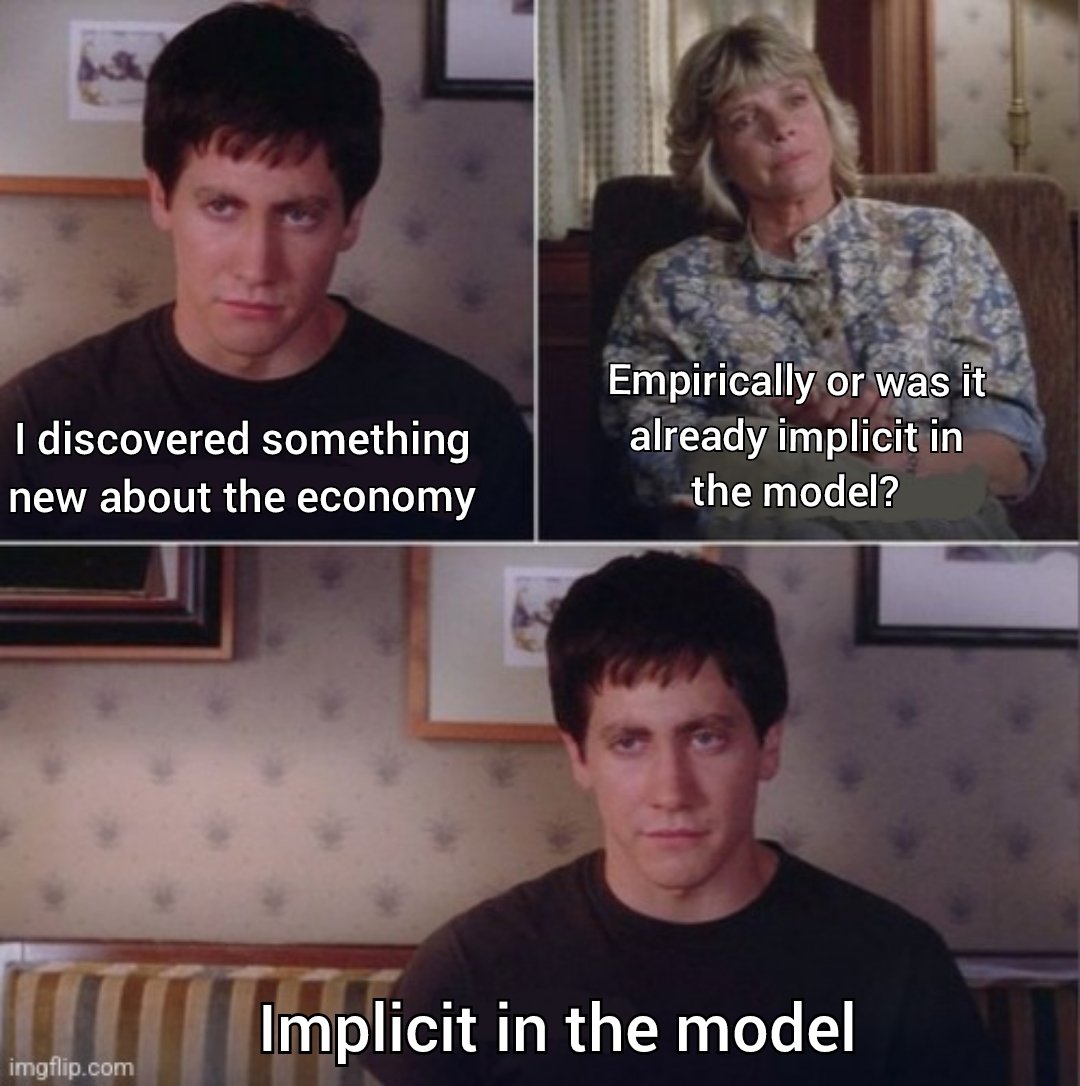
Why does economics work with utility functions, and not just decision rules? The key trick is the use of the mathematical technique of Lagrangians to solve the age-old philosophical "is-ought" problem
How to Think About Macroeconomics:
1. Start with accounting identities and balance sheets, not theoretical assumptions.
2. View the economy as a system of interconnected sectors, not a collection of indicators.
3. Strictly distinguish between stocks and flows.
4. Explain economic phenomena through causal mechanisms, not mere correlations.
5. Distinguish between real resource constraints and nominal financial constraints.
6. Do not conflate accounting identities, theoretical hypotheses, and empirical regularities.
7. Analyze economic processes in historical time, accounting for fundamental uncertainty and path dependence.
Highly recommended!
"From RANK to HANK, without FIRE" by George-Marios Angeletos, Joao Guerreiro, and Dalton Rongxuan Zhang.
"We offer guidance and tools for augmenting macroeconomic models with a realistic friction in expectations and for quantifying its implications. We start by distilling the common essence of a few popular alternatives to FIRE (Full Information Rational Expectations), including noisy or sticky information, rational or behavioral inattention, level-k thinking and cognitive discounting. We then develop a new specification, which captures the same essence while maximizing tractability. We show how this works in both RANK (the Representative-Agent New Keynesian model) and HANK (Heterogeneous-Agent New Keynesian models). We further clarify the separate partial- and general-equilibrium effects of informational frictions or bounded rationality; emphasize the interaction of such frictions with the Intertemporal Keynesian Cross and other forms of strategic complementarity; review concrete lessons for business cycles and macroeconomic policy; and discuss how to discipline the theory with appropriate survey evidence."
https://t.co/IZMD7b1Bc2
A guide for students of economics: Ten statements that demonstrate that someone does not understand modern economics or what an equilibrium is, and that you can safely ignore everything else they say.
1. “Equilibrium means the economy is stable or at rest.”
Many assume that an equilibrium is a peaceful state with no forces at play. Instead, an equilibrium is just an arrangement of actions and expectations over time that are mutually consistent. It can be locally unstable, explosive, or fragile. Nothing in the definition of equilibrium implies stability.
2. “Equilibrium implies optimality or social efficiency.”
Equilibrium is often conflated with efficiency, but equilibrium merely reflects decentralized consistency, not welfare maximization. Market power, externalities, incomplete markets, nominal rigidities, and frictions routinely produce inefficient equilibria. I often teach a first-year macro graduate course, and not a single one of the equilibria I define is efficient.
3. “Equilibrium is a unique outcome.”
Many often expect models to have one equilibrium. In reality, multiple equilibria arise naturally in dynamic, strategic, and incomplete-market environments. Models of coordination failures, self-fulfilling expectations, bubbles, overlapping generations, and liquidity traps all hinge on the existence of equilibrium multiplicity.
4. “Equilibrium requires perfect foresight or perfect information.”
Equilibrium does not assume agents know the future. In fact, equilibria are often stochastic. The definition of equilibrium only requires that beliefs are consistent with the (perceived) stochastic laws of motion implied by the model. Bayesian learning, noisy signals, ambiguity, and subjective uncertainty all fit well within an equilibrium framework, provided beliefs converge to an internally consistent (but possibly incorrect) distribution.
Bonus point: equilibria are compatible with agents having diverging beliefs that never converge to a single Dirac distribution.
5. “Real economies are rarely in equilibrium, so the concept is unrealistic.”
Equilibrium is not meant to describe the daily state of the world. It is a conceptual device used to understand the outcome of our models under the assumptions we make. Also, see point 1 above.
6. “Equilibrium requires agents to be fully rational in a psychological sense.”
Equilibrium only assumes internal consistency: agents optimize given preferences and constraints. It does not assume realism about human cognition. We can and do define equilibria in models with behavioral biases, bounded rationality, inattention, or rule-of-thumb behavior. We only need to ensure that the resulting actions and beliefs are mutually compatible.
7. “Equilibrium eliminates dynamics or learning.”
Equilibrium is sometimes misinterpreted as a static state in which nothing evolves. In fact, many equilibria are sequences of probability distributions over states driven by shocks, policy rules, and endogenous responses. Learning dynamics (Bayesian updating, adaptive rules, experience-based expectations) can occur within equilibrium if the evolution of beliefs is self-consistent.
8. “Equilibrium renders expectations unimportant.”
A common misconception is that equilibrium mechanically determines outcomes. In reality, expectations are often central: they determine investment, consumption, asset prices, and policy responses. Many equilibria differ only in their expectations. This is why communication, credibility, and forward guidance matter even in fully rational models.
9. “Equilibrium excludes policy intervention.”
Some interpret equilibrium as a laissez-faire concept. In fact, equilibrium analysis is the foundation of modern policy evaluation. Fiscal, monetary, and regulatory interventions work through equilibrium responses (prices, wages, interest rates, quantities) and must satisfy equilibrium conditions to be credible. Equilibrium is a tool for policy design, not a barrier to it.
10. “Equilibriums…”
Aequilibrium is a Latin neuter noun of the second declension, which forms a nominative plural in “a”. It is composed of aequus (equal; the same root as equality or equity) and libra (balance or scales or the name of several currencies over history).
A final thought: “equilibrium” is a term of art. Its meaning in economics differs from its use in the natural sciences or in everyday language. Terms of art are ubiquitous across academic disciplines, and the first act of intellectual diligence when one starts studying a discipline is to learn what they mean.
Why is agricultural productivity in India so low?
@UMN_Econ JMC Scott Sommers @scott_sommers56 argues weather shocks magnify land market restrictions as source of misallocation in agriculture. He uses micro data to build model of heterogeneous farmers.
https://t.co/GPr4FM1oJl
'In the fall of 1972 President Nixon announced that the rate of increase of inflation was decreasing. This was the first time a sitting president used the third derivative to advance his case for reelection.' -- Hugo Rossi
Department of Economics PhD Candidate Anastasiia Evdokimova’s research interests are Industrial Organization, Health Economics. Learn more about Anastasiia & other Northwestern Economics Job Market Candidates at https://t.co/ZCkpPN8e8z
One of the questions we ponder in this paper: Can exchange rate be generically reconstructed by no arbitrage from other asset returns (e.g. stocks and bonds) and discount factors that price them?
@ChrisPhelanEcon In last few years, literally every protest in Russia has been suppressed on the grounds of it “causing traffic disruptions”. The line between reasonable and not is quite ephemeral. I’m just worried that such kind of argument unleashes arbitrary justifications.
As we announced in Cartagena last year, and due to our perception that demand to present papers at the SED meetings has been increasing, we decided to increase the supply (we considered increasing prices ....).
Thus, the first WInter Meetings of the SED will take place... 🥁 1/3
4/ Thus, one CANNOT attribute the properties of the observable MPC to the slope of policy functions (e.g. curvature). Crucial for understanding the effect of policy interventions on aggregate demand.
My working paper "Marginal Propensity to Consume of Consumption and Savings Targeters" is now available at SSRN https://t.co/2BVlEhY5DO
🧵
1/ Evidence suggests that, while making financial plans, people tend to choose optimal spending for today OR optimal savings for tomorrow
3/ I show analytically that aggregate MPC is affected by the presence of people who switch between these two types.
Specifically, aggregate MPC doesn't coincide with the aggregate slope of the policy function.