#ChemAsianJ A Theoretical Investigation on the Role of Primary, Secondary, and Tertiary Amine Substituents in Excited State Intramolecular Proton Transfer of p-Amino o-Hydroxy Benzaldehyde (Amit Kumar Paul and co-workers) @kpamit • https://t.co/BVjVjsXtdt
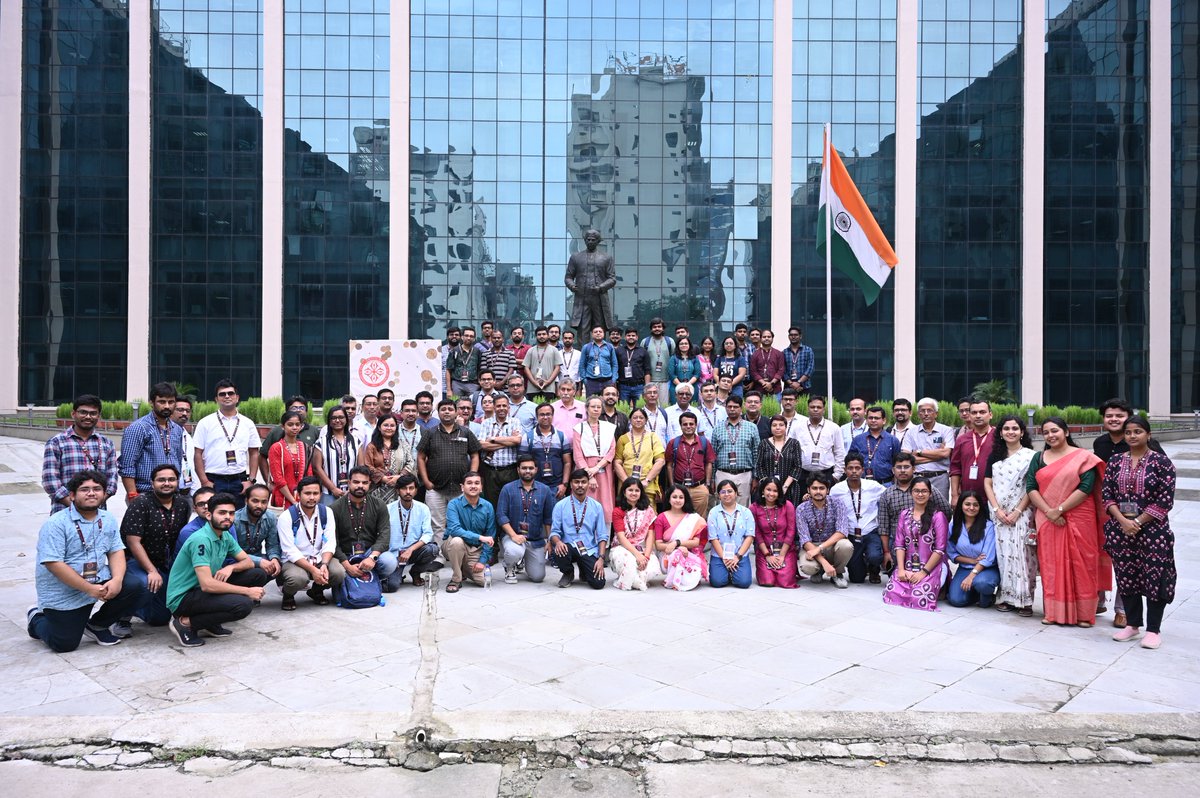
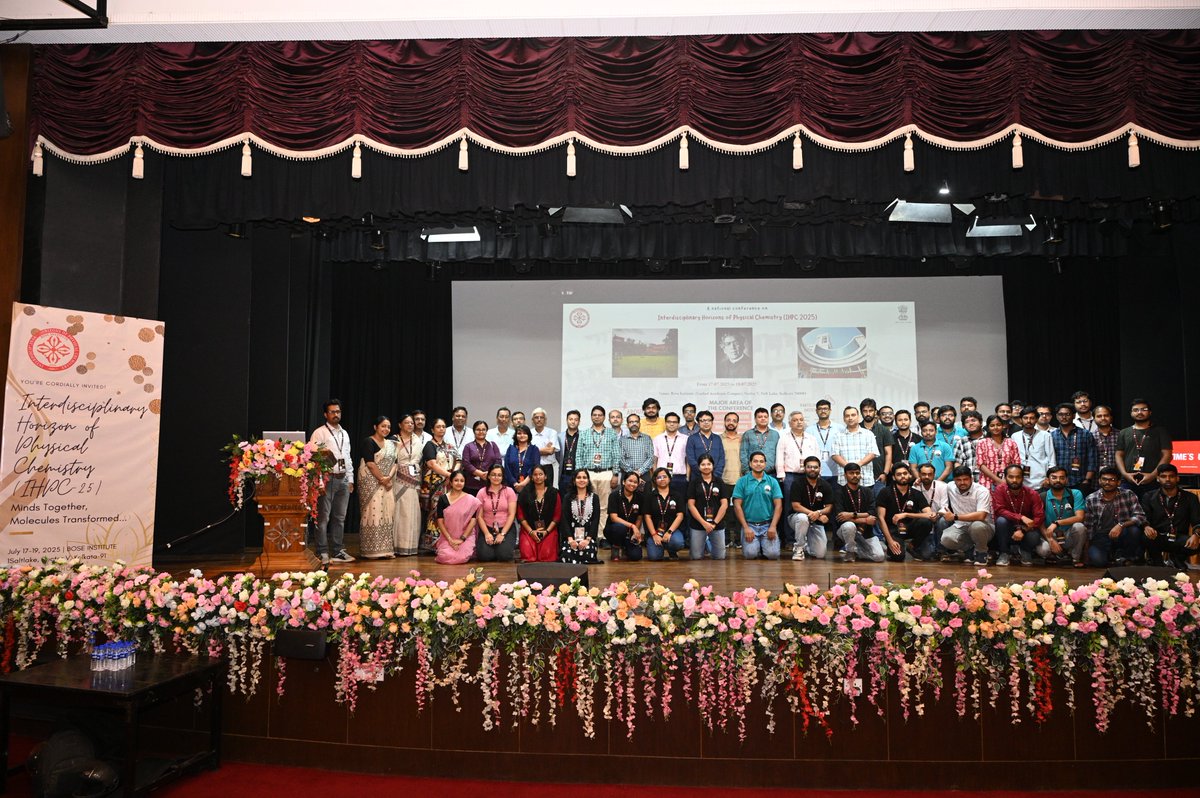
Department of Chemical Sciences, @bose_institute, organized a meeting on "Interdisciplinary Horizons of Physical Chemistry (IHPC) - 2025" during 17-19 July 2025. Thanks to all the participants and the volunteers to make it a Grand Success!!
The Department of Chemical Sciences, Bose Institute is privileged to host the National Conference on "Interdisciplinary Horizons of Physical Chemistry (IHPC), 2025" in collaboration with SNBNCBS and IISER from 17-19th July 2025. @DrJitendraSingh@karandi65@IndiaDST@PIB_India
The fourth student from my group, Palash Jyoti Boruah, defended his Ph.D. thesis on 5th December. We are grateful to Debasis Mukhopadhyay (CU) and Riccardo Spezia (Sorbonne) for evaluating the thesis.
This article reports post-transition state dynamics of catechol ozonolysis using a new QM+MM model. Condensed phase calculations with an N2 bath are done at different temperatures and the results are compared with those in vacuum. @kpamit
https://t.co/lKYULfw1YS
A JRF position is available in my group under a SERB-funded project (CRG). Interested candidates are requested to apply by Jan. 30th, 2023.
Details can be found in the given web link.
https://t.co/HjXZMRzj0o
Group delights: Award recipients from left, Himashree, Ph.D., Basudha, Institute Silver Medal, Partha, Best https://t.co/u8Pi7UORLa. thesis, and Samir, Ph.D. I wish them all the very best!
https://t.co/3woVOngUDX
A new bath model to simulate Association-Dissociation dynamics in 1000 N2 environment. Results are compared with the same reactions performed in vacuum. Just accepted in @PCCP.
In this work, @kpamit et al. performed on-the-fly dynamics on the ozonolysis reaction of catechol and showed, in detail, the different possible reaction pathways at different temperatures.
https://t.co/El68NwWCSA
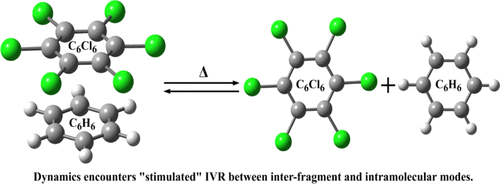
In unimolecular dissociation dynamics, random excitation of the vibrational modes of the C6H6-C6Cl6 complex showed a slower dissociation rate than that of C6H6-C6F6. It is faster for non-random excitation due to a "stimulated" IVR dynamics. @kpamit
https://t.co/m4fS9Lh2Hi
Department of Chemistry, National Institute of Technology Meghalaya is organizing a one-day seminar on Theoretical and Computational Chemistry funded by TEQIP-III on 13/03/2021.