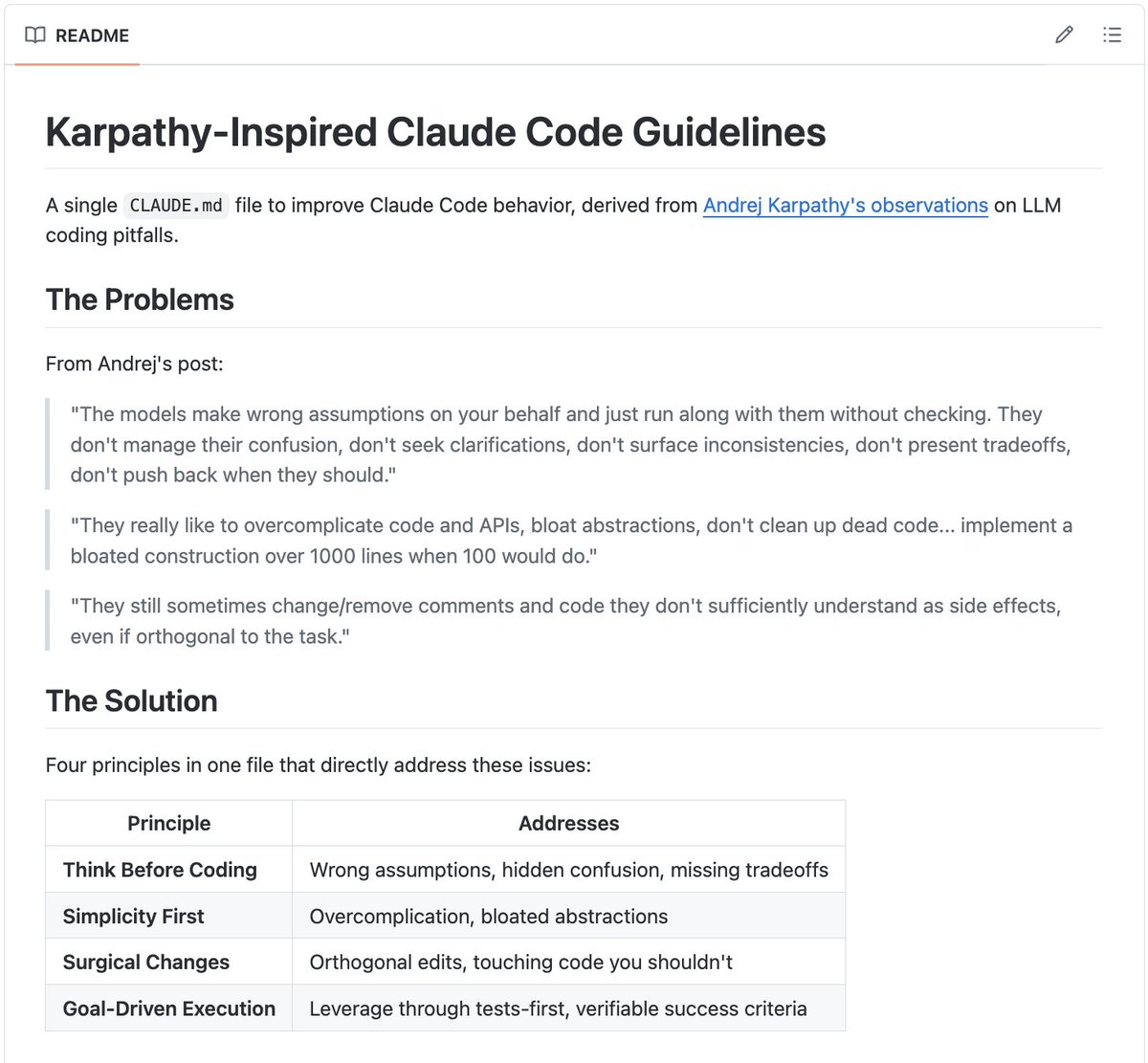
A single 𝗖𝗟𝗔𝗨𝗗𝗘.𝗺𝗱 file just hit 192k GitHub stars.
(derived from Karpathy's coding rules)
Andrej Karpathy observed that LLMs make the same predictable mistakes when writing code: over-engineering, ignoring existing patterns, and adding dependencies you never asked for.
If you've used AI coding assistants, you've hit all of these.
But here's the thing:
If the mistakes are predictable, you can prevent them with the right instructions.
That's exactly what this 𝗖𝗟𝗔𝗨𝗗𝗘.𝗺𝗱 does. You drop one markdown file into your repo, and it gives Claude Code a structured set of behavioral guidelines for your entire project.
This is a big deal.
- Built entirely around prompt engineering for AI coding assistants
- No framework, no complex tooling, just one .md file that shapes behavior
Developers are moving past "use AI to write code" and into "engineer the AI's behavior so the code is actually good."
The Claude Code ecosystem is growing fast, and the best tools in it aren't always software. Sometimes they're just well-crafted instructions.
100% open-source.
Link to the GitHub repo: https://t.co/pq6g88tNE3
That said, I wrote an article on the anatomy of the .claude folder, which was read by 11 million people.
It's a complete guide to 𝗖𝗟𝗔𝗨𝗗𝗘.𝗺𝗱, hooks, skills, agents, and permissions, and how to set them up properly.
The article is quoted below.
Yıllardır bu videoyu ararım.
40k yıl önce yok olduğu söylenen neandartel fosiliyle doğrudan bağlantılı tek kişi orta asyadaki Türkler.
Amerika'nın yerlileri, direkt Türkle aynı kök.
Orta Avrupa ve Kuzey Avrupa direkt bizden geliyor.
¡Google acaba de anunciar algo brutal!
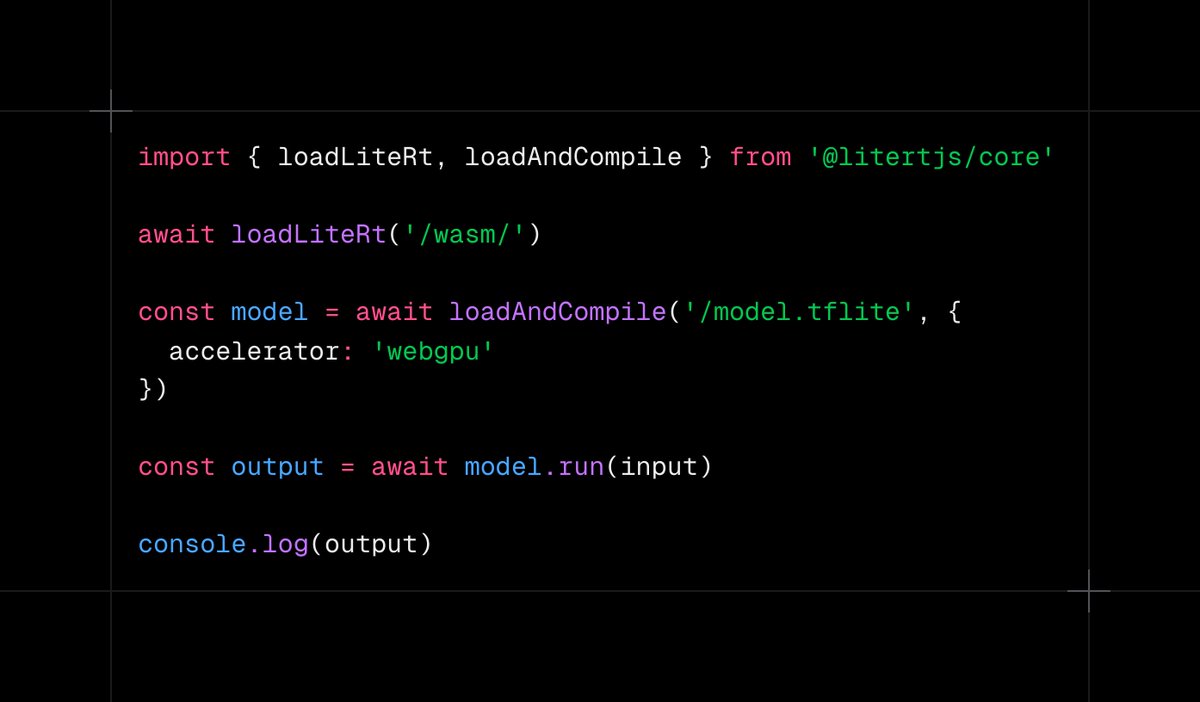
Se llama LiteRT.js y es IA corriendo en el navegador con WebGPU. Sin servidores, APIs y 100% privado.
Mejor rendimiento que TensorFlow y ONNX.
→ https://t.co/dvTG4cFJVi
This is the best site on the internet to learn harness engineering.
Free. Completely.
Most AI engineers have never heard the term. https://t.co/SPOv8UBs2O
Bookmark this site.
Then read this setup ↓
Google Brain founder, Andrew Ng:
"100% of my tasks are done by ai agents, self-improving loops are next.
Give it 3-6 months and prompting is gone."
32 minutes of clear explanation on building loops from scratch.
Worth more than any $500 agentic course.
Watch it, then read the full guide below.
Postgres 19 made I/O worker pools dynamic instead of fixed.
PG18 forced you to pick one static number (io_workers = X) and hope it was correct.
PG19 gives you real controls instead:
→ io_min_workers
→ io_max_workers
→ io_worker_idle_timeout
→ io_worker_launch_interval
Now the pool can grow and shrink automatically based on load.
Much better than guessing the right number.
https://t.co/qdRpAvhUSz
PostgreSQL 19 introduces graph-style queries.
Instead of manually connecting table after table with joins, you can describe the path through your data:
customer → bought → product ← bought ← similar customer → follows → brand
Useful for recommendations, access control, fraud detection, knowledge graphs, and AI context.
https://t.co/5WETAOUezI
Ex-NVIDIA engineer who built Unsloth explained RL, kernels, reasoning, quantization, and agents in 2 hours 42 minutes - better than $5000 fine-tuning bootcamps.
pick the base model -> write triton kernels for 2x faster fine-tune -> quantize to 4-bit -> run GRPO/DPO -> ship a reasoning model on your single GPU.
That loop is why Unsloth is the default way to fine-tune Llama, Qwen, Gemma, and Phi on hardware you already own.
Unsloth + Triton kernels + 4-bit quantization + GRPO/DPO + single-GPU fine-tuning - that's the stack.
Watch and save it, then fine-tune your first model tonight.
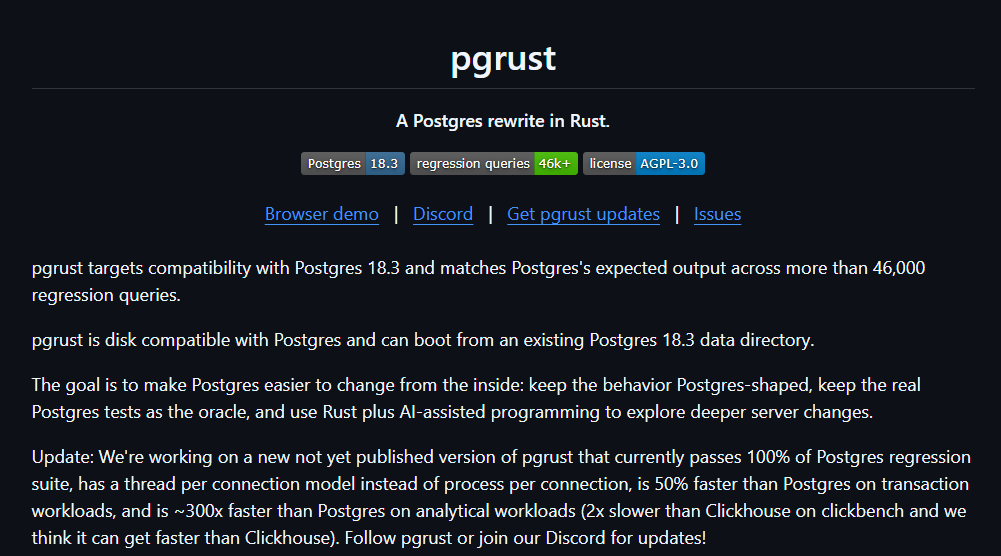
Reescribieron PostgreSQL completo en Rust... y ya pasa el 100% de los tests oficiales de Postgres!
Ojo, no es un fork, es una reimplementación desde cero en Rust que actualmente:
• Pasa las 46.066 queries del regression suite de PostgreSQL 18.3
• Es disk-compatible (puedes bootearlo directamente con tu data directory actual)
• Tiene demo funcional en el browser
El objetivo Es hacer que una de las bases de datos más complejas del mundo sea mucho más fácil de modificar, extender y optimizar desde dentro usando Rust + programación asistida por IA.
Y lo más loco: ya existe una versión WIP (aún no publicada) que promete ser 50% más rápida en workloads transaccionales y ~300x más rápida en workloads analíticos.
REPOOO👇
OpenAI just launched a 3-hour course on building agentic systems from scratch:
00:00 - Building workspace agents
37:42 - Deep dive into OpenAI AgentKit
1:24:01 - Agent memory (loops, context, evals)
2:21:44 - Agentic training (OpenAI playbook)
This 3-hour watch will replace you 10 paid agentic courses.
Watch it today, then learn how to build a team of AI agents from scratch in the article below.
New skill: /improve-animations
Inspired by @shadcn’s improve skill I made one specifically for animations.
Use your most capable model to audit animations in your project and hand the execution to cheaper models.
Fable is available through July 12, so make good use out of it!
UI TASARIMLARINDA SLOP GÖRÜNME DEVRİ BİTTİ!
Hallmark diye açık kaynak bir design skill çıkmış. Claude Code, Cursor veya Codex'e ekleyip kullanabiliyorsun. UI ve landing page'leri baştan itibaren tasarım duyarlılığıyla ürettiriyor.
Kurulumu tek satır. Şunu yazman yeterli:
npx skills add nutlope/hallmark
Sadece kodlamayı AI'a bırakırsan çalışan ama görsel olarak sönük ekranlar çıkıyor. Diğer tüm AI ile yapılan sitelerin birebir kopyası gibi görünüyor ve işe yaramaz oluyor, zaten buna da slop design diyoruz.
Bu skill'i verince iş baştan daha profesyonel görünüyor. Skill'e tasarım kurallarını, arayüz prensiplerini baştan sona öğretmişler.
Claude Code veya Codex ile UI üretenler için denemeye değer.
Örnekler videoda var.
The open-source library of CSS motion effects, Kinetics, now contains 99 motion effects.
You can copy CSS to the clipboard or the prompt so it's easy to replicate in your AI tool.
https://t.co/gmkIc4z4mn