Please take 1 minute and watch this clip from Andreas Antonopoulos at ETHDenver 2019
The exact moment Andreas is warning about, where moloch tries to turn Ethereum into corposlop, is here
We need the courage to resist it
“We want to live in a free, European Democracy. After 16 years of sorrow, corruption and Russian influence. We have had enough”
The organisers & singers at the massive Budapest concert told me why Orban has to go.
Bro, call me retard but
I was bull posting 1400$ $eth during the April 2024 lows.
Why won't I bullpost 2100$ $eth today ?
We are up 50% since April 2024 lows !
BTC and SOL down 5% since 2024 lows.
We will win. Because we care about this industry, about decentralization, about onchain economy, about credible neutrality, about destroying corruption, about privacy and transparency.
Bitcoin people only care about number go up, they have forgotten why they were here. It is not a P2P e-cash anymore.
Solana fanboys have made this industry, a gambling industry.
Ethereans are the only community in crypto who care about cypherpunk vision.
The ticker is ETH.
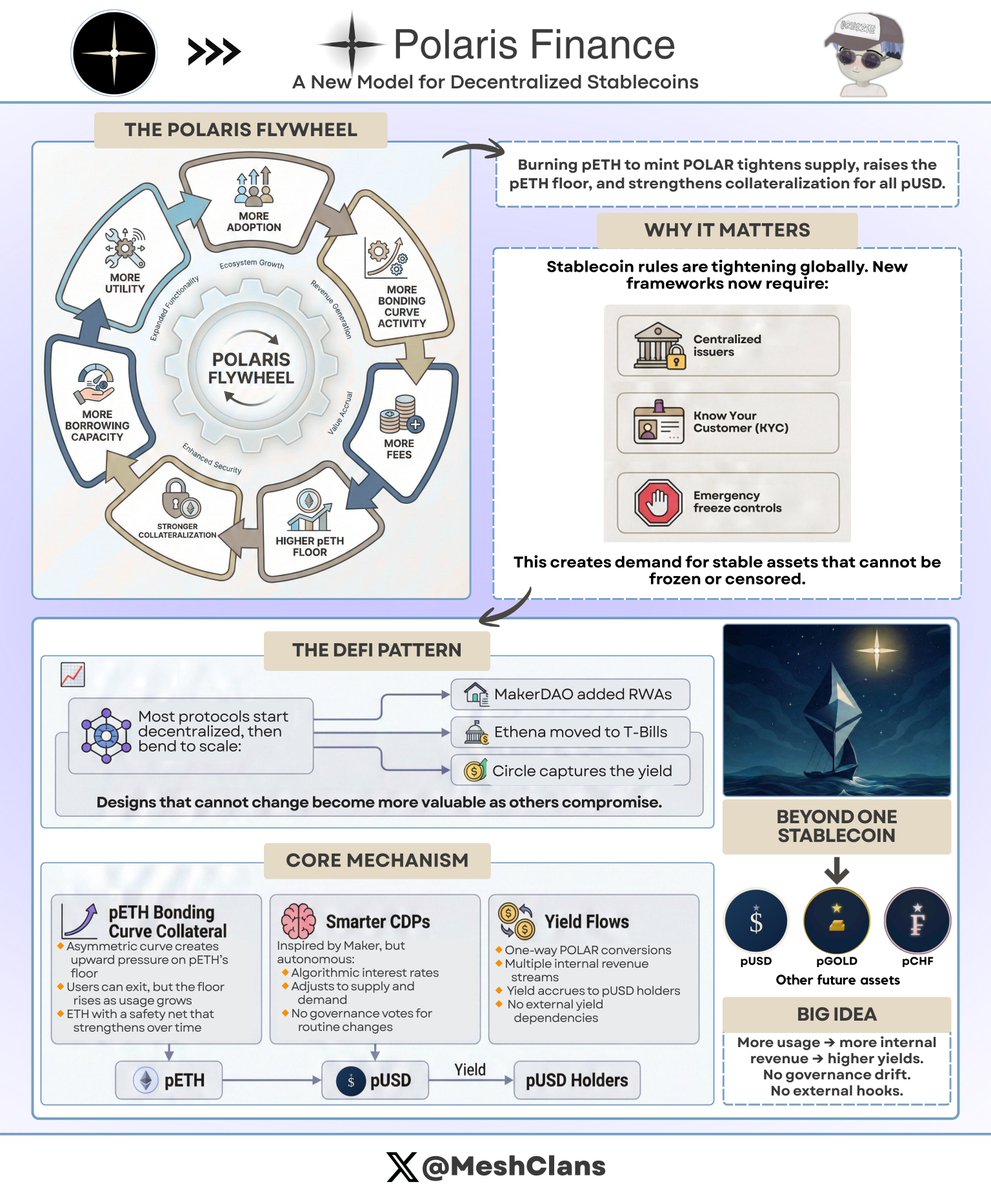
Polaris Finance is building something the stablecoin market hasn't seen before: a system designed to stay decentralized while scaling yield generation.
I've been digging into the architecture. Here's what makes it interesting.
Polaris runs on three interconnected tokens:
🔸 pUSD - the stablecoin you hold
🔸 pETH - ETH with a rising price floor
🔸 POLAR - minted by burning pETH
Yield comes from four internal sources:
🔸 Bonding curve fees when users trade pETH
🔸 Interest from CDP borrowing
🔸 Value capture from POLAR conversions
🔸 Trading fees from PolarEX (planned DEX)
The philosophy: yield grows with protocol activity instead of depending on external rates. Everything generates returns from onchain activity.
Right now, 98% of stablecoins are centralized. USDC generates billions from T-Bill yields but returns zero to holders. Circle captures everything.
Most decentralized alternatives import yield from somewhere else. MakerDAO uses RWAs. Ethena uses CEX basis trades. Both introduce counterparty risk and dependency.
@polarisfinance_ monetizes ETH volatility directly through the bonding curve. More volatility means more trading, more fees and more protocol revenue.
Traditional stablecoins suffer when markets get choppy. This one is built to benefit from it. That's a clever inversion imo.
Core contracts will be immutable after deployment. The bonding curve formula, CDP mechanics, conversion ratios: locked permanently.
What this guarantees:
🔸 No governance drift toward centralization
🔸 No pivoting to T-Bills when yields compress
🔸 No upgradable proxies that can change the rules
POLAR holders adjust parameters within hard-coded ranges (interest rate bounds, fee levels) but can't touch the fundamental architecture.
Immutability means the protocol can't compromise later, but also can't adapt if conditions change. That's the tradeoff they're making. I'm honestly not sure which risk is bigger.
The flywheel works like this:
More adoption → more bonding curve activity → more fees → higher pETH floor → stronger collateralization → more borrowing capacity → more utility → more adoption
POLAR conversions reinforce this. Burning pETH to mint POLAR removes collateral supply, which raises the floor price and improves collateralization ratios for all outstanding pUSD.
Each piece strengthens the others. Designed to compound, not dilute.
Stablecoin regulations are tightening. US Stablecoin Act, EU MiCA, other frameworks now require:
🔸 Centralized issuers
🔸 KYC
🔸 Emergency controls
This creates real pressure. Projects that can't be frozen or censored suddenly matter more.
Meanwhile, the pattern keeps repeating in DeFi. Protocols launch decentralized, then compromise for scale. MakerDAO added RWAs. Ethena shifted to T-Bills. Circle extracts the yield.
We've seen this movie before. A protocol that can't change by design gets more valuable as everything else bends.
The bonding curve as collateral is interesting. Unlike standard AMM curves, this has asymmetric design creating upward pressure on the pETH floor.
Users can sell pETH back to the curve, but the floor keeps rising as the protocol grows.
Think of it as ETH with a safety net that strengthens over time.
The CDP system is inspired by Maker's CDP but enhances it with autonomous interest rate management. Rates adjust algorithmically based on supply and demand. No governance votes needed for every tweak.
Combine that with one-way POLAR conversions and you get multiple revenue streams flowing to pUSD holders.
Polaris isn't just pUSD. StablecoinOS is infrastructure for multiple stablecoins sharing the same pETH liquidity pool.
Potential expansion:
🔸 pGOLD - gold-pegged
🔸 pCHF - Swiss franc
🔸 Other assets using the same collateral base
Each addition grows the shared liquidity. Network effects at the platform level.
If the mechanism works, it becomes infrastructure for decentralized stable assets broadly. That's the real vision here.
@TokenBrice and @0xluude come from DeFi Collective: an org focused on genuinely decentralized protocols. TokenBrice has years analyzing DeFi, knows where protocols compromise and why.
Bootstrap approach (no big VC round) aligns incentives with long-term decentralization over exit liquidity. I respect that choice, even if it makes the path somehow harder.
Most stablecoins make tradeoffs:
🔸 USDC gets scale through centralization
🔸 LUSD gets decentralization but can't scale
🔸 Ethena gets yield but adds CEX dependency
Polaris is testing a different hypothesis: yield that scales WITH decentralization instead of against it.
More protocol usage → more internal revenue → higher yields. No external dependencies needed.
If it works at scale, that changes the design space. Big if.
Polaris is attempting what DeFi actually needs: a stablecoin that stays decentralized while scaling both adoption and yield.
The design addresses real problems:
🔸 Bonding curve collateral model
🔸 Multi-engine yield generation
🔸 Immutable core
🔸 Platform expansion via StablecoinOS
Execution determines everything. The mechanism is novel, needs real-world testing.
But the design thinking tackles actual stablecoin problems rather than repackaging existing approaches.
The market needs genuinely decentralized options that can compete at scale.
Polaris is building toward that with a differentiated technical approach.
I'll be tracking how this plays out.
What's your take on the immutability tradeoff? Does permanent architecture beat the ability to adapt, or is that too rigid for DeFi's pace?
2026 is the year we take back lost ground in computing self-sovereignty.
But this applies far beyond the blockchain world.
In 2025, I made two major changes to the software I use:
* Switched almost fully to https://t.co/ZIKj4U5XFM (open source encrypted decentralized docs)
* Switched decisively to Signal as primary messenger (away from Telegram). Also installed Simplex and Session.
This year changes I've made are:
* Google Maps -> OpenStreetMap https://t.co/Xm0pad5nh9, OrganicMaps https://t.co/yvbwXqEPwo is the best mobile app I've seen for it. Not just open source but also privacy-preserving because local, which is important because it's good to reduce the number of apps/places/people who know anything about your physical location
* Gmail -> Protonmail (though ultimately, the best thing is to use proper encrypted messengers outright)
* Prioritizing decentralized social media (see my previous post)
Also continuing to explore local LLM setups. This is one area that still needs a lot of work in "the last mile": lots of amazing local models, including CPU and even phone-friendly ones, exist, but they're not well-integrated, eg. there isn't a good "google translate equivalent" UI that plugs into local LLMs, transcription / audio input, search over personal docs, comfyui is great but we need photoshop-style UX (I'm sure for each of those items people will link me to various github repos in the replies, but *the whole problem* is that it's "various github repos" and not one-stop-shop). Also I don't want to keep ollama always running because that makes my laptop consume 35 W. So still a way to go, but it's made huge progress - a year ago even most of the local models did not yet exist!
Ideally we push as far as we can with local LLMs, using specialized fine-tuned models to make up for small param count where possible, and then for the heavy-usage stuff we can stack (i) per-query zkp payment, (ii) TEEs, (iii) local query filtering (eg. have a small model automatically remove sensitive details from docs before you push them up to big models), basically combine all the imperfect things to do a best-effort, though ultimately ideally we figure out ultra-efficient FHE.
Sending all your data to third party centralized services is unnecessary. We have the tools to do much less of that. We should continue to build and improve, and much more actively use them.
(btw I really think @SimpleXChat should lowercase the X in their name. An N-dimensional triangle is a much cooler thing to be named after than "simple twitter")
Now that ZKEVMs are at alpha stage (production-quality performance, remaining work is safety) and PeerDAS is live on mainnet, it's time to talk more about what this combination means for Ethereum.
These are not minor improvements; they are shifting Ethereum into being a fundamentally new and more powerful kind of decentralized network.
To see why, let's look at the two major types of p2p network so far:
BitTorrent (2000): huge total bandwidth, highly decentralized, no consensus
Bitcoin (2009): highly decentralized, consensus, but low bandwidth - because it’s not “distributed” in the sense of work being split up, it’s *replicated*
Now, Ethereum with PeerDAS (2025) and ZK-EVMs (expect small portions of the network using it in 2026), we get: decentralized, consensus and high bandwidth
The trilemma has been solved - not on paper, but with live running code, of which one half (data availability sampling) is *on mainnet today*, and the other half (ZK-EVMs) is *production-quality on performance today* - safety is what remains.
This was a 10-year journey (see the first commit of my original post on DAS here: https://t.co/Fa0jKFgObW , and ZK-EVM attempts started in ~2020), but it's finally here.
Over the next ~4 years, expect to see the full extent of this vision roll out:
* In 2026, large non-ZKEVM-dependent gas limit increases due to BALs and ePBS, and we'll see the first opportunities to run a ZKEVM node
* In 2026-28, gas repricings, changes to state structure, exec payload going into blobs, and other adjustments to make higher gas limits safe
* In 2027-30, large further gas limit increases, as ZKEVM becomes the primary way to validate blocks on the network
A third piece of this is distributed block building.
A long-term ideal holy grail is to get to a future where the full block is *never* constituted in one single place. This will not be necessary for a long time, but IMO it is worth striving for us at least have the capability to do that.
Even before that point, we want the meaningful authority in block building to be as distributed as possible. This can be done either in-protocol (eg. maybe we figure out how to expand FOCIL to make it a primary channel for txs), or out-of-protocol with distributed builder marketplaces. This reduces risk of centralized interference with real-time transaction inclusion, AND it creates a better environment for geographical fairness.
Onward.
In Defense of Exponentials
I used to tell founders, the reaction you are going to get to your launch is not hate, it’s indifference. By default, nobody cares about your new chain.
I have to stop telling them that now. Monad just launched this week, and I’ve never seen so much hate about a blockchain that just launched. I’ve been investing into crypto professionally for 7+ years now. Before 2023, almost every chain I’ve ever seen that launched was mostly met with enthusiasm or indifference.
But now, new chains are born into a chorus of hate. The amount of haters I’ve seen for projects like Monad, Tempo, MegaETH—before they even hit mainnet—is a genuinely new phenomenon.
I’ve been trying to diagnose: why is this happening now, and what does it mean about the psychology of this market?
The Cure is Worse than the Disease
Forewarning: this is going to be the vaguest blockchain valuation post you ever read. I don’t have any fancy metrics or charts to sell you on. Instead, I’ll be arguing against the zeitgeist of Crypto Twitter, which for the last couple of years, I’ve been constantly on the opposite side of.
In 2024, I felt like what I was arguing against was financial nihilism. Financial nihilism is the belief that none of these assets matter, it’s all memes at the end of the day, and everything we’ve built is inherently worthless.
Thankfully, that’s no longer the vibe. We have broken out of that spell.
But the zeitgeist now is what I’d call financial cynicism: OK, maybe some of this stuff has value, maybe it’s not all memes, but it’s grossly overvalued and it’s only a matter of time before Wall Street finds that out. Not that all chains are worthless. But these things are all maybe worth 1/5th-1/10th of what they’re currently trading at (have you seen these PE ratios?), and so you’d better pray like hell Wall Street doesn’t call us on our bluff, because once they do it’s all getting wiped out.
You’ve got many bullish analysts now trying to conjure up optimistic L1 valuation models, inflating PE ratios, gross margins, DCFs, trying to fight against this mood.
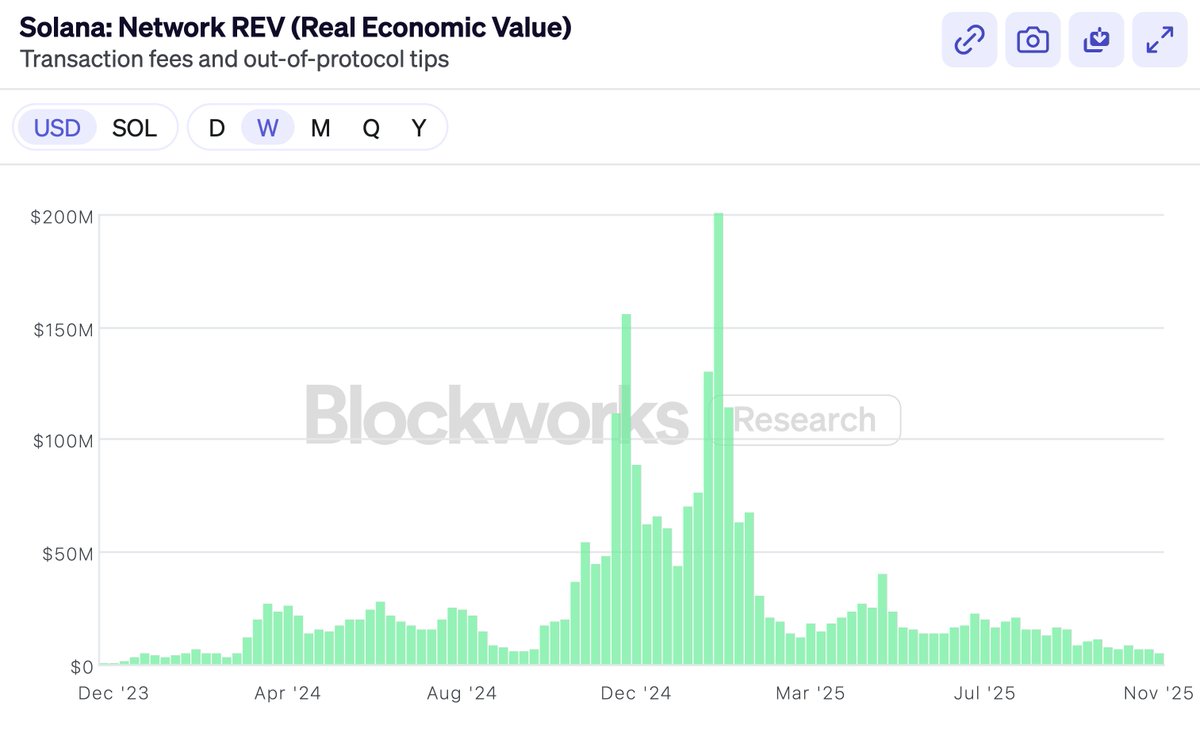
Late last year, Solana very proudly embraced REV as a metric that could finally justify their valuation. They proudly announced: we—and only we—are no longer bluffing to Wall Street!
And, of course, almost immediately after REV was embraced, it fell off a cliff (though $SOL, tellingly, did better than REV did).
Not that there’s anything wrong with REV. REV is a very clever metric. But the point of this post is not metric selection.
Then came the launch of Hyperliquid. A DEX that had real revenue and buybacks and PE multiples. And the chorus said—look, look I told you! Finally, for the first time ever, a token that has some real profits and a proper PE multiple. (Nevermind BNB, we don’t talk about that.) Hyperliquid will eat everything because obviously Ethereum and Solana don’t make any real money, we can stop pretending to value them now.
Hyperliquid, Pump, Sky, these buyback-heavy tokens are all great. But the market always had the ability to invest into exchanges. You could always buy Coinbase, or BNB, or whatever. We own $HYPE, and I agree that it’s a fantastic product.
But that’s not why people were investing in ETH and SOL. The fact that L1s don't have exchange-like profit margins is not why people were buying them—if they wanted that, they could’ve bought Coinbase stock.
So if I’m not critiquing blockchain financial metrics, maybe you think this post is going to be chiding the sinfulness of the token-industrial complex.
Obviously, everyone has lost money on tokens in the last year, VCs included. Alts are down bad this year. And so the other half of the zeitgeist on CT is arguing about who's to blame. Who’s become greedy? Are the VCs greedy? Is Wintermute greedy? Is Binance greedy? Are the farmers greedy? Are the founders greedy?
The answer, of course, is the same as it’s ever been.
Everyone is greedy. Everyone. The VCs, Wintermute, the farmers, Binance, the KOLs, they're all greedy, and you are greedy too. But it doesn't matter. Because no functioning market has ever required anyone to act against their self-interest. If we're right about crypto, we can all be greedy and the investments will still work out. Trying to analyze a market that has gone down by figuring out “who’s greedy” is going to be about as fruitful as commissioning witch trials. I guarantee you, nobody just started being greedy in 2025.
So this, too, is not what I’m going to be writing about.
Many people want me to write a post about why $MON should be valued at X or $MEGA at Y. I’m not interested in writing this post, or advocating that you buy anything in particular. In fact, you probably shouldn’t buy any of them if you don’t already believe in them.
Will any new challenger chain win? Who knows. But if it has a material chance of winning, it's going to be priced on that basis. If Ethereum is worth $300B or Solana is worth $80B, a project that has a 1-5% chance of becoming the next Ethereum or Solana will be priced according to those probabilities.
Somehow CT is scandalized by this, but it’s no different than Biotech. A drug that has less than a 10% chance of curing Alzheimer's is priced by the market as worth billions of dollars, even if 90% chance it won’t pass stage 3 trials and will go to 0. That's how the math works—and turns out, markets are pretty good at doing math. Binary outcomes are priced on probabilities, not on run rates or moral turpitude. It’s the “shut up and calculate” school of valuation.
I really don’t think that’s an interesting question to write about. “5% chance to win? No way, that’s clearly a 10% chance!” Markets, not articles, are the best way to assess that for any individual token.
So here’s what I am going to write about: CT doesn't seem to believe anymore that chains are valuable.
I don’t think this is because they don’t believe new chains can win market share. We just saw Solana dominate market share after emerging from the ashes less than 2 years ago. It’s not easy, but of course it’s possible.
It’s more that people have come to believe that even if a new chain wins, there’s no prize worth winning. If $ETH is just a meme, if it’ll never generate real revenue, then even if you win, you won’t be worth $300B. The contest is not worth winning, because these valuations are all bunk and it’ll all come crashing down before you go to claim your prize.
Being optimistic about chain valuations has become passé. Not that nobody is optimistic—obviously there must be optimists out there. For every seller there’s a buyer, and as much as CT cool kids love to drag L1s, people are comfortable buying SOL at $140, ETH at $3000.
But there’s a perception now that all the smartest people are over buying smart contract chains. Smart people know the jig is up. If not now, then soon. The only people buying here are suckers—Uber drivers, Tom Lee, and KOLs who say stuff like “trillions.” And maybe the US Treasury. But not the smart money.
This is bullshit. I don’t believe it, and you shouldn’t either.
So I felt like I had to write a smart person’s manifesto on why general purpose chains are valuable. This post is not about Monad or MegaETH. It’s really in defense of ETH and SOL. Because if you believe ETH and SOL are valuable, the rest is straight downstream.
Defending ETH and SOL valuations is generally not my job as a VC, but fuck it, if nobody else is willing to do it, then I’ll write it.
Feeling the Exponential
My partner Bo experienced the Chinese Internet boom first-hand as a VC. I’ve heard how “crypto is like the Internet” so many times now that it doesn’t even register for me anymore. But when I hear his stories, it always reminds me how costly it is to be wrong about these things.
A story he often tells is about when all the early e-commerce VCs (it was a small group back then) got together for coffee in the early 2000s. They debated: how big is the market for e-commerce going to be?
Is it going to be mostly electronics (maybe only techies will use PCs)? Could it ever work for women (perhaps they’re too tactile)? What about food (maybe impossible to manage perishables)? These were deeply important questions for early VCs to decide what to invest in and what prices to pay.
The answer, of course, was that literally every single one of them was devastatingly wrong. E-commerce would sell everything, and the target audience was the whole fucking world. But nobody at the time actually believed it. And even if they did, it would be too absurd to say out loud.
You just had to wait long enough for the exponential to show you. Even among the believers, very few thought e-commerce would become as big as it became. And those few who did, almost all of them became billionaires from just not selling. Every other VC—as Bo tells me, since he was one of them—sold too early.
It has become passé in crypto to believe in the exponential.
I believe in the crypto exponential. Because I’ve lived it.
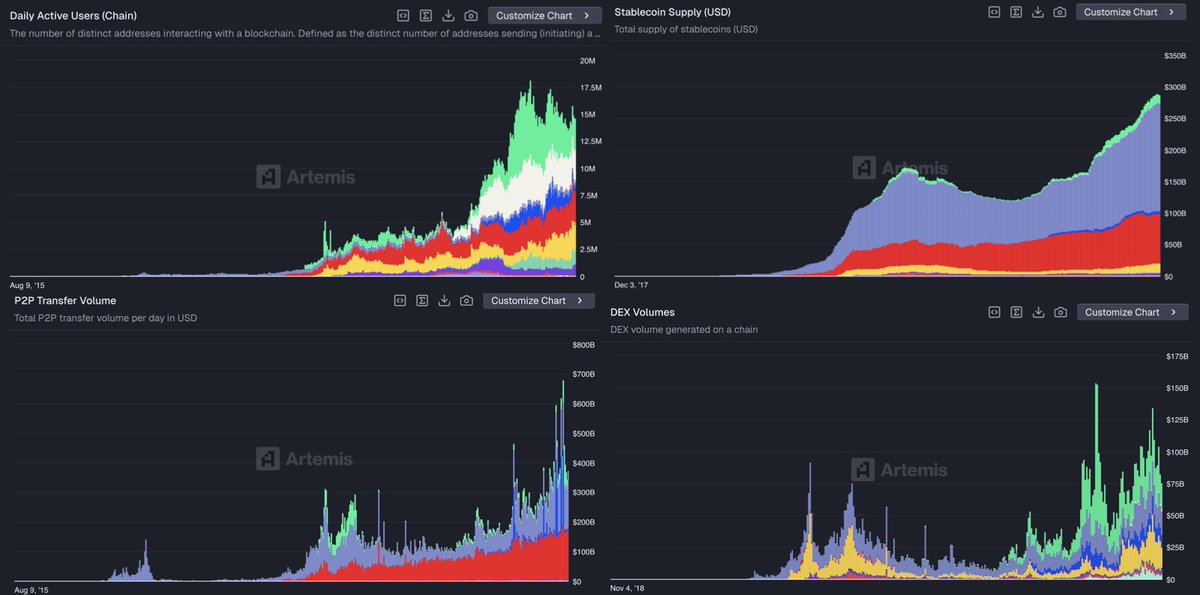
When I started in crypto, nobody used this stuff. It was tiny and broken and awful. TVL on-chain was in the millions. We invested into the first generation of DeFi, MakerDAO, Compound, 1inch, back when they were science projects. I remember playing around on EtherDelta back when DEXes traded single digit millions a day, and that was considered to be a huge success. It was complete dogshit. Now we routinely trade in the tens of billions on-chain every day. I remember believing it was crazy that Tether hit a billion dollars in issuance and was being written up in the NYT as a ponzi scheme on the brink of shutdown. Now stablecoins are over $300B and regulated by the Federal Reserve.
I believe in the exponential because I’ve lived it. I’ve seen it over and over again.
But you might respond—well, stablecoin growth might be exponential, maybe DeFi volumes are exponential, but they don’t accrue to ETH or SOL. The value doesn’t get captured by the chains.
To which I answer: you still don’t believe in the exponential.
Because the exponential’s answer is always the same: it doesn’t matter. This stuff is going to be so much bigger than it is today. And when it’s absolutely enormous, you’ll make it up on scale.
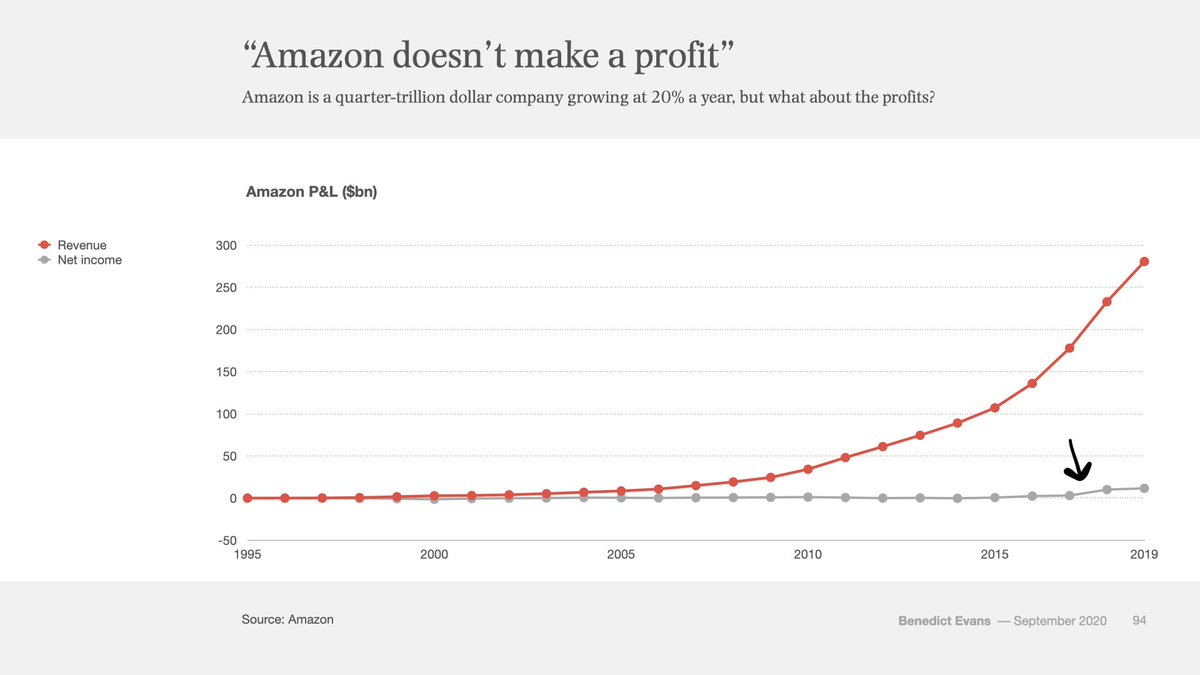
Study this chart.
This is Amazon’s P&L from 1995 to 2019. That’s 24 years. Red is revenue, gray is profit. You see that little blip on the end where the gray line goes up? That’s when, 22 years in, Amazon started actually making a profit.
Amazon was 22 years old when this little gray line of net income first peeled off of 0. Every single year before then, there were op eds and critics and short sellers claiming that Amazon was a ponzi scheme that would never make any money.
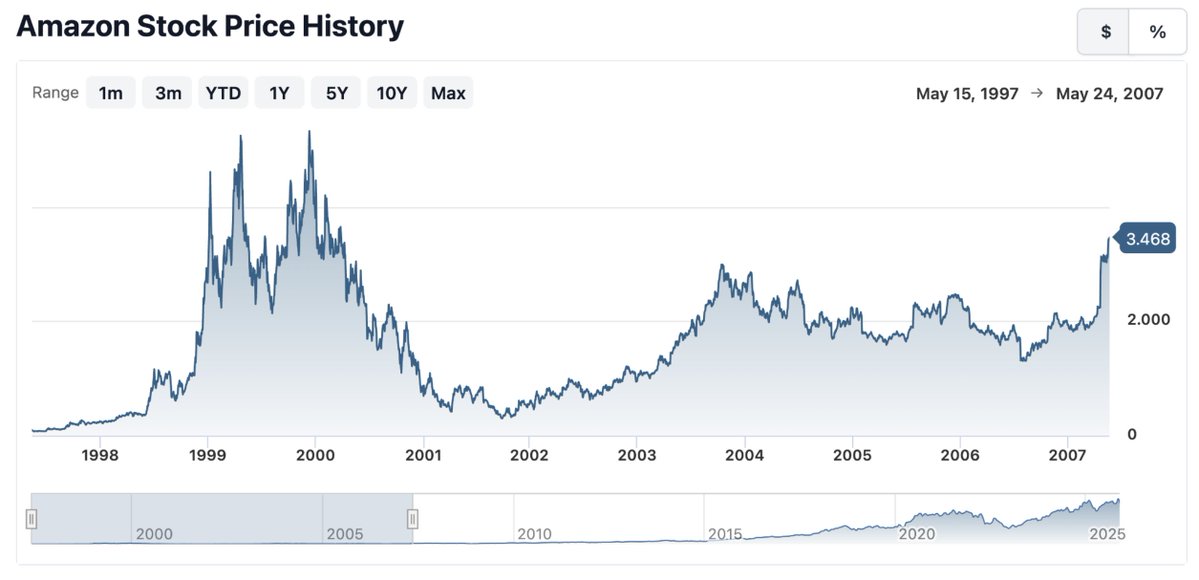
Ethereum just turned 10 years old. This is what the first 10 years of Amazon stock looked like:
10 years of chop. All along the way, Amazon was beset with doubters and non-believers. Is e-commerce a VC-subsidized charity? They’re selling underpriced cheap low-quality knick-knacks to bargain hunters, who cares? How are they ever going to make actual money, like Walmart or GE?
If you were arguing about Amazon’s P/E ratio, you were in the wrong regime. That’s the regime of linear growth. But e-commerce was not a linear trend, and so every single person for 22 years arguing about P/E ratios was devastatingly wrong. No matter what you paid, no matter when you bought, you were not bullish enough.
Because that’s what exponentials do. When it comes to truly exponential technologies, no matter how big you think it’s going to get, it just keeps getting even bigger.
This is the thing that Silicon Valley has always understood better than Wall Street. Silicon Valley was raised on exponentials, while Wall Street was raised on linearity. And over the last few years, crypto’s center of gravity has migrated from Silicon Valley to Wall Street. You can feel it.
Granted, crypto growth doesn’t look as smooth as e-commerce’s growth. It’s burstier, it goes in fits and starts. This is because crypto, being about money, is deeply tied to macro forces, and it also has more violent regulatory push and pull than e-commerce. Crypto strikes at the heart of the state—money—and so it’s more unnerving to governments than e-commerce ever was.
But the exponential is no less inevitable. It's a crude argument. But if crypto is exponential, then the crude argument is correct.
Zoom out.
Financial assets want to be free. They want to be open. They want to be interconnected. Crypto turns financial assets into file formats, makes it as easy to send a dollar or a stock as to send a PDF. Crypto makes it possible for everything to talk to everything. It makes it all 24/7, global, interconnected, and open.
That will win. Open always wins.
If there’s no other lesson I've learned from the Internet, it’s that. Incumbents will fight against it, governments will huff and puff, but eventually they will give up against the adoption, the generativeness, the sheer efficiency that this technology enables. It’s what the Internet did to every other industry. Blockchains are how that same trend will gobble up all of finance and money.
Yes—with enough time—all of it.
An old saying goes: people overestimate what can happen in two years, but they underestimate what can happen in ten.
If you believe in the exponential, if you zoom out enough, then it’s all still cheap. And it should humble you that every day, the holders outlast the sellers and naysayers. Big capital has a longer time horizon than CT swing traders might lead you to believe. Big capital has been trained through history not to fade big technologies. You know, the big gushy story that originally got you to buy $ETH or $SOL? Big capital believes that story and hasn't stopped.
So what exactly am I arguing?
I am arguing that applying P/E ratios to smart contract chains (the “revenue meta,” as it’s now called), is giving up on the exponential. It means you have consigned this industry to the regime of linear growth. It means you believe 30 million DAUs on-chain and <1% of M2 is it. Crypto is just one of the things in the world. A sideshow. It did not win. It was not inevitable.
More than anything, I’m arguing to be a believer. Not just a believer, but a long-term believer.
I’m arguing that this exponential will be bigger than anything else you’ve been a part of in your life. That this is your e-commerce. That you will look back when you’re old and tell your kids—I was there when it all happened. Not everyone believed it was possible, that whole societies could change, that all of money and finance would be transformed by programs running on decentralized computers that we collectively owned.
But it actually happened. It changed the world.
And you were a part of it.
Disclosure: These are my own views. Dragonfly is an investor in $MON, $MEGA, $ETH, $SOL, $HYPE, $SKY among many other tokens. Dragonfly believes in the exponential. This is not investment advice, but is advice of another kind.
🤯 two 5090s now prove every L1 EVM block 🤯
The @zksync Airbender team pulled off something insane ahead of tomorrow's https://t.co/cTmas4QhBE demo. Mainnet proofs on two gaming GPUs. One box, ~1kW—basically a toaster.
Props to @robik, Michael Carrili, @MarcinM02, @Shamatar.
The L1 gas limit is going higher. So much higher.
Beast mode. Gigagas L1. Believe in something.
“Is it a bubble” total market cap cheat sheet:
March 10, 2000 (top of dotcom bubble):
US Equity: $18.3T
Gold: $2.0T
Today:
US Equity: $58T
Gold: $22.6T
Crypto: $4.0T
Bear with me, long ETH bullpost incoming:
I think we're finally going to see the effects of The Merge + EIP-1559/burn overall issuance reduction going forward (which was a 90%+ reduction in newly issued ETH).
What was missing over the last couple of years was the demand piece - unfortunately after EIP-1559 and during The Merge, it was a bear market and then ETH didn't capture the meta (memecoins) or any of the new macro buyers (they went to BTC).
Now, ETH *is* capturing the macro buyers in a really big way mainly via the ETFs and the treasury companies (and we've only just begun here) + Ethereum has firmly captured the meta of stablecoins/tokenization and companies building their own chains as L2's.
All of this puts a massive bid on ETH that we haven't seen under a paradigm where ETH has an extremely limited supply.
The ETH ETFs over the last 9 days have eaten all of the net issued ETH (inc. the burn) since The Merge. And that's just the ETFs - I'm not even including the treasury companies here!
Now on top of all this net new demand, we can throw in an increasing ETH burn as we scale the L1+L2's and onchain activity goes up which will just further reduce the available ETH for all of these entities to buy.
I don't think I've ever been this bullish on ETH - the stars have never been this aligned for it and all of this is extremely reflexive to the upside.
ETH to $100 trillion isn't just a dream - it will be reality!
VIRGIL GRIFFITH IS OUT OF PRISON!!!
just released this morning! he'll be in a halfway house for a few weeks, and parole after that with work restrictions (so a pardon is still important), but HE IS OUT 🙏🙏🙏🙏🙏🙏🙏🙏
Ethereum meets AI:
We've just launched a new page on @ethdotorg dedicated to AI Agents 🤖
🔗 Learn how blockchain and AI can work together to shape the future, starting in the present ↓
https://t.co/Z3byPb7q1j
🔒Top 9 Cryptocurrency Hardware Wallets of 2025 🔒
After seeing the Bybit team hacked for $1.4B, Radiant Capital hacked for $50M, and many other teams hacked due to not verifying signed data, I wanted to find out:
Which wallet does it best? 👇
We review all 9 in this thread!
Introducing the MegaETH public testnet.
20,000 tps / 1.7 gigagas/s of pure, single-threaded performance alongside 10 ms blocktimes.
You will remember what real-time feels like.
Today marks a huge victory for privacy, open source technology, and immutable, permissionless smart contracts. The U.S. Treasury Department has lifted the sanctions on https://t.co/uPuZ7wR86l and the TORN token: https://t.co/aakbYenuab
A heartfelt thank you to everyone who supported and tirelessly fought for this cause. The list is extensive, and this achievement belongs to all of us.
Although Treasury's decision sets crucial precedent, the SDNY prosecutors still haven't dropped their case against me. So while we have won a big battle, the war is far from over. I look forward to the community’s continued support as I head to trial and my legal team seeks a dismissal from the judge or acquittal by the jury.