“Finance used to close at 4 PM.”
5 years from now:
Stocks: 24/7
Bitcoin: never sleeps
Stocks: tokenized
Bots: trading at 3 AM
And this isn't sci-fi.
Bitcoin ETFs, tokenized stocks and 24/7 trading are already here.
TradFi is slowly becoming DeFi in a suit.
@officialmudrex
SOL’s September test: institutional demand.
ETF flows fell from $153.9M to $6.2M in a week.
If flows return and SOL holds $100, I’m bullish.
If $100 breaks, thesis invalid.
Watch the money, not the memes.
@officialmudrex
The biggest mistake people make about Solana?
They’re still looking at yesterday’s Solana.
Memecoins got attention.
Payments, stablecoins, RWAs and institutional finance could define what comes next.
@officialmudrex
📱 TradFi group chat:
BTC: “$81K again 👀”
Retail: “WE’RE BACK!”
Wall Street: “$731M just hit BTC ETFs.”
Fed: “What?”
Coinbase: “24/7 stocks?”
Robinhood: “Tokenized stocks?”
BTC: “Took you long enough 😂”
$731M inflows = real demand, not just hype.
@officialmudrex
Solana has an identity problem.
People still associate it with memecoins.
But the network is moving toward payments, stablecoins, RWAs and institutional finance.
The real question:
What if the market is valuing the old Solana while the new one is being built?
@officialmudrex
Everyone’s watching SOL’s price.
I’m watching the flows.
$100 is the key level.
If institutional money comes back and SOL holds it, September could get interesting.
If flows stay weak, the rally needs to prove itself.
No hype. Just follow the money.
@officialmudrex
SOL’s September test isn’t really about one upgrade.
My biggest bullish catalyst for SOL this month is institutional demand becoming persistent.
Here’s why I’m watching it closely 👇
For years, the SOL narrative was dominated by trading, DeFi and memecoins.
That narrative is changing.
Solana is increasingly becoming infrastructure for RWAs, tokenized assets, payments and institutional products.
And the numbers are starting to matter.
Solana’s ecosystem entered September with:
• $4B+ in RWA value
• 350K+ RWA-holding addresses
• $500M+ in xStocks AUM
• $1.34B+ cumulative U.S. Solana ETF inflows
That’s important because price ultimately needs capital behind the narrative.
But there’s a catch.
ETF flows have cooled sharply.
Weekly inflows reportedly fell from roughly $154M to just $6M in the week ending September 4.
So I’m not blindly bullish.
The question for September is:
Can institutional demand accelerate again while Solana’s infrastructure and real-world usage continue expanding?
If yes, SOL could get a very different kind of narrative.
Not:
“SOL pumps because crypto is pumping.”
But:
“Capital is flowing into an increasingly useful financial network.”
That distinction matters.
The next piece I’m watching is the network upgrade cycle.
Solana is continuing to improve its infrastructure, including larger transaction sizes and the longer-term Alpenglow roadmap targeting dramatically faster finality.
Better infrastructure alone doesn’t guarantee a higher SOL price.
But if better infrastructure attracts more applications, more users, more tokenized assets and ultimately more capital.
then the fundamental demand story becomes much stronger.
My September framework:
🟢 Bull case
SOL reclaims $100 and then convincingly breaks the ~$107 area.
If ETF flows start accelerating again alongside growing network activity, I think $120–$125 becomes a reasonable upside zone to watch.
🔴 Bear case
SOL loses the ~$97 area and institutional flows continue weakening.
In that scenario, the September bullish thesis starts looking much less convincing, with ~$88 becoming an important downside area.
So my bet isn’t simply:
“Solana is fast, therefore SOL goes up.”
It’s this:
Solana is trying to evolve from a high-volume crypto network into financial infrastructure.
If institutional capital starts treating it that way, September could become an important test of whether that narrative has real demand behind it.
@officialmudrex
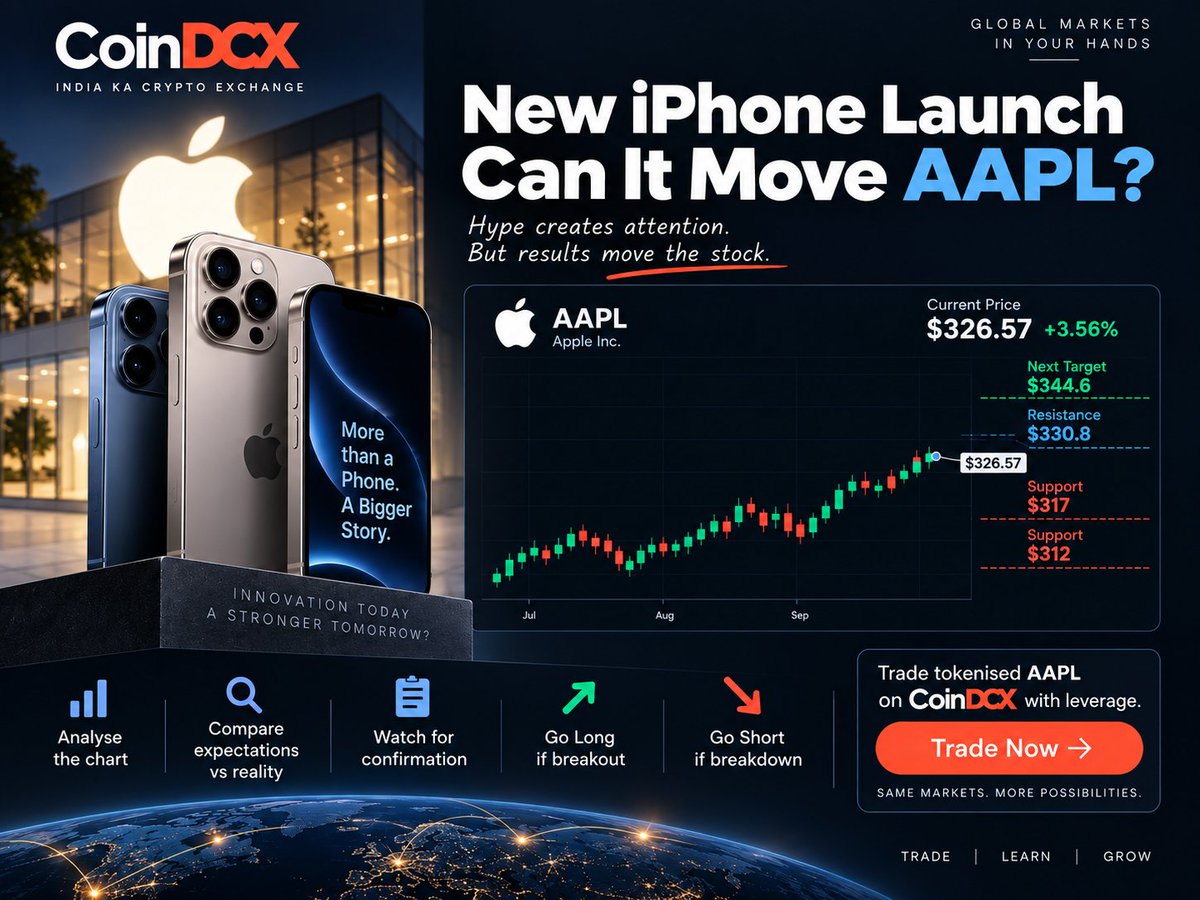
📱 Apple launched the new iPhone.
But here’s the part traders often miss:
A great iPhone launch does NOT automatically mean AAPL will keep going up.
The stock market doesn’t trade the news.
It trades the difference between expectations and reality.
Think about it this way 👇
If investors were already expecting a massive iPhone launch, strong demand and higher revenue and Apple delivers exactly that, the news might already be priced in.
But if demand, sales or future guidance come in better than expected, that can create a fresh reason for buyers to step in.
And if the numbers disappoint?
Even a successful product launch can turn into a sell-the-news event.
So what is AAPL’s chart saying?
After the launch, AAPL showed strong upside momentum and closed around $326.57, gaining roughly 3.56%.
That’s encouraging.
But I wouldn’t chase the green candle blindly.
I’d watch the key levels:
🟢 Bullish confirmation: AAPL breaks and holds above the ~$330.8 area.
If buyers can defend that breakout, the next major level I’d watch is around $344.6, near the recent 52-week high.
🔴 Bearish warning: If AAPL gets rejected around resistance and loses ~$317 support, the launch momentum could start fading.
A deeper break below ~$312 would make the bullish thesis much weaker.
My CoinDCX approach 👇
I’d start with the AAPL chart, not the iPhone headlines.
If price confirms the bullish structure, I can consider a leveraged long on CoinDCX’s tokenised AAPL setup.
If resistance rejects price and key support breaks, the setup could shift bearish, giving a trader a reason to consider the short side.
And if neither side gets confirmation?
I’d simply wait.
Because leverage can magnify both gains AND losses. The goal isn't to trade every move it’s to trade when the setup actually makes sense.
The real AAPL trade isn't:
“New iPhone = BUY Apple.”
It’s:
Expectations → Actual results → Price reaction → Confirmation → Trade.
That’s the difference between trading the hype and trading the market.
A great iPhone can create excitement.
But sustained AAPL upside needs more:
📱 Strong iPhone demand
💰 Higher sales
📊 Better revenue expectations
👥 Strong consumer sentiment
🔮 Positive future guidance
If the business delivers more than investors expected, the stock has a stronger reason to keep climbing.
If reality falls short of expectations, the same launch can become a reason to sell.
My takeaway:
Don’t ask only:
“Was the iPhone launch good?”
Ask:
“Was it better than what the market expected and does AAPL’s price action confirm it?”
That’s the setup I’d be watching on CoinDCX.
#LearnKaroCryptoKaro
🚨 BTC can go up and you can STILL pick the wrong Call.
I checked the CoinDCX Options chain and compared two nearby BTC Calls for the 8 Sep expiry.
BTC: $79,357.92
🟢 $79,500 Call
Premium: 355 USDT
🔵 $80,000 Call
Premium: 195 USDT
Same BTC view.
Same expiry.
Just a $500 difference in strike.
Here’s why that matters 👇
Strike ≠ just a number.
For a Call:
Breakeven = Strike + Premium
So:
$79.5K Call
→ $79,500 + $355
→ $79,855 breakeven
$80K Call
→ $80,000 + $195
→ $80,195 breakeven
From BTC at $79,357.92:
📈 $79.5K Call needs about +0.63%
📈 $80K Call needs about +1.05%
The $80K Call is cheaper but BTC has to make a bigger move before it reaches breakeven.
Now let's say my bullish target is $81,000 at expiry.
$79.5K Call:
$81,000 − $79,500 − $355
= 1,145 USDT
$80K Call:
$81,000 − $80,000 − $195
= 805 USDT
But look at the capital efficiency:
355 → 1,145 = ~323%
195 → 805 = ~413%
So the cheaper $80K Call can produce the higher percentage return if BTC makes the move but it also has a higher breakeven and a tougher path to profitability.
That’s the part I think traders often overlook.
If I expect a smaller BTC move, the closer strike may give me a more realistic path.
If I expect a strong move, the further strike can offer greater percentage upside while accepting the extra risk.
So I wouldn't choose a strike just because the premium is cheaper.
I'd compare:
Strike → Premium → Breakeven → Required Move → Potential Profit
And that's exactly why checking nearby strikes on CoinDCX Options matters.
Same prediction.
Different strike.
Completely different trade.
The best strike isn't necessarily the one with the biggest potential return.
It's the one that matches the move you actually expect.
#LearnKaroCryptoKaro
⚡ OPEC+ just paused. Oil didn’t get the supply relief the bears wanted.
OPEC+ decided to keep October output policy unchanged after six consecutive monthly increases.
That matters because the oil market is already dealing with a much bigger problem: physical supply disruption.
Brent closed Friday at $96.28, up 7.6% for the week, while traffic through the Strait of Hormuz remains severely impaired. Recent tracking showed only a handful of commodity vessels crossing the strait over the weekend, versus much higher pre-war traffic.
So I see the setup like this:
🟢 OPEC+ keeps October supply unchanged
🟢 Iran/Hormuz disruption limits physical flows
🟢 Less incremental supply relief
🟢 Geopolitical risk keeps a premium in crude
The real surprise would have been the opposite:
A much larger-than-expected increase in available barrels that could genuinely offset the disruption.
If that happens → bearish oil thesis.
But right now, OPEC+ is essentially moving barrels on paper while the physical market remains constrained.
My trade bias:
🛢️ LONG Tokenized Oil Futures on CoinDCX
⚡ Leverage: 2x
Why 2x?
Because this is an event-driven trade. Oil can move violently when geopolitics change. I want enough exposure to express the thesis without pretending the outcome is guaranteed.
My invalidation:
If Hormuz flows normalize materially, Iran-related supply disruption eases, or additional OPEC+ supply becomes available faster than expected, the bullish thesis weakens.
The trade isn't simply:
“OPEC+ = bullish.”
It's:
Constrained physical supply + no fresh October output increase + geopolitical risk = potential upside pressure on crude.
Now the market has to decide how much of that risk is already priced in.
That’s the trade I’m watching.
#LearnKaroCryptoKaro
🔥 THE TRADFI GROUP CHAT RIGHT NOW
BTC:
guys I’m back above $81K 👀
Retail:
WAIT WHAT
I thought the rally was dead 😭
Wall Street:
$731M just went into spot Bitcoin ETFs.
Retail:
…so institutions are buying?
Wall Street:
Apparently.
Fed:
Can everyone please stop celebrating liquidity like it’s a personality trait.
Coinbase:
Anyway, what if equities traded 24/7? 👀
Wall Street:
Absolutely not.
Robinhood:
What if stocks were tokenized?
Wall Street:
I said absolutely not.
Bitcoin:
You guys spent decades building financial markets…
Bitcoin:
…and now you're slowly rebuilding them with my features.
Retail:
So when does the stock market open?
Coinbase:
It doesn't.
Retail:
💀
The funny part?
This isn't just a BTC pump.
ETF flows show institutions are willing to get Bitcoin exposure through traditional rails, while crypto companies are pushing markets toward 24/7 trading and onchain assets.
TradFi isn't disappearing.
It's just downloading the crypto update.
Wall Street.exe has stopped responding. 😂
@officialmudrex
HYPE’s value isn’t just speculation.
The thesis is a flywheel:
Users → volume → fees → HYPE buybacks → stronger token economics → more ecosystem growth → more users.
But there’s one catch:
If real usage slows, the flywheel slows too.
That’s the HYPE test. 🔄
HYPE’s value isn’t just speculation.
The thesis is a flywheel:
Users → volume → fees → HYPE buybacks → stronger token economics → more ecosystem growth → more users.
But there’s one catch:
If real usage slows, the flywheel slows too.
That’s the HYPE test. 🔄
HYPE isn’t just “Hyperliquid’s token.”
The interesting part is the flywheel:
More trading → more fees → HYPE buybacks → stronger token economics → more ecosystem growth → more trading.
The flywheel is real.
But it only works if the volume is real. 🔄
@officialmudrex
Most people look at HYPE and see “Hyperliquid’s token.”
I think that misses the interesting part.
The real HYPE story is the flywheel:
Trading activity → fees → HYPE buybacks → tighter supply → stronger ecosystem → more trading activity.
If Hyperliquid keeps attracting real volume, HYPE isn’t just riding the success of the protocol.
It is designed to capture part of that success.
The mechanism is pretty simple.
Traders use Hyperliquid → the protocol generates fees → a huge portion of those fees flows into the Assistance Fund → the Fund buys HYPE from the open market.
So the more the exchange is used, the more mechanical demand can be created for HYPE.
That’s very different from a token whose value depends almost entirely on narrative.
And the flywheel gets more interesting as Hyperliquid expands beyond crypto perps.
RWA markets, new trading products, HyperEVM, prediction/outcome markets and a growing ecosystem can all potentially increase activity on the same infrastructure.
More products → more users → more volume → more fees → more HYPE demand.
That’s the bullish case.
But here’s the part I think the market sometimes ignores:
A buyback is NOT a guaranteed price floor.
If trading activity falls, fee generation falls.
If fee generation falls, buybacks fall.
And if new token supply enters the market faster than organic demand absorbs it, the flywheel can slow down.
That’s why the upcoming supply events matter too.
The question isn't simply:
“Is Hyperliquid growing?”
It’s:
“Is Hyperliquid growing fast enough to turn that growth into sustainable HYPE demand?”
That distinction matters.
For me, the HYPE flywheel is real.
But it isn't magic.
The token deserves a premium only if Hyperliquid can keep converting actual financial activity into recurring economic value for HYPE.
In other words:
HYPE doesn't need more hype.
It needs more volume. 📈
What’s Actually Driving BTC?
Everyone is calling this a new bull market.
I’m not convinced the most important story is the Fed, the short squeeze, or even the 20%+ BTC move.
I think the bigger story is what happened AFTER the leverage got flushed.
BTC ripped from roughly $63.5K to above $80K.
Yes, shorts got crushed. On Aug. 19, short liquidations were responsible for the overwhelming majority of liquidations, creating the fuel for the initial acceleration.
But here’s what caught my attention:
While BTC was moving higher, futures open interest actually fell from around 646K BTC to roughly 588K BTC.
That’s unusual.
A leveraged rally normally makes you expect leverage to expand with price.
Instead, we saw price going up while speculative leverage was being reduced.
And at the same time, spot Bitcoin ETFs pulled in around $2.8B across eight consecutive sessions.
That tells me this isn't simply:
“Shorts got liquidated → BTC pumped → traders chased it.”
There was real spot demand underneath the move.
But I think the market is getting ahead of itself by immediately calling this a confirmed bull market.
Because the real test starts now.
The short squeeze has already happened.
The easy liquidity impulse has already been repriced.
Jackson Hole has also introduced a problem: Fed Chair Kevin Warsh sounded more concerned about persistent inflation than markets wanted, and BTC subsequently pulled back from above $80K.
So my question isn't:
“Can BTC pump again?”
Of course it can.
My question is:
“Will spot buyers keep absorbing supply when the squeeze is gone?”
If ETF inflows stay strong while futures leverage remains relatively controlled, I'd take that as a much healthier signal than another massive OI expansion.
If ETF flows fade and traders start rebuilding leverage aggressively, I'd be much more cautious.
That's the part I think people are underestimating.
The rally doesn't need more leverage.
It needs the spot bid to survive.
That, to me, is the difference between a squeeze and a sustainable trend.
@officialmudrex
Bitcoin’s move from ~$64K to $80K+ looks explosive.
But I don’t think the entire rally was “new demand.”
My take: the macro catalyst started the move. The short squeeze poured gasoline on it.
BTC had been trapped around $62K–$67K for weeks. Then the U.S. Treasury announced it would at least double long-end bond buybacks from $2B to $4B per operation.
Yields fell. The dollar weakened. BTC broke out.
And then the leverage kicked in.
As BTC pushed through resistance, traders who were heavily short started getting forced out.
By the end of the move, more than $4B of bearish crypto positions had been liquidated.
That matters because a liquidated short isn’t just a trader taking a loss.
It becomes forced buying.
BTC ↑ → shorts get liquidated → forced buying ↑ → BTC ↑ → more shorts get liquidated.
That feedback loop can turn a normal breakout into a vertical move.
But here’s the part I find more interesting:
If this was ONLY a short squeeze, the rally should struggle once the shorts are gone.
Yet spot BTC ETFs reportedly pulled in around $1.92B in one week, suggesting there was genuine spot demand underneath the forced buying too.
So I’d break the rally down like this:
Macro catalyst = spark 🔥
Short liquidations = gasoline ⛽
Spot/ETF demand = fuel that determines whether it keeps burning
That’s why I don’t think calling this rally “just a short squeeze” tells the full story.
The squeeze explains the speed.
The macro shift explains the direction.
And the next test for BTC is simple:
Can it keep moving higher after the forced buyers are gone?
That’s where we find out whether this was just leverage unwinding or the beginning of something bigger.
@officialmudrex
BTC’s $64K → $70K Domino Effect 🧵❌
BTC didn’t just wake up and randomly pump nearly 9%.
The move looked more like a domino chain.
Macro improved risk sentiment → BTC started breaking higher → leveraged shorts got squeezed → forced buying pushed BTC even higher → ETH and SOL caught the momentum.
What interests me most is the leverage effect.
When BTC started moving, traders betting on further downside were suddenly trapped. Once those shorts were liquidated, their positions became forced buying.
That buying pushed BTC higher, which created even more pressure on remaining shorts.
That’s the feedback loop:
BTC ↑ → shorts liquidated → forced buying ↑ → BTC ↑ again.
Then ETH and SOL followed as traders became more confident that the move wasn't limited to BTC.
My takeaway: I wouldn't automatically call this the start of a new bull market. A leveraged squeeze can make a move look much stronger than the original catalyst.
For me, the real test comes next:
Can BTC hold the higher levels and attract genuine spot demand after the short-squeeze fuel disappears?
If yes, this domino effect could be the beginning of something bigger.
If not, the move may turn out to have been mostly leverage unwinding.
@officialmudrex
Here's the biggest takeaway from the CoinDCX example.
BTC was around $79,303.82.
Yet:
🔵 79,250 Call → ₹593.33
🟠 82,500 Call → ₹48.19
At first glance, someone might simply say:
“₹48 is cheap. ₹593 is expensive.”
But that's not the right way to think about options.
Ask WHY.
The 79,250 Call is already slightly ITM.
The 82,500 Call is around $3,196 above BTC and therefore needs a much larger move to reach its strike.
At expiry, ignoring fees:
79,250 Call breakeven ≈ $79,843.33
82,500 Call breakeven ≈ $82,548.19
So the premium is giving us information about the opportunity being priced into each contract.
And this is where the 3-factor framework helps:
⏳ TIME: How long does BTC have to make the move?
🎯 STRIKE: How far does BTC need to move?
🌪️ VOLATILITY: How much movement does the market expect?
Put all three together and the premium starts making much more sense.
💡 Key takeaway:
An option premium isn't just a number you pay.
It's the market pricing the opportunity, time and expected movement behind that option.
Next time you open CoinDCX Options, don't just search for the cheapest premium.
Pick two options.
Compare their expiry, strike distance and expected volatility.
Then ask:
“Why is the market pricing this option here?”
That's when you're actually reading the options chain not just looking at numbers. ⚡
#LearnKaroCryptoKaro
I’d pick Tokenized Gold (XAUT) 🪙
I still like physical gold, but XAUT fits better with how I manage my assets today. Most of my portfolio is already digital, so having gold in a digital form feels more practical to me.
No worrying about physical storage, and I can move my gold exposure more easily alongside my other digital assets.
It’s not about saying physical gold is outdated it’s about choosing the format that fits my lifestyle.
Physical gold = gold I store.
XAUT = gold I can move.
That flexibility is what makes XAUT my pick.
#XAUTonCoinDCX @tethergold@CoinDCX