Curry Economist . "अर्थ" को अर्थ खोज्दै गरेको अर्थशास्त्री Fellow, Hoover Institution,Stanford University @HooverInst @Stanford Glory Glory Man United !!!
Hoover Institution, Stanford University मा Stanford Nepali Student Association र Nepal Study Group (Centre for South Asia) द्वारा संयुक्त रूपमा आयोजित कार्यक्रममा @sudheerktm daji सँग। हजुरको समय र अर्थपूर्ण अन्तरक्रियाका लागि धन्यवाद। छिट्टै पुनः भेट्ने आशा गर्दछु।@stanford #Stanford #HooverInstitution #NepalStudyGroup #StanfordNepaliStudentAssociation #NepaliDiaspora #SouthAsia #Nepal #AcademicExchange
Could the success of America's greatest innovators have happened anywhere else?
Hosted by @CondoleezzaRice, Only in America is a new Hoover Institution documentary series featuring Jensen Huang (@NVIDIA), Indra Nooyi, @MTBarra (@GM), @DrFeiFei, @YoYo_Ma, and @TomSiebel (@C3_AI) on freedom, risk, and the American institutions that made their achievements possible.
Follow the @HooverInst to get notified when each episode premieres.
Milton Friedman: “Keep your eye on one thing and one thing only: how much government is spending, because that’s the true tax.”
“If you’re not paying for it in the form of explicit taxes, you’re paying for it indirectly in the form of inflation or borrowing.”
This is not mine. This is yours. This is ours.
From all the players, staff and everyone involved in the club, to you guys who supported us every single day of the season.
Grateful for your love and support ❤️
USCIS announced this week that adjustment of status, the in-country pathway most skilled workers use to obtain permanent residency, will be treated as a discretionary, extraordinary form of relief, with consular processing reaffirmed as the ordinary route.
The statute hasn't changed. The administrative default has. That distinction matters: it is the kind of policy change that shifts behavior without shifting eligibility, making its effects measurable.
A few things worth tracking as data comes in:
• How firms in research-intensive sectors adjust hiring and location decisions
• How retention evolves for workers already deep in the green card backlog
• Whether observable outcomes such as patenting, startup formation, and internal mobility move in step with the policy shift
Immigration policy has always been political. Increasingly, it is also a question about how a country builds and retains its talent base, and that question is empirical.
Official USCIS announcement: https://t.co/FF9oMQRjwP
#Immigration #Economics #Innovation #HigherEducation #GlobalTalent @FoxNews@NBCNews@thehill
Harvard University just voted to limit the number of A grades given in undergraduate classes to about 20% of the class. I’m not in favor of this. It deeply runs counter to how I believe education should be. We should hold a high bar, but also work mightily to support the success of 100% of learners, rather than a fraction.
Harvard’s administration took this step — over the objections of a large fraction of the student body — to counter grade inflation. Grade inflation is real: Many universities have been awarding A and B grades to ever larger fractions of students, and this has caused grade point averages (GPAs) to become less useful as signals of student skill. At the same time, we want students to succeed. The heart of the question is the role of educational institutions. Should our goal be:
- To help students succeed?
- To judge students?
Both of these have value. But my focus when working in education is almost entirely helping students succeed.
To me, it is clear that many people want to learn, to be empowered, to build skills that let them do new things! This is what we focus on at DeepLearningAI. This philosophy is also why my online courses (going back to my early online Stanford courses on Coursera) permitted an unlimited number of retries for graded assignments.
I believe in letting — and even encouraging — someone to redo something until they succeed. This is as opposed to standing in judgement of the fact they didn’t get it right the first time. Further, I want homework assignments to be designed primarily to help people practice and learn, rather than to judge their skill level. This is why I prefer to create “Practice Problems” and “Practice Labs” — questions that, when you think through them, help you to gain practice and reinforce what you know. As opposed to “Assessment Problems” designed primarily to judge skill.
But won’t Harvard’s move make GPAs more meaningful and help prospective employers identify strong candidates? Having hired a large number of people from Harvard and other institutions, I can say confidently that GPA is not an important signal. We have screening and interviewing processes that give far more accurate ways to figure out if someone is truly skilled. I do not need a wider spread in applicant GPA scores to figure out who's really good!
To be clear, there is also value in assessment. Even though standardized testing is much hated, high-quality tests like the SAT, ACT, GRE, TOEFL, etc. provide objective measures of ability in a domain. I find that most people want to learn and succeed. There are also people who want rigorous assessment (for example, to apply for school admissions), but this is a lesser need, and is not my focus when building educational products.
Harvard is often described as an “elite” educational institution. There are two ways to be elite: One option involves limiting enrollments, and then even among admitted students, cap the number of people that do well at 20%. I would rather pursue a different path: Set a high bar and teach elite, cutting-edge skills, but strive relentlessly to help everyone succeed. This way, eliteness is defined not by excluding people but by helping as many people as possible to be excellent.
[Original text: The Batch newsletter]
New course: Build AI agents that generate images and videos -- an under-explored frontier. A key to performance is having the agent evaluate its own output, and iterate to improve quality. This short course is built together with @googlecloudtech and taught by Katie Nguyen and Wafae Bakkali.
You'll learn three evaluation techniques and combine them in an agent: image-text similarity scoring to check the output matches the prompt, an LLM judge that scores against custom criteria like brand consistency, and structured rubrics that break a prompt into verifiable yes/no questions like "is the subject in the frame?" and "does the camera motion match?"
Skills you'll gain:
- Learn image and video prompt engineering
- Build an image agent that turns brand guidelines into UI mockups
- Build a video agent that plans multi-scene explainers and animates reference frames with synchronized audio
Join and build agents that create images and video!
https://t.co/bjuSjIxcIG
Really cool!
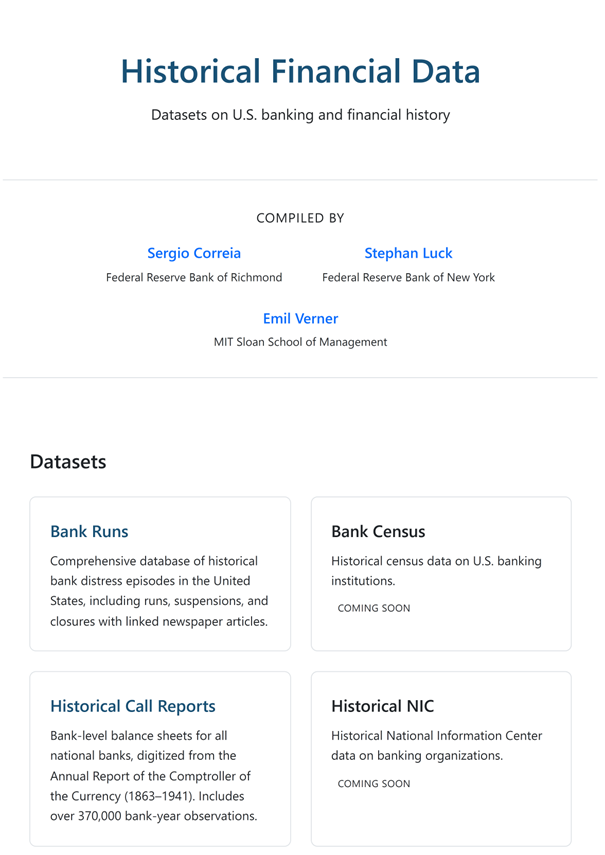
"Historical Financial Data: Datasets on U.S. banking and financial history" by Sergio Correia, Stephan Luck, and Emil Verner.
https://t.co/jtTFaS9BX3
For researchers interested in U.S. banking and finance, we are sharing a new data resource!
It contains information on bank balance sheets, bank runs, and bank failures from the 19th century to the present: